wayground logo

Bảng tính có thể in miễn phí

MỚI

Cỡ chữ

S
M
L
XL
bảng tính

HEAT and HEAT TRANSFER QUIZ

Total câu hỏi: 35

Worksheet time: 39mins

Tên
Lớp học
Ngày
1.

What temperature does water freeze on the Celsius scale?

a)

100

b)

212

c)

32

d)

0

2.

What is an insulator?

a)

Something that DOES NOT absorb heat very well.

b)

Something that DOES absorb heat very well

3.

Why does cool air sink?

a)

Hot air and cool air have the same density.

b)

Hot air is more dense than cool air.

c)

Cool air is more dense than hot air.

4.
When does CONDUCTION happen?
a)
when heat is transferred through empty space as electromagnetic waves
b)
when a  fluid (gas or liquid)  expands, becomes less dense, and rises or cools, becomes more dense, and sinks.
c)
When heat transfers between objects that are touching.
5.
When does CONVECTION happen?
a)
when heat is transferred through empty space as electromagnetic waves
b)
when a  fluid (gas or liquid)  expands, becomes less dense, and rises or cools, becomes more dense, and sinks.
c)
When heat transfers between objects that are touching.
6.
What does RADIATION happen?
a)
when heat is transferred through empty space as electromagnetic waves
b)
when a  fluid (gas or liquid)  expands, becomes less dense, and rises or cools, becomes more dense, and sinks.
c)
When heat transfers between objects that are touching.
7.
You're holding hands with your best friend.  Your friend's hands are REALLY warm and yours are really cold.  After a few minutes, your hand has warmed up.  How might you explain what happened?
a)
The cold energy from your hand transferred to your friend's hand through conduction.
b)
The heat energy from your friend's hand transferred to your hand through conduction. 
c)
The cold energy from your hand transferred to your friend's hand through convection.
d)
The heat energy from your friend's hand transferred to your hand through convection.
8.

A large block of ice has thermal energy.

a)

True

b)

False

9.

Heat and temperature are the same thing.

a)

True

b)

False

10.

Heat passes from...

a)

higher material to lower material

b)

cooler material to warmer material

c)

warmer material to cooler material

d)

heat cannot be passed

11.

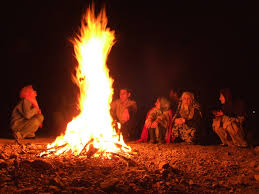
A group of friends gather AROUND a fire to stay warm. How is energy transferred to them?

a)

conduction

b)

convection

c)

radiation

12.
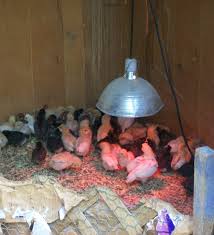
The baby chickens are kept warm from the heat lamps demonstrates this type of heat transfer. 
a)
conduction
b)
convection
c)
radiation
13.
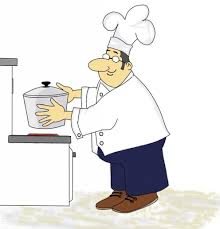
The man goes to take the hot pot off the stove with his bare hands.
a)
conduction
b)
convection
c)
radiation
14.
Hot coffee is stirred with a spoon; the spoon gets hot due to
a)
conduction
b)
convection
c)
radiation
15.
"Lava lamps" contain colored liquids. These liquids form globs that rise to the top due to
a)
conduction
b)
convection
c)
radiation
16.
Near the ceiling of a room the air is warmer; the warm air rises because of
a)
conduction
b)
convection
c)
radiation
17.

Some cook pans have copper on the bottom to heat evenly.

Copper transfers heat to the pan by

a)

conduction

b)

convection

c)

radiation

18.
In a swimming pool, water near the surface is slightly warmer. The warm water rises because of
a)
conduction
b)
convection
c)
radiation
19.
A house burns down. The vinyl siding of the house next door warps due to
a)
conduction
b)
convection
c)
radiation
20.
Warm air over the beach rises while cooler, dense air from the ocean rushes in due to
a)
conduction
b)
convection
c)
radiation
21.
A huge rock at the state park gets hot during the day. The rock was warmed from the Sun by
a)
conduction
b)
convection
c)
radiation
22.

A lizard lays on a warm rock at night and keep warm from the rock by

a)

conduction

b)

convection

c)

radiation

23.
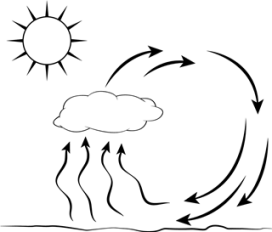
Weather systems in the Earth's atmosphere are due to
a)
conduction
b)
convection
c)
radiation
24.
After cooking an egg in boiling water, you cool the egg by putting it into a bowl of cold water.  Which of the following explains the egg's cooling process?
a)
Temperature is transferred from the egg to the water.
b)
Energy is transferred from the water to the egg.
c)
Energy is transferred from the egg to the water.
d)
Cold moves from the water into the egg.
25.
Why do we wear sweaters in cold weather?
a)
To keep cold out.
b)
To generate heat.
c)
To reduce heat loss.
d)
All of the above.
26.
If you put a metal spoon and a wooden spoon into a pot of boiling water, one will become too hot to touch.  Why?
a)
Metals conduct heat better than wood.
b)
Wood conducts heat better than metals.
c)
Metals pull in heat because heat is attracted to metals.
d)
Wood isn't as strong as metals.
27.
When you hold a metal coat hanger in a camp fire to roast a marshmallow, the coat hanger might get too hot to hold.  Why might the coat hanger get too hot?
a)
The heat radiates along the coat hanger.
b)
The heat builds up near the flame until it can't hold it anymore and then moves along the coat hanger.
c)
Metal atoms vibrate with more energy when they get hot, and they collide with atoms near them, which makes the neighboring atoms vibrate, too.
d)
Since metals melt in fire, they react very strongly to fire and get hot easily.
28.
When placed in direct sunlight, which object will absorb the most radiation?
a)
A black sweater
b)
A white sweater
c)
A snowball
d)
Aluminum foil
29.
As water in a freezer turns into ice,
a)
the water absorbs energy from the air in the freezer.
b)
the water absorbs the coldness from the air in the freezer.
c)
the freezer air absorbs heat from the water.
d)
the water neither absorbs nor releases energy.
30.

In how many ways does heat move around the universe?

a)

One

b)

Three

c)

Two

d)

Heat cannot move

31.
Molecules in cold things move more _________
than in hot things.
a)
quickly
b)
slowly
c)
happily
d)
merrily
32.
What causes the circulation of air in the atmosphere?
a)
Air in the atmosphere is heated by the sun and sinks to the ground.
b)
The ground is heated by the sun and then heats the air, causing the air to rise.
c)
Air loses heat to the ground and then rises upward to obtain more energy.
d)
The sun heats the clouds which forces the cooler air to move away and sink.
33.
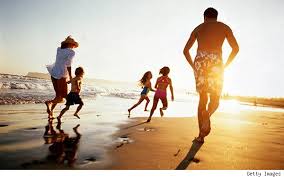
The sun shines down on this family as the play on the beach.
a)
conduction
b)
convection
c)
radiation
34.
In this experiment, the WARM red dye and the COLD blue dye was placed in the water at the same time. The warm red dye rose to the top while the cold blue dye sank to the bottom.
a)
conduction
b)
convection
c)
radiation
35.

What temperature does water boil on the Fahrenheit scale?

a)

100

b)

212

c)

32

d)

0