
 Worksheets
Yr8 End of year quiz 2017
Total questions: 60
Worksheet time: 57mins
Name
Class
Date
1.

Name this bacteria shape
a)
coccus
b)
spirillum
c)
bacillus
2.

Name this bacteria shape
a)
bacillus
b)
coccus
c)
spirillum
3.

Name this bacteria shape
a)
coccus
b)
bacillus
c)
spirillum
4.
Bacteria that help break down dead material in the environment are called
a)
vaccines
b)
decomposers
c)
oats
5.
How do bacteria move?
a)
flagella
b)
cilia
c)
they don't
6.
All bacteria are harmful to humans
a)
True
b)
False
7.

This picture represents which method of reproduction?
a)
Binary Fission
b)
Conjugation
c)
Sexual reproduction
8.
Which statement about bacteria is true?
a)
All bacteria are prokaryotes
b)
All bacteria are eukaryotes
c)
All bacteria are autotrophs
d)
All bacteria are heterotrophs
9.
Which one of these does not add CO2 to the atmosphere?
a)
cooking with gas
b)
planting trees
c)
burning wood
d)
riding in a bus
10.
Combustion is another word for _______________.
a)
a train
b)
a bus
c)
a dog
d)
burning
11.
What does not produce carbon dioxide?
a)
Photosynthesis
b)
Burning Fossil Fuels
c)
Animal respiration
d)
Plants decaying
12.
How do living organisms return carbon to the atmosphere in the carbon cycle?
a)
respiration and photosynthesis
b)
decomposition and respiration
13.

In the carbon cycle, producers take in the gas __
a)
carbon dioxide
b)
oxygen
c)
nitrogen
d)
carbon monoxide
14.
What keeps mucus and dirt out of your lungs?
a)
Your diaphragm
b)
Your medula
c)
Your heart
d)
Cilia
15.

Alveoli has a mesh covering made of what?
a)
Cartilage
b)
Blood Vessles
c)
Bronchi
d)
Blue Alveoli
16.

What is the entrance to the lungs called?
a)
Lungs
b)
Bronchi
c)
Trachea
17.
The trachea leads to the...
a)
Bronchioles
b)
Bronchi
c)
Esophagus
d)
Pulmonary Vessel
18.

What is this?
a)
Trachea
b)
Vocal Cord
c)
Aveoli
d)
Pharynx
19.

When you breathe, your lungs take in ___ and remove ___.
a)
Air/Oxygen
b)
Oxygen/Carbon Dioxide
c)
Carbon Dioxide/Waste
d)
Waste/air
20.

The air sacs that are covered with capillaries where gas exchange takes place is _________?
a)
Bronchi
b)
Blue/Yellow Trachea
c)
Oxygen
d)
Alveoli
21.

What is the tube that is also known as your windpipe?
a)
Esophagus
b)
Bronchi
c)
Trachea
d)
Alveoli
22.
8.7: Combustion is when a __________ reacts with oxygen
a)
petrol
b)
fuel
c)
fire triangle
d)
carbon dioxide
23.
What are the types of combustion?
a)
Complete & incomplete
b)
Incomplete & inexact
c)
Impossible & complete
d)
Computer & incompete
24.
Complete combustion is when there is plenty of oxygen to react with.
a)
True
b)
False
25.
Another term for burning is
a)
Fire triangle
b)
Magnesium oxide
c)
Combustion
d)
Bustion
26.

What is the hazard shown in this hazard sign?
a)
Fireworks
b)
Broken Glass
c)
Explosive
d)
Corrosive
27.

What is the hazard shown in this hazard sign?
a)
Fire
b)
Goku
c)
Flammable
d)
Inflammable
28.

What is the hazard shown in this hazard sign?
a)
Explosive
b)
Corrosive
c)
Irritant
d)
High level Irritant
29.

What is the hazard shown in this hazard sign?
a)
Death
b)
Pirates
c)
Corrosive
d)
Toxic
30.

What is the hazard shown in this hazard sign?
a)
Pikachu
b)
Lightning
c)
Electrical
d)
Fault
31.

What is letter B
a)
Optic nerve
b)
Lens
c)
Cornea
d)
Retina
32.

What is letter E?
a)
Vitreous humor
b)
Retina
c)
Cornea
d)
Optic nerve
33.

What is letter F?
a)
Retina
b)
Pupil
c)
Vitreous humor
d)
Iris
34.

What is letter G?
a)
Sclera
b)
Retina
c)
Lens
d)
Vitreous humor
35.

What is letter H?
a)
Cornea
b)
Optic nerve
c)
Iris
d)
Retina
36.

What is letter I?
a)
Cornea
b)
Lens
c)
Vitreous humor
d)
Optic nerve
37.

The drops of water that appear on the outside of a glass of cold juice on a warm day are an example of?
a)
sublimation
b)
condensation
c)
evaporation
38.

A gas
a)
has a definite shape but no definite volume
b)
has a definite volume but no definite shape
c)
has fast-moving particles
39.

Which of the following occurs when a liquid becomes a gas?
a)
the particles slow down
b)
the particles beak away from one another
c)
the particles move closer together
40.

At higher temperatures
a)
particles in an object have less energy
b)
particles in an object move faster
c)
a gas contracts
41.
______________________ takes place when a liquid changes to a solid.
a)
freezing
b)
melting
c)
boiling
d)
sublimation
42.
Melting is ...
a)
liquid to solid
b)
solid to liquid
c)
solid to gas
d)
gas to liquid
43.
Freezing is...
a)
Solid to gas
b)
Liquid to solid
c)
Gas to solid
d)
Liquid to gas
44.
Boiling is ...
a)
liquid to gas
b)
gas to solid
c)
gas to liquid
d)
solid to liquid
45.

What variable is on the x-axis?
a)
Time
b)
Temperature
c)
Heat
d)
Phases
46.

What variable is on the y-axis?
a)
Time
b)
Temperature
c)
Heat
d)
Phases
47.

On a "heat curve" what increases with time?
a)
Phase
b)
Heat
c)
Loss of Heat
48.

What is the state of the substance at point A?
a)
Liquid
b)
Solid
c)
Gas
d)
Plasma
49.

What is the state of the substance at point C?
a)
Liquid
b)
Solid
c)
Gas
d)
Plasma
50.

What is the state of the substance at point E?
a)
Liquid
b)
Solid
c)
Gas
d)
Plasma
51.

What phase change is happening at point B?
a)
Vaporization
b)
Sublimation
c)
Condensation
d)
Melting
52.

What phase change is happening at point D?
a)
Vaporization
b)
Sublimation
c)
Freezing
d)
Melting
53.
Where do asteroids collect in the Solar System?
a)
between Earth and Mars
b)
Between Mercury and Venus
c)
Between Mars and Jupiter
d)
Near Pluto
54.
An icy ball of dust and gas
a)
Comet
b)
Asteroid
c)
Meteor
d)
Planetesimal
55.

Which season is taking place in the Northern Hemisphere in Position 3?
a)
Winter
b)
Spring
c)
Summer
d)
Fall
56.

Which season is taking place in the Northern Hemisphere in Position 3?
a)
Winter
b)
Spring
c)
Summer
d)
Fall
57.

Which season is taking place in the Northern Hemisphere in Position 4?
a)
Winter
b)
Spring
c)
Summer
d)
Fall
58.

At position A, which hemisphere would have summer?
a)
Northern hemisphere
b)
Southern hemisphere
59.

What happens when the area in which you live tilts away from the sun?
a)
It is summer.
b)
It is spring.
c)
It is winter.
d)
It is fall.
60.
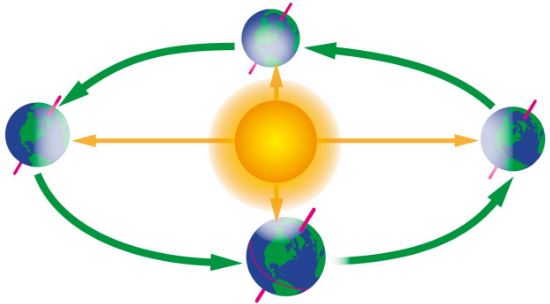
In spring/summer, the axis of the earth is pointed away or toward the sun?
a)
towards
b)
Neither away or toward
c)
away
100 %

