
 Worksheets
Earth Science, Chapter 10, Plate Tectonics, Quiz
Total questions: 25
Worksheet time: 14mins
Name
Class
Date
1.
This layer of Earth is the thickest part
a)
crust
b)
outer core
c)
mantle
d)
inner core
2.
What is Pangaea?
a)
The name of a German Scientist
b)
the name of the supercontinent that existed millions of years ago
c)
another name for continental drift
d)
the name of an ancient fossil
3.
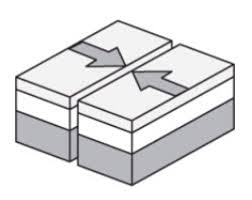
Name the boundary
a)
convergent boundary
b)
divergent boundary
c)
transform boundary
d)
sergent boundary
4.

Name the boundary
a)
convergent boundary
b)
divergent boundary
c)
transform boundary
d)
sergent boundary
5.
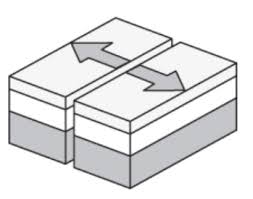
Name the boundary
a)
convergent boundary
b)
divergent boundary
c)
transform boundary
d)
sergent boundary
6.
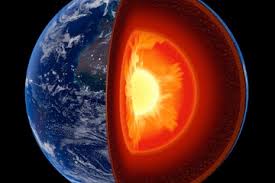
As you travel from the inner core to the crust, how would temperature, pressure and density of the material change?
a)
The would all increase
b)
The would all decrease.
c)
They would stay the same.
d)
Temperature would decrease, but pressure and density would increase.
7.
A subduction zone is formed...
a)
when one tectonic plate sinks below another
b)
at every type of convergent plate boundary
c)
at every type of divergent plate boundary
d)
at transform boundaries
8.
Plate movement is caused by ______________.
a)
the rotation of the Earth
b)
ocean tides
c)
convection currents in the mantle
d)
the moon's gravity
9.
What are mid-ocean ridges?
a)
A chain of underwater waterfalls
b)
A chain of underwater volcanos
c)
A chain of underwater mountains
d)
A chain of underwater rocks
10.
What does the theory of continental drift state?
a)
The continents were once joined in a super-continent and have moved over time
b)
Continents are stationary and do not move
c)
The Earth is broken into lithospheric plates that move due to convection currents
d)
none of the above
11.

Who is the person credited with developing the theory of continental drift?
a)
Harry Hess
b)
Galileo
c)
Alfred Wegener
d)
Newton
12.
The process that creates new sea floor as plates move away from each other at the mid-ocean ridges
a)
seafloor spreading
b)
plate tectonics
c)
continental drift
13.
Which of these have been found on several continents separated by oceans. suggesting that they were once geographically closer together?
a)
plate boundaries
b)
plant fossils
c)
animals
d)
ice sheets
14.
Which of these is made up of the crust and the solid, uppermost mantle?
a)
hydrosphere
b)
lithosphere
c)
seafloor
d)
biosphere
15.
Where did scientists find glacial features that are usually associated with cooler climates?
a)
mountain ranges
b)
Africa
c)
Antarctica
d)
plate boundaries
16.
What word do geologists use to describe the forces that shape Earth's surface?
a)
mantle
b)
lithosphere
c)
comiplactic
d)
tectonic
17.
In which state do magnetized objects reverse themselves to point south?
a)
reversed polarity
b)
normal polarity
c)
seafloor spreading
d)
magnetic polarity
18.
What evidence supports the continental drift?
a)
The deserts, mountains, oceans, and planes supports the hypothesis of continental drift
b)
The puzzle piece fit of continents, fossils evidence, climate, rocks, and mountain ranges support the hypothesis of continental drift
19.
Divergent is:
a)
to slide past each other
b)
to collide with each other
c)
to separate from each other
20.
Transform is:
a)
To slide past each other
b)
To collide with each other
c)
To separate from each other
21.
Convergent is:
a)
to slide past each other
b)
to collide with each other
c)
to separate from each other
22.
The solid, plastic layer of the mantle beneath the lithosphere, made of mantle rock that flows very slowly, which allows tectonic plates to move on top of it is called what?
a)
terrane
b)
lithosphere
c)
asthenosphere
d)
mid-ocean ridge
23.
What is a long undersea mountain chain that has a steep, narrow valley at its center, that forms as magma rises from the asthenosphere, and that creates new oceanic lithosphere as tectonic plates move apart known as?
a)
sea-floor spreading
b)
mid-ocean ridge
c)
asthenosphere
d)
terrane
24.
What is the primary cause of volcanoes and earthquakes?
a)
crustal plate movements
b)
Earth's gravitational force
c)
higher than usual tides
d)
solar magnetic storms
25.
A collision between two pieces of continental crust at a converging boundary produces a
a)
mid ocean ridge
b)
deep ocean trench
c)
rift valley
d)
mountain range
100 %

