
 Worksheets
Earth Science SOL Practice Test IV
Total questions: 61
Worksheet time: 42mins
Name
Class
Date
1.
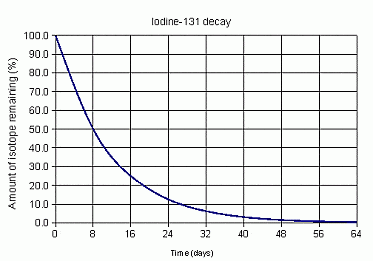
What is the half-life of iodine-131?
a)
32 days
b)
8 days
c)
16 days
d)
24 days
2.

a)
LAYER 1
b)
LAYER 3
c)
LAYER 4
d)
LAYER 6
3.
Which of the following describes a group of living things that is no longer living.
a)
fossil
b)
extinct
c)
mold
d)
cast
4.
states that the geologic feature which cuts another is the younger of the two features
a)
law of horizontality
b)
cross cutting relationships
c)
law of superposition
d)
uniformitarianism
5.
Connect points of equal elevation, and are drawn at specific intervals
a)
index contours
b)
reference contours
c)
topographic contours
d)
contour lines
6.

Identify the type of front that is shown in the image.
a)
Occluded Front
b)
Cold Front
c)
Stationary Front
d)
Warm Front
7.

What is the difference between an isotherm and an isobar?
a)
An isotherm shows air pressure and an isobar shows temperature
b)
They both show types of precipitation you can expect in your area
c)
An isotherm shows temperature and an isobar shows air pressure
d)
A high pressure area will bring nice weather while a low pressure area brings storms
8.

At 30°S 135°E, what continent would you be located in?
a)
Australia
b)
Africa
c)
Europe
d)
South America
9.
What is the standard interval or spacing between isobars?
a)
2
b)
4
c)
5
d)
10
10.

What do the v-shaped contour lines represent?
a)
mountains
b)
steep areas
c)
gradual areas
d)
rivers
11.
Carbon Dioxide, Oxygen, and acids
a)
are gasses
b)
create erosion
c)
agents of mechanical weather
d)
agents of chemical weathering
12.

The imaginary lines running “up-down” on the globe, showing the distance east or west of the prime meridian; measured in degrees
a)
Longitude
b)
Latitude
13.
What does the redshift of galaxies found by Edwin Hubble tell us about the movement of those galaxies?
a)
The galaxies are moving away from us.
b)
The galaxies are moving towards us
c)
The galaxies are stationary
d)
idk lol fml
14.

What kind of galaxy is this?
a)
Spiral galaxy
b)
Irregular galaxy
c)
Elliptical galaxy
d)
Barred elliptical galaxy
15.
What were the original two elements in our universe?
a)
Lithium and Carbon
b)
Hydrogen and Neon
c)
Helium and Chlorine
d)
Hydrogen and Helium
16.
About how long ago do scientists believe the universe began?
a)
13-14 billion years ago
b)
13-14 million years ago
c)
12-13 billion years ago
d)
12-13 million years ago
17.
Nebula's are mixtures of gases and what?
a)
clouds
b)
stars
c)
tiny particles
d)
dust
18.
The moon probably formed when...
a)
A piece of the Earth broke off due to it's fast rotation
b)
A Mars-sized object rammed into the Earth
c)
Earth captured the moon gravitationally as it attempted to pass by.
d)
the molten bubble of the Earth budded.
19.

Earth and the other planets closest to the Sun are made mostly of _______
a)
gas
b)
metal
c)
water
d)
rock
20.

Violent cyclonic storm that develops in tropical regions.
a)
El Nino
b)
Hurricane
c)
Wallaby
21.
___________ describes how the mineral reflects light.
a)
cleavage
b)
magnetic
c)
luster
22.
What are the 3 major types of rocks?
a)
Igneous, Metamorphic, Sedimentary
b)
Metamorphic, Igneous, Cementation
c)
Brown, Red, Gray
d)
Streak, Hardness, Breakage
23.
Two ways to describe types of igneous rocks are _____
a)
Extrusive and Intrusive
b)
Foliated and Non-Foliated
c)
Clastic and Biochemical
d)
Black and Gray
24.
Coal is an example of a ________ formed sedimentary rock
a)
clastic
b)
chemically
c)
organically
d)
poorly
25.
Students on a geology trip will identify minerals by their streak. Which of these should the students bring on the field trip
a)
a long pointed iron rod
b)
a rough white ceramic tile
c)
a disposable sample of talk
26.
Which cloud would be found in the middle of the atmosphere?
a)
altostratus
b)
cirrostratus
c)
stratus
d)
cirrocumulus
27.

These rocks were broken apart from the continuous freeze/thaw of water in the cracks of the rocks. This is an example of:
a)
ice wedging
b)
acid rain
c)
permeability
d)
abrasion
28.

A sinkhole created by the collapsing of a cave is called _________________
a)
Karst Topography
b)
Groundwater
c)
Erosion
d)
Weathering
29.
the spaces that allow air and water to move through the soil
a)
soil horizon
b)
soil porosity
c)
soil permeability
30.

Suppose there is a drought in this area. The level of the river drops because of it.
What else could happen here?
What else could happen here?
a)
The river will immediately rise again.
b)
The water table will rise.
c)
The water table will fall.
d)
A new aquifer will form.
31.
Erosion caused by the sandblasting effect of windblown sediments is called
a)
deflation
b)
abrasion
c)
loess
d)
outwash
32.

The _____ is the thinnest layer of the earth.
a)
Inner Core
b)
Crust
c)
Mantle
d)
Outer Core
33.
What is the parent rock of marble?
a)
shale
b)
obsidian
c)
quartz sandstone
d)
limestone
34.
Which of the following is a renewable resource?
a)
wind and solar
b)
coal and natural gas
c)
wind and coal
d)
solar and natural gas
35.
Which geographic region of Virginia has flat topography and large deposits of sand and gravel?
a)
Valley and Range
b)
Piedmont
c)
Blue Rdige
d)
Coastal Plain
36.
What is the disadvantage of using fossil fuels?
a)
They are recycable
b)
They are clean burning fuels
c)
They contribute to global warming
d)
There is an overabundance of fossil fuels
37.

Which minerals can scratch quartz?
a)
topaz, corundum, diamond
b)
diamond, talc, orthoclase
c)
orthoclase, apatite, flourite
d)
diamond only
38.
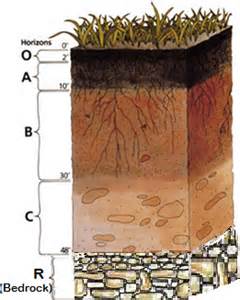
Which horizon is made up of partially weathered rocks?
a)
Horizon A
b)
Horizon B
c)
Horizon C
d)
Horizon D or R
39.
What is the periodic rise and fall of the water level in the oceans?
a)
Tide
b)
Tidal range
c)
Spring Tide
d)
Neap Tide
40.
What is a trough?
a)
highest point on a wave
b)
lowest point on a wave
c)
longest point on a wave
d)
shortest point on a wave
41.

A wave that forms far below the ocean surface is called a _______________. This is usually caused by an earthquake beneatht the ocean floor.
a)
Tornado
b)
Tsunami
42.

A large stream of moving water that flows through the ocean is a ___________________.
a)
current
b)
climate
43.
Elliptical, spiral, and irregular are all types of ______.
a)
solar systems
b)
universes
c)
galaxies
d)
stars
44.

The most powerful surface current in the North Atlantic Ocaean is the ________________________.
a)
Coriolis Effect
b)
Climate
c)
Gulf Stream
45.
A term describing the sudden collapse of a cliff such as seen during a rock slide.
a)
mass extinction
b)
mass wasting
c)
earthquake
d)
attrition
46.

The triangular deposition of sediment that forms where a stream/river enters a large body of water, such as a lake or ocean, is called
a)
Alluvial fan
b)
Delta
c)
Flood plain
d)
Meander
47.
Streams erode on the ______ of the curves
a)
outside
b)
inside
48.
____________________ is stored in the spaces between soil and rock beneath the Earth's surface.
a)
Groundwater
b)
Ice
c)
Salt water
d)
Runoff
49.

In thinking about a solar eclipse, what does the light source in the diagram represent?
a)
the Earth
b)
the Moon
c)
the Sun
50.
Tide with the greatest difference between high and low tide.
a)
neap tide
b)
spring tide
51.
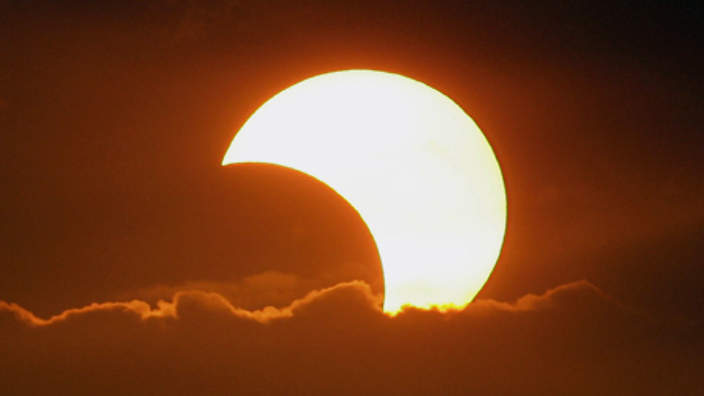
This image is an example of
a)
Lunar Eclipse
b)
Full Moon
c)
New Moon
d)
Solar Eclipse
52.

What landform is this a picture of?
a)
Cavern
b)
Island
c)
Canyon
d)
Valley
53.
Karst topography is characterized by the existence of many
a)
Wells
b)
Geysers
c)
Sinkholes
d)
Springs
54.

This forms from a depression left by a glacier and fills with water. (and the water is there for the entire year)
a)
Moraine
b)
Prairie pothole
c)
Kettle Lake
d)
Fiord
55.
Which units of measurement are used for volume?
a)
grams
b)
centimeters
c)
grams/milliliter
d)
milliliter
56.

I have two objects with the same volume but different masses. Which object will be more dense?
a)
The object with less weight.
b)
The object with more weight.
c)
The object with more mass.
d)
The object with less mass.
57.
Water droplets condense around _____________ to form a cloud.
a)
dust
b)
water
c)
cloud particles
d)
precipitation
58.

The following is a diagram of a
a)
sea breeze
b)
land breeze
c)
rain shadow
d)
density current
59.
What provides energy for stars?
a)
Sun
b)
Supernova
c)
Fusion
d)
Nebula
60.
An instrument that records vibrations in the ground and determines the location and strength of an earthquake.
a)
Seismograph
b)
Shakeograph
c)
Seismogram
d)
Epicenter
61.
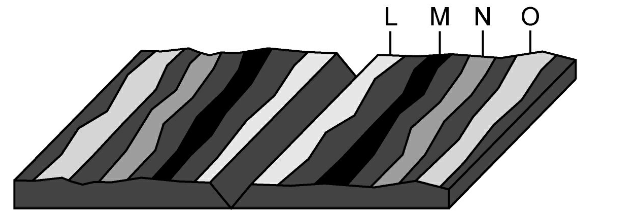
Where would the oldest rock be found?
a)
L
b)
M
c)
N
d)
O
100 %

