
 Worksheets
CTHS 2017 Spring Final Review
Total questions: 60
Worksheet time: 50mins
Name
Class
Date
1.
Which of the following languages has the most native speakers?
a)
English
b)
Chinese
c)
German
d)
Spanish
2.

The architecture of the Alamo in San Antonio clearly shows the influences of which other culture on Texas?
a)
French
b)
German
c)
Arabic
d)
Spanish
3.

the heartland of place of origin of a major culture; a site of innovation from which basic ideas, materials, and technology diffuse to other cultures.
a)
state
b)
nation
c)
cultural hearth
d)
suburb
4.

the cultural change that occurs when individuals in a society accept or adopt an innovation.
a)
diffusion
b)
acculturation
c)
innovation
d)
invention
5.
Where did both Hinduism and Buddhism begin?
a)
India
b)
China
c)
Sumer
d)
Egypt
6.
In terms of diffusion, what is a hearth?
a)
The point of origin
b)
The final destination
c)
The mid-way point
d)
All points along the diffusion route
7.

The United States is a heterogeneous culture meaning
a)
There may only be 1 religion
b)
There can be many religions
c)
there is only 1 language
d)
there is only 1 language and 1 religion
8.
· roads & highways
· canals
· water treatment facilities
· communication lines
The best title for the list above would be –
· canals
· water treatment facilities
· communication lines
The best title for the list above would be –
a)
perceptual regions
b)
natural geographic features
c)
cultural patterns
d)
infrastructure
9.

The economy of Sub-Saharan Africa is based on what?
a)
Manufacturing
b)
Mining
c)
Agriculture
d)
Service industries
10.

belief in one God
a)
monotheism
b)
polytheism
11.

belief in more than one God
a)
monotheism
b)
polytheism
12.

Due in part to its proximity to Latin America, most Hispanic Immigrants have settled in this region of the United States.
a)
Southwest
b)
Southeast
c)
East Coast
d)
North
13.
A similarity between Judaism, Christianity, and Islam is that all three religions –
a)
are polytheistic.
b)
originated in eastern Asia.
c)
provide a code of ethics to guide their followers’ behavior.
d)
strictly enforce the practice of fasting during the month of Ramadan.
14.
Which of the following terms describes the spreading of ideas or products from one culture to another?
a)
displacement
b)
diffusion
c)
exploration
d)
leveling
15.

The spread of McDonalds throughout the world is an example of -
a)
how marketing has caused the diffusion of western food corporations
b)
convergence of classical architectural styles
c)
globalization of automated food service machines
d)
growth of agricultural monopolies, especially cash crops like coffee
16.

Which is NOT one of the effects of the caste system in South Asia?
a)
social stratification
b)
discrimination
c)
war
d)
limited economic opportunities
17.
The Columbian Exchange refers to:
a)
the military conflict between Old and New World
b)
the transfer of peoples, plants, and animals between the Old and New World
c)
the control of the Caribbean basin by Christopher Columbus and members of his family
d)
the exchange of scientific knowledge from the New World to the Old.
18.

Which process is illustrated by the map?
a)
the Columbian Exchange
b)
the movement of goods
c)
cultural diffusion
d)
cultural divergence
19.
The dominance of the Spanish language in Latin America and continued use of the French language in Senegal are examples of
a)
social mobility
b)
cultural diffusion
c)
humanism
d)
marxism
20.
Which of the following is a cultural trait?
a)
religion
b)
food
c)
music
d)
All of these are correct
21.

What conclusion be drawn from the paragraph below about the Mongols?
a)
The Mongols rejected technology.
b)
The Mongols were urbanized.
c)
The Mongols were a peaceful people.
d)
The Mongols contributed to cultural diffusion.
22.
Which of the following is the most likely effect of building a railroad to reach an area rich in natural resources?
a)
Railroad owners take control of the area.
b)
The number of people that settle in the area increases.
c)
There is a sharp increase in movement away from the area.
d)
Government leaders close the area to future settlement.
23.

Why do women in more developed countries (MDCs) have lower rates of fertility?
a)
they are engaged in business and political activities
b)
they have access to medical care and birth control
c)
they pursue education opportunities, thus delaying child birth
d)
all of the above
24.

Life expectancy is lowest in:
a)
East Asia.
b)
North America.
c)
Africa.
d)
Western Europe.
25.

Which country produced the most goods and services ( Highest GDP)?
a)
India
b)
Pakistan
c)
Burma
d)
Vietnam
26.
As a country develops, a decreasing amount of workers work in what economic sector?
a)
Secondary
b)
Primary
c)
Tertiary
d)
Quaternary
27.
What makes up the human development index?
a)
life expectancy
b)
per capita income
c)
education level and literacy rate
d)
all of the above
28.

For every 1,000 babies born in Mozambique this year, nearly 150 of them will die before they reach their 1st birthday. The rate of 150 deaths per 1,000 births is known as the:
a)
crude death rate.
b)
crude birth rate.
c)
total fertility rate.
d)
infant mortality rate.
29.
This major event happened at the end of stage 1 pushing countries into stage 2 many years ago
a)
Medical Revolution
b)
Industrial Revolution
c)
American Revolution
d)
Agricultural Revolution
30.
The total number of live births per year per 1,000 people in a society is the:
a)
crude birth rate.
b)
crude death rate.
c)
total fertility rate.
d)
natural increase rate.
31.
What stage is this: BR is very low, DR is very low w/ slight increase, NIR is very low?
a)
1
b)
2
c)
3
d)
4
32.
What is life expectancy?
a)
It measures how well off people in the country are.
b)
The percentage of adults who can read and write
c)
the average number of years a person in a country is expected to live
d)
none of these
33.
Things that tend to attract people to a new area
a)
Push Factors
b)
Pull Factors
34.
Having no jobs available is an example of a..
a)
Push Factor
b)
Pull Factor
35.
Having Freedom of religion is an example of a..
a)
Push Factor
b)
Pull Factor
36.

Flooding
a)
Push from a rural environment
b)
Pull to an urban environment
37.
War is a _______ reason to move
a)
Social
b)
Environmental
c)
Economic
d)
Political
38.
Better employment opportunities in cities
a)
Economic reason for moving
b)
Social reason for moving
c)
Political reason for moving
d)
Environmental reason for moving
39.
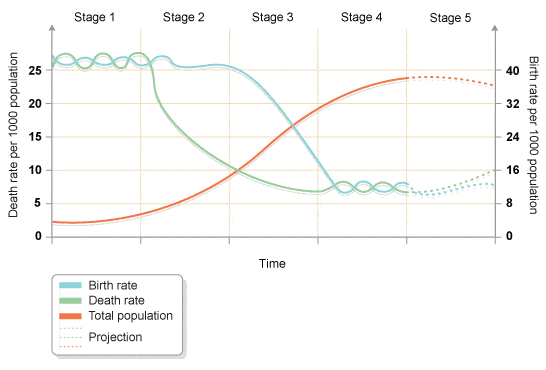
A characteristic of stage Three of the DTM shows?
a)
High birth and death rates
b)
Low death and high birth rates
c)
Declining birth and death rates
d)
High death and low birth rates
40.

A characteristic of stage four of the DTM shows
a)
High birth and death rates
b)
Low death and high birth rates
c)
Low birth and death rates
d)
High death and low birth rates
41.

A characteristic of stage one of the DTM shows
a)
High birth and death rates
b)
Low death and high birth rates
c)
Low birth and death rates
d)
High death and low birth rates
42.
Which of the following is an example of PRIMARY business activity?
a)
Factories
b)
Shops
c)
Schools
d)
Farmers
43.
What is a monarchy?
a)
The ruler (usually a king or a queen) inherits power.
b)
A government is given power by the governed.
c)
The monarch is a symbolic head of state and shares power with a legislature.
d)
A form of government in which people choose leaders by voting.
44.
What is theocracy?
a)
The ruler (usually a king or a queen) inherits power.
b)
The monarch is a symbolic head of state and shares power with a legislature.
c)
A government is given power by the governed.
d)
Government is controlled by a religious person.
45.

How would a free market economy be described?
a)
An economy in which decisions are made by the government.
b)
The international exchange of goods.
c)
An economy based on supply and demand with little or no government control
d)
An economy that is communist
46.
Oligarchy
a)
Rule by a few
b)
Military, religious, or family power
c)
Power always acquired by force
d)
An example would include South Africa (Apartheid)
47.
Who owned everything under communism?
a)
Wealthy people
b)
The secret police
c)
The government
d)
The poor people
48.
Boundaries based on traits like language.
a)
Geometric Boundary
b)
Physical Boundary
c)
Cultural Boundary
d)
Linear Boundary
49.
the state holds total authority over the society and seeks to control all aspects of public and private life wherever possible
a)
oligarchy
b)
dictatorship
c)
monarchy
d)
totalitarianism
50.
Boundaries established by rivers, oceans, deserts, mountains, etc.
a)
Political boundaries
b)
Physical boundaries
c)
Cultural boundaries
d)
Geographic boundaries
51.
Which type of boundary would use lines of latitude and longitude?
a)
Antecedent
b)
Subsequent
c)
Geometric
d)
Relic
52.
Creating ownership over a defined space, either personal, or publicly
a)
Sovereignty
b)
Territoriality
c)
Spatial Recognition
d)
Encomienda
53.

The Government runs some basic industries.
a)
Socialism
b)
Communism
c)
Capitalism
d)
All of the above
54.
Conflicts often occur on borders because
a)
direct, physical contact often takes place between two neighboring states
b)
Direct, physical contact never takes place between two neighboring states
c)
boundary lines are carefully drawn between different cultures
d)
boundary lines are invisible
55.
Which of the following is NOT an indicator of a nation’s economic development?
a)
labor force characteristics
b)
major religions
c)
urban/rural ratio
d)
educational achievement
56.

This image represents which sector?
a)
Primary Activity
b)
Secondary Activity
c)
Tertiary Activity
d)
Quaternary Activity
57.
The UN is an example of what?
a)
Alliance
b)
Multinational state
c)
Confederation
d)
Supranational organization
58.
What is subsistence farming?
a)
growing only enough crops to feed the farmer and his family
b)
growing crops to sell for a profit
c)
growing crops as a hobby
d)
None of the above
59.
What are the four types of economies?
a)
command, demand, capitalist, communism
b)
traditional, command, market, mixed
c)
mixed, market, traditional, primary
d)
None of the above
60.
Burger King and McDonalds keep their prices low because of
a)
Competition
b)
Property Rights
c)
Limited Role of Government
d)
Freedom of Enterprise
100 %

