
 Worksheets
Final Exam Review Day 1
Total questions: 33
Worksheet time: 24mins
Name
Class
Date
1.
What is a tool you should measure the volume of a liquid?
a)
ruler
b)
stopwatch
c)
eye dropper
d)
graduated cylinder
2.
What is a testable explanation, or an educated guess to a question called?
a)
inference
b)
results
c)
observations
d)
hypothesis
3.
What is a unit to measure length?
a)
liters
b)
seconds
c)
meters
d)
grams
4.
What is a measure of how much space something takes up.
a)
area
b)
mass
c)
weight
d)
volume
5.
What term means the amount of matter in an object?
a)
volume
b)
mass
c)
weight
d)
area
6.
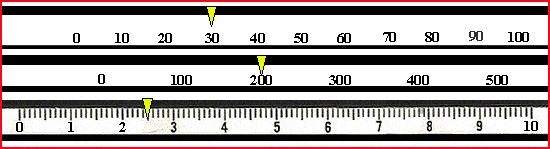
What is the mass on the triple beam balance?
a)
232.5
b)
237.0
c)
750.
7.
5. The metric base unit for mass is_________.
a)
Meter
b)
Liter
c)
Gram
8.

What temperature does the thermometer show?
a)
31° C
b)
35° C
c)
32° C
d)
39° C
9.
How many independent variables can be tested in a controlled experiment?
a)
one
b)
two
c)
three
d)
as many as possible
10.
Jeff is 6 feet 2 inches is a ___________ assesment
a)
Qualitative
b)
Quantitative
11.
The cake has a sweet smell is a _______ assessment.
a)
Qualitative
b)
Quantitative
12.

Mr. Krabbs is trying a new money making scheme. On Tuesdays he is selling his crabby patties on colored buns. He usually averages 25 customers per day. On Tuesdays he now averages 27 customers.
What was the independent variable?
What was the independent variable?
a)
The customers
b)
The crabby patty
c)
The colored buns
d)
The number of customers
13.
The summary at the end of an experiment that explains the results.
a)
conclusion
b)
procedures
c)
materials
d)
responding variable
14.

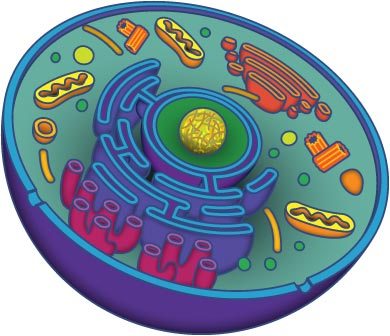
What organelle is labeled with "A"?
a)
Mitochondria
b)
Golgi Apparatus
c)
Nucleus
d)
Endoplasmic Reticulum
15.

What organelle is labeled with "C"?
a)
Mitochondria
b)
Golgi Apparatus
c)
Nucleus
d)
Endoplasmic Reticulum
16.

What organelle is labeled with "B"?
a)
Mitochondria
b)
Golgi Apparatus
c)
Nucleus
d)
Endoplasmic Reticulum
17.

What organelle is labeled with "D"?
a)
Mitochondria
b)
Golgi Apparatus
c)
Nucleus
d)
Endoplasmic Reticulum
18.

In what kind of cell can you find a cell wall?
a)
plant
b)
animal
c)
both
d)
neither
19.

Which type of cells have a cell membrane?
a)
plants
b)
animals
c)
bacteria
d)
all of them
20.
All living things are made up of...
a)
cells
b)
cell tissues
c)
organ
d)
organ systems
21.
Which of these is NOT an example of the body maintaining homeostasis?
a)
sweating to control one's temperature
b)
maintaining the pH inside a cell
c)
moving out of the way of a car
d)
less urination when dehydrated
22.
What is missing from the cell theory?
1. all cells come from previous cells
2. cells are the basic unit of structure and function in living things
1. all cells come from previous cells
2. cells are the basic unit of structure and function in living things
a)
2. all living things are made of minerals
b)
all living things are made of cells
c)
cells make up the most intelligent of the species
d)
there are no cells in living things
23.
English scientist that looked at a sliced cork and called it cells
a)
Hans & Zacharias Janssen
b)
Robert Hooke
c)
Walter Fleming
d)
Rudolf Virchow
24.
Before cells can divide, what must be copied?
a)
mitochondria
b)
cytoplasm
c)
DNA
d)
Cell Wall
25.
A human cell has 46 chromosomes before mitotic division. How many chromosomes will the daughter cells after mitosis.
a)
12
b)
23
c)
46
d)
92
26.
Put the following stages of mitosis in order: anaphase, prophase, metaphase, and telophase.
a)
prophase, metaphase, telophase, anaphase
b)
prophase, anaphase, metaphase, telophase
c)
prophase, metaphase, anaphase, telophase
d)
prophase, telophase, metaphase, anaphase
27.
If a somatic (body) cell in a butterfly contains 24 chromosomes, a butterfly egg would contain
a)
3
b)
6
c)
12
d)
24
28.
What makes up a tissue?
a)
a group of organs
b)
a group of different cells
c)
a group of the same cells
d)
several organ systems
29.
When many organ systems work together it can form...
a)
organ
b)
cells
c)
organ system
d)
organism
30.
A group of tissues that work together to perform a similar function is called_____. (Examples include the heart, lungs or stomach)
a)
cells
b)
tissues
c)
organs
d)
organ system
31.
What is diffusion?
a)
when molecules move from a low concentration to a high concentration
b)
when molecules move from a high concentration to a low concentration.
c)
no movement
d)
molecules move everywhere
32.
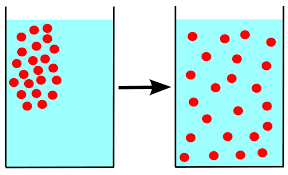
The picture below is an example of _________________.
a)
osmosis
b)
isotonic
c)
diffusion
d)
active transport
33.
Osmosis is the movement of _____ across a membrane.
a)
food
b)
energy
c)
oxygen
d)
water
100 %

