
 Worksheets
Physical Science Quarterly Review
Total questions: 89
Worksheet time: 1hrs 11mins
Name
Class
Date
1.
Aluminum
a)
Al
b)
A
c)
Ai
d)
Au
2.
Potassium
a)
P
b)
Po
c)
Ps
d)
K
3.
The positive particles of an atom are
a)
electrons
b)
positrons
c)
neutrons
d)
protons
4.
the central region of an atom where its neutrons and protons are is its
a)
nucleus
b)
electron cloud
c)
core
d)
center
5.
an atom with atomic number 6 would have how many protons
a)
6
b)
12
c)
3
d)
cannot be determined
6.
Particles in an atom that are neutral and have no charge are
a)
negatrons
b)
electrons
c)
neutrons
d)
protons
7.

A section of the Periodic Table of Elements is provided. What is the chemical symbol for magnesium?
a)
12
b)
Mg
c)
24.31
d)
Magnesium
8.
An atoms overall charge is generally
a)
positive
b)
depends on its mood
c)
neutral
d)
negative
9.

Which of these is the proton.
a)
A
b)
B
c)
C
d)
None
10.

B and C are found in the ______ of an atom.
a)
Energy levels
b)
Space
c)
Nucleus
d)
Outside
11.

Which number here is my atomic number?
a)
5
b)
10.811
12.
The early periodic table organized the elements in periods of increasing atomic mass. What information is currently used to organize the elements on the periodic table?
a)
number of valence electrons
b)
number of energy levels
c)
atomic number
d)
ionic radius
13.
All elements found on the left side of the Periodic Table of the Elements have what properties in common?
a)
They conduct heat and electricity
b)
They are all gases
c)
They are brittle and dull
d)
They are radioactive
14.

Which of these elements has an electron structure most similar to that of element X?
a)
1
b)
2
c)
3
d)
4
15.
Based on their locations in the periodic table, which element has chemical properties most similar to those of calcium, Ca?
a)
beryllium, Be
b)
potassium, K
c)
titanium, Ti
d)
yttrium, Y
16.
The number of valence electrons in an element affects the reactivity of that element. Which element listed has the fewest valence electrons?
a)
beryllium (Be)
b)
sodium (Na)
c)
oxygen (O)
d)
neon (Ne)
17.
According to the Periodic Table of the Elements, which set of elements has similar properties?
a)
H, C, I
b)
He, H, Al
c)
He, Ne, Ar
d)
Na, Ca, Al
18.
Hydrogen is a gas at a room temperature, but it is found with the alkali metals in group 1 (1A) on the periodic table. Which is the most likely reason hydrogen is grouped with alkali metals?
a)
All group 1 elements have the same number of protons.
b)
Alkali metals behave like hydrogen gas at high temperatures.
c)
Hydrogen behaves more like the alkali metals than other gases.
d)
All group 1 elements have one valence electron.
19.
Sodium (Na) and potassium (K) are in the same group on the periodic table. Based on their locations, which statement about sodium and potassium is true?
a)
Sodium is less electronegative than potassium.
b)
Sodium has fewer energy levels than potassium.
c)
Sodium has a larger ionic radius than potassium.
d)
Sodium has lower ionization energy than potassium.
20.

What is the family name of this group of elements?
a)
Alkali metals
b)
Halogens
c)
Noble Gases
d)
Alkali Earth Metals
21.
Is carbon a metal or non metal?
a)
metals
b)
non metal
22.
On which side of the periodic table are the metals located?
a)
left
b)
right
23.

What element is this?
a)
Helium
b)
Hydrogen
c)
Argon
d)
Silver
24.

What element is represented in this Bohr Model?
a)
Carbon
b)
Hydrogen
c)
Aluminum
d)
Lithium
25.

The period for Bromine is ___________.
a)
3
b)
2
c)
4
26.
an element will always have the same number of
a)
neutrons
b)
protons
c)
isotopes
d)
atoms
27.
An element with five valence electrons is
a)
phosphorus
b)
oxygen
c)
beryllium
d)
rubidium
28.
Rows on the period table are called _____ while columns are called _____.
a)
groups, families
b)
groups, periods
c)
periods, groups
d)
families, groups
29.
What is the name of the group that has the MOST reactive METALS in it?
a)
Alkaline earth
b)
Alkali
c)
transition
d)
actinides
30.
Which group of the periodic table is composed of inert (not reactive) gases?
a)
alkali metals
b)
alkaline earth metals
c)
halogens
d)
noble gases
31.

?
a)
Helium
b)
Hydrogen
c)
Argon
d)
Silver
32.

?
a)
Boron
b)
Carbon
c)
Nitrogen
d)
Lithium
33.

?
a)
Lithium
b)
Boron
c)
Carbon
d)
Neon
34.

?
a)
Helium
b)
Hydrogen
c)
Argon
d)
Silver
35.
What does a chemical equation show?
a)
how reactants change into products
b)
how products change into reactants
c)
the loss of matter when elements change
d)
composition of molecules in a compound
36.
What does a balanced chemical equation show?
a)
equal numbers of molecules in reactants and products
b)
equal numbers of atoms in reactants and products
c)
similar properties in reactants and products
d)
conservation of reactants and products
37.
The law of conservation of matter states that
a)
chemical reactions change matter.
b)
in chemical reactions, the identity of reactants and products is conserved.
c)
atoms are neither created nor destroyed in chemical reactions.
d)
a chemical equation must be balanced.
38.
Use this equation:
4H + O2 --> 2H2O
How many atoms of oxygen are on the reactant side of the arrow?
4H + O2 --> 2H2O
How many atoms of oxygen are on the reactant side of the arrow?
a)
4
b)
8
c)
1
d)
2
39.
Use this equation:
4H + O2 --> 2H2O
How many atoms of hydrogen are on each side of the arrow?
4H + O2 --> 2H2O
How many atoms of hydrogen are on each side of the arrow?
a)
4
b)
2
c)
8
d)
1
40.

How many oxygen atoms are in this chemical formula?
a)
6 oxygen atoms
b)
2 oxygen atoms
c)
3 oxygen atoms
d)
4 oxygen atoms
41.

How many oxygen atoms are in this chemical formula?
a)
7 oxygen atoms
b)
4 oxygen atoms
c)
3 oxygen atoms
d)
1 oxygen atoms
42.
Is this balanced?
2HgO → 2Hg + O2
a)
Yes
b)
No
43.
Is this balanced?
Al + O2 → 2Al2O3
Al + O2 → 2Al2O3
a)
Yes
b)
No
44.
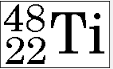
How many protons does this isotope of titanium have?
a)
48
b)
22
c)
26
d)
70
45.

How many neutrons does the isotope of lithium have?
a)
8
b)
3
c)
4
d)
5
46.
How many neutrons in C-14?
a)
6
b)
7
c)
14
d)
8
47.

In a correctly written symbol what would be located in the "A" position?
a)
number of neutrons
b)
atomic number
c)
number of electrons
d)
mass number
48.
The defining property of an atom is:
a)
The number of neutrons in the atom.
b)
The number of protons in the atom.
c)
The number of electrons in the atom.
d)
The number of positrons in the atom.
49.
An Atom:
a)
An ancient idea about the structure of substances that is incorrect.
b)
Has electrons and neutrons in the nucleus.
c)
Makes up protons.
d)
Is the smallest discrete particle of an element than can exist.
50.
Why is the relative atomic mass not a whole number?
a)
Nuclei can contain partial neutrons.
b)
Nuclei can contain varying number of electrons.
c)
Nuclei can contain partial protons.
d)
Nuclei can contain different numbers of neutrons and be the same element.
51.
Which is an alkali metal?
a)
Magnesium
b)
Iron
c)
Sodium
d)
Europium
52.
A horizontal row of elements in the periodic table.
a)
column
b)
group
c)
period
53.
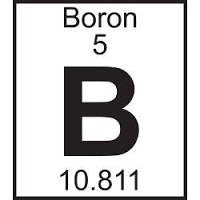
How many Electrons
a)
2.5
b)
5
c)
6
d)
10.81
54.
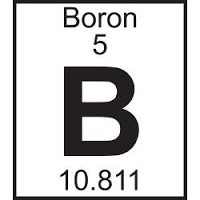
How many protons does this atom have?
a)
2.5
b)
6
c)
5
d)
10.811
55.

Which number here is my atomic number?
a)
5
b)
10.811
56.

In order for me to find the number of neutrons, I must round the atomic mass and then do what?
a)
atomic number-atomic mass
b)
atomic number x atomic mass
c)
atomic mass + atomic number
d)
atomic mass - atomic number
57.
What elements generally make an ionic bond?
a)
metal and nonmetal
b)
2 nonmetals
c)
metal
d)
none of the above
58.
What elements generally make a covalent bond?
a)
metal and nonmetal
b)
2 nonmetals
c)
metal
d)
none of the above
59.
In chemical compounds, covalent bonds form when
a)
the electronegativity difference between two atoms is very large.
b)
electrons are completely transferred between two metals.
c)
pairs of electrons are shared between two nonmetal atoms.
d)
two nonmetal atoms are attracted to each other by opposite charges.
60.
An ionic bond forms when
a)
Valence electrons are shared
b)
a sea of mobile electrons surround the cations
c)
valence electrons are transferred between atoms
d)
none of the above
61.
A covalent bond forms when
a)
Valence electrons are shared
b)
a sea of mobile electrons surround the cations
c)
valence electrons are shared between atoms
d)
none of the above
62.
Predict the bond that will form between Be and F.
a)
Ionic
b)
Covalent
63.
Predict the bond that will form between Se and Cl
a)
Ionic
b)
Covalent
64.
Predict the bond that will form between Sr and S.
a)
Ionic
b)
Covalent
65.
Sulfur
a)
Metal
b)
Nonmetal
66.
Calcium
a)
Metal
b)
Nonmetal
67.
In metals, the _______ electrons form a shared sea of electrons.
a)
Metallic
b)
Inner
c)
Outer
d)
Ionic
68.
There are more metals than non metals in the periodic table.
a)
True
b)
False
69.
Where are Halogens located on the periodic Table?
a)
Left Side
b)
Right Side
c)
Bottom
d)
Top
70.
In which group would you find the Noble Gases?
a)
5
b)
6
c)
7
d)
8
71.

How many elements are in the Noble Gas family?
a)
24
b)
13
c)
6
d)
18
72.
The moon probably formed when...
a)
A piece of the Earth broke off due to it's fast rotation
b)
A Mars-sized object rammed into the Earth
c)
Earth captured the moon gravitationally as it attempted to pass by.
d)
the molten bubble of the Earth budded.
73.
Nebula's are mixtures of gases and what?
a)
clouds
b)
stars
c)
tiny particles
d)
dust
74.
A force of attraction between any two objects is called _____________.
a)
static electricity
b)
rotation
c)
gravity
d)
orbit
75.
The ______is between the orbits of Mars & Jupiter.
a)
solar system
b)
asteroid belt
c)
terrestrial planets
d)
photosphere
76.
A giant sphere of glowing gases is a ___________
a)
Galaxy
b)
Light-year
c)
Star
d)
Magnitude
77.

The __________ has planets, moons, comets, and asteroids.
a)
solar system
b)
earth
c)
rotation
d)
United States
78.
Planets revolve around the sun.
a)
True
b)
False
79.
The sun is a planet.
a)
True
b)
False
80.
The reason the collapsed cloud spins faster as it contracts
a)
gravity
b)
centripetal force
c)
acceleration
d)
temperature
81.
What force acted on the massive nebula to collapse it and eventually form our sun?
a)
electrostatic force
b)
strong force
c)
weak force
d)
gravity
82.
What is the nebular hypothesis?
a)
Prediction about how the universe was formed
b)
Prediction of how the moon was formed
c)
Prediction of how comets were formed
d)
Prediction of how the Solar System was formed
83.
What would you be most likely to find at a transform boundary?
a)
Earthquakes
b)
Volcanoes
c)
Mountains
d)
Rift
84.
What would you be most likely to find at a convergent boundary between two pieces of oceanic crust?
a)
Mountains
b)
Rift
c)
Mid-Ocean Ridge
d)
Island Arc
85.
What would you be most likely to find at a divergent boundary between two pieces of oceanic crust?
a)
Rift
b)
Mid-Ocean Ridge
c)
Island Arc
d)
Flat land
86.

What kind of plate boundary is shown here?
a)
divergent
b)
convergent
c)
transform
d)
strike slip
87.

Name this Boundary type
a)
Convergent boundary
b)
Divergent Boundary
c)
Transform
d)
Equal Arm Balance
88.

What kind of plate boundary is shown here?
a)
divergent
b)
convergent
c)
transform
d)
strike slip
89.

What kind of plate boundary is shown here?
a)
divergent
b)
convergent
c)
transform
d)
strike slip
100 %

