
 Worksheets
Regents Earth Science - Dating and Earth's History Review
Total questions: 50
Worksheet time: 1hrs 10mins
Name
Class
Date
1.
How old do Paleontologists believe the Earth is?
a)
3.6 million years old
b)
3.6 billion years old
c)
4.6 billion years old
d)
4.6 million years old
2.

Which of the following is the oldest?
a)
Rock Layer L
b)
Igneous Intrusion D
c)
Igneous Intrusion H
d)
Rock Layer E
3.

Which of the following correctly lists the layers in order from oldest to youngest?
a)
A, B, C, D, E
b)
E, B, C, D, A
c)
E, D, C, B, A
d)
C, B, A, D, E
4.

What is the youngest layer?
a)
A
b)
B
c)
C
d)
D
5.

The rock formation labeled "P" is a(n)...
a)
fault
b)
igneous intrusion
c)
index fossil layer
d)
unconformity
6.
Which rock formation is the youngest?
(Which happened last?)
(Which happened last?)
a)
Rock Layer Q
b)
Rock Layer L
c)
Igneous Intrusion M
d)
Igneous Intrusion P
7.

What is the oldest layer?
a)
B
b)
C
c)
D
d)
E
8.
Most fossils are found in __________ rock layers
a)
metamorphic
b)
sedimentary
c)
igneous
d)
igneous and sedimentary
9.
Certain fossils existed all over the world, but only for a short period of geologic time. If a geologist finds this fossil in a layer of rock, he/she will be able to tell how old that rock layer is. These are called
a)
intrusion fossils
casts
casts
b)
imprint fossils
c)
index fossils
d)
intrest fossils
10.
The amount of time it takes for 50% of the remaining radioactive parent material to decay into stable daughter material is called
a)
radiocarbon dating
b)
radioactive decay
c)
half-life
d)
daughter product
11.
How do MOST fossils form?
a)
living things die and their remains are quickly buried by sediments
b)
the hard parts of an organism dry out in the air
c)
the soft parts of an organism change to stone
d)
freezing preserves the remains of an organism
12.

Which of the four features below is the oldest?
a)
Rock Layer B
b)
Rock Layer A
c)
Igneous Intrusion D
d)
Fault E
13.

What evidence helps determine that fault E is younger than intrusion D?
a)
Fault E cuts through Intrusion D, so it happened after than D
b)
Fault E cuts through Layers B and C, so it happened after D
c)
Intrusion D cuts through B and C, so it happened before E
d)
None of these answers
14.

According to the law of superposition, the oldest fossils are found
a)
At the top of the rock layers
b)
Near the bottom of the rock layers
c)
In the middle of the rock layers
d)
Somewhat near the surface
15.

Which rock layer in the diagram seems to be the oldest?
a)
F
b)
E
c)
B
d)
C
16.

Gaps in rock layers caused by uplift, erosion, flooding, and more deposition are called...
a)
law of superposition
b)
unconformities
c)
uniformitarianism
d)
relative dating
17.

Which area is most likely the youngest?
a)
1
b)
2
c)
3
d)
4
18.
Paleozoic, Mesozoic & Cenozoic are all
a)
Epochs
b)
Eras
c)
Periods
d)
Eons
19.

How have the rocks been disturbed?
a)
tilting
b)
folding
c)
faulting
d)
igneous intrusion
20.

How have the rocks been disturbed?
a)
tilting
b)
folding
c)
faulting
d)
igneous intrusion
21.

Which cannot be viewed in the diagram?
a)
tilting
b)
folding
c)
faulting
d)
igneous intrusion
22.

Which letter indicates a fault?
a)
A
b)
C
c)
D
d)
E
23.
Which letter indicates an igneous intrusion?
a)
A
b)
C
c)
D
d)
E
24.
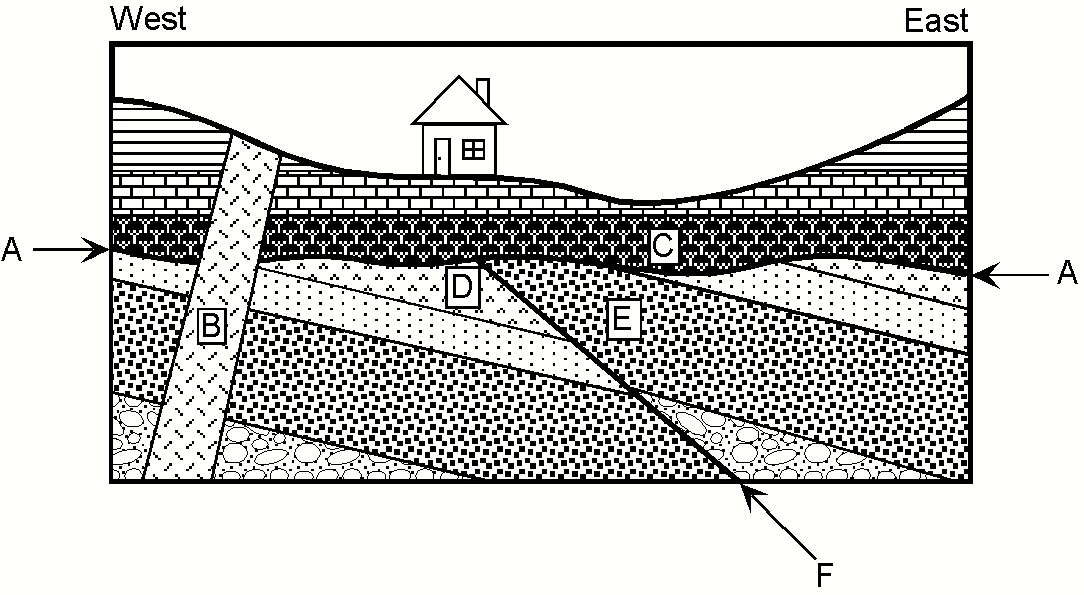
Letter "A" is an....
a)
inclusion
b)
intrusion
c)
fault
d)
unconformity
25.

Index fossils CAN tell us the age of a rock layer.
a)
True
b)
False
26.

On top of Mt. Everest, there are fossilized remains of sea life; this tells us that the rocks at the top of world's highest mountain
a)
used to be above sea level
b)
used to be below sea level
c)
used to be on Mars
d)
came from an asteroid
27.

Which best describes a fossil that helps determine the relative age of a rock layer?
a)
trace fossil
b)
index fossil
c)
radioactive fossil
d)
unconformity fossil
28.

The diagram represents the placoderm fish Bothriolepis, an index fossil found in New York State. What time period is this fossil from?
a)
Ordovician
b)
Silurian
c)
Devonian
d)
Cambrian
29.

Valcouroceras is a New York State index fossil. Which mountain-building event occurred in New York State during the time when Valcouroceras was living in oceans covering parts of New York State?
a)
Alleghenian orogeny
b)
Taconian orogeny
c)
Acadian orogeny
d)
Grenville orogeny
30.

Which fossil could be classified as an index fossil?
a)
Fossil 1
b)
Fossil 2
c)
Fossil 3
d)
Fossil 4
31.

The index fossil shown at the top has been found in New York State sedimentary bedrock.
Which other index fossil could also be found in New York State bedrock of the same age?
Which other index fossil could also be found in New York State bedrock of the same age?
a)
LIchenaria
b)
Manticoceras
c)
Elliptocephala
d)
Eospirifer
32.

When these rocks were deposited as sediments, this area was most likely (1)
a)
under the ocean
b)
a desert between high mountains
c)
repeatedly covered by lava flows
d)
glaciated several times
33.
When an unstable radioactive atom decays, it usually turns into:
a)
a more stable atom
b)
a less stable atom
c)
the exact same atom but with less pure energy
d)
empty space
34.
Radiometric dating is possible because the rates of decay of radioactive isotopes _____.
a)
change over time
b)
change from place to place
c)
are constant
d)
vary widely
35.
The time it takes for 50% of the nuclei in a radioactive sample to decay to its stable isotope is called _____.
a)
the daughter product
b)
geologic time
c)
the half-life
d)
the half-time
36.

According to the graph, what fraction of the original parent isotope still exists after 3 half lives?
a)
0,5000 g
b)
0,2500 g
c)
0,1250 g
d)
0.0625 g
37.

You find a rock sample with radioactive atoms present. If 12.5% of the original radioactive atoms were present, how many half-lives has the rock been around for? (Hint, at Half-Life = 0, you start with 100%)
a)
zero
b)
1
c)
2
d)
3
38.
You find a rock sample with radioactive atoms present. If 25% of the original radioactive atoms were present, how many half-lives has the rock been around for? (Hint, at Half-Life = 0, you start with 100%)
a)
zero
b)
1
c)
2
d)
3
39.
If the half-life of a radioactive group of atoms is 100 years, then how old is the rock if there have been two half-lives?
a)
25 years
b)
200 years
c)
400 years
d)
800 years
40.

Suppose you found a material in which 12.5% of the original radioactive atoms were still present. If the half-life of an atom is 60 years, how old is the material?
a)
30 years old
b)
60 years old
c)
120 years old
d)
180 years old
41.
If the half-life of a radioactive group of atoms is 100 years, then how old is the rock if there have been ten half-lives?
a)
10 years
b)
100 years
c)
1000 years
d)
10000 years
42.

Using ESRT (A) [Radioactive Decay Data], what is the half-life in standard notation of carbon-14?
a)
5,700 years
b)
57,000 years
c)
570,000 years
d)
5,700,000 years
43.
Using ESRT (A) [Radioactive Decay Data], what is the half-life in standard notation of Uranium-238?
a)
4,500 years
b)
450,000 years
c)
4,500,000 years
d)
4,500,000,000 years
44.

The table shows the radioactive decay of carbon-14. Part of the table has been left blank.
After 22,800 years, approximately what percentage of the original carbon-14 remains?
After 22,800 years, approximately what percentage of the original carbon-14 remains?
a)
15%
b)
12.5%
c)
6.25%
d)
3.125%
45.

The graph shows the generalized rate of decay of radioactive isotopes over 5 half-lives.
If the original mass of a radioactive isotope was 24 grams, how many grams would remain after 3 half-lives?
If the original mass of a radioactive isotope was 24 grams, how many grams would remain after 3 half-lives?
a)
12
b)
24
c)
3
d)
6
46.

Which radioactive isotope takes the greatest amount of time to undergo radioactive decay?
a)
Carbon-14
b)
Potassium-40
c)
Uranium-238
d)
Rubidium-87
47.

The graph shows the radioactive decay of a 50-gram sample of a radioactive isotope.
According to the graph, what is the half-life of this isotope?
According to the graph, what is the half-life of this isotope?
a)
100 years
b)
150 years
c)
200 years
d)
300 years
48.
Potassium-40 is useful for radioactive dating of Earth's rocks because the half-life of potassium-40
a)
decreased as the amounts of 40Ar and 40Ca in the rock increased
b)
remained constant during the radioactive decay process
c)
increased as pressure from the overlying sedimentary rock increased
d)
was shortened by the high temperature of the magma that formed the rock
49.

The graph shows the decay of a radioactive material over time.
How long does it take for this radioactive material to decay through 2 half-lives?
How long does it take for this radioactive material to decay through 2 half-lives?
a)
1 x 10³ years
b)
5 x 10³ years
c)
10 x 103 years
d)
40 x 103 years
50.
The characteristic of the radioactive isotope uranium-238 that makes this isotope useful for accurately dating the age of a rock is the isotope’s
a)
organic origin
b)
constant half life
c)
common
occurrence in sediment
occurrence in sediment
d)
resistance to weathering
100 %

