
 Worksheets
Test Review for Unit 3: Thinking Scientifically
Total questions: 50
Worksheet time: 1hrs 2mins
Name
Class
Date
1.
Density can be calculated, but cannot be measured directly. This is because it expresses a relationship between two variables that can be measured. What relationship does density describe?
a)
relationship between the control and constant
b)
relationship between the independent variable and the dependent variable
c)
relationship between mass and volume
d)
relationship between the state of matter and volume
2.

What property do these tools measure?
a)
volume
b)
mass
c)
length
d)
temperature
3.
An object that floats in water is _____________
a)
Less dense than water
b)
More dense than water
c)
Same density as water
4.

Put the liquids in order from most dense to least dense.
a)
4, 3, 2, 1
b)
1, 2, 3, 4
c)
3, 4, 2, 1,
d)
4, 3, 1, 2
5.

Find the volume of this piece of brass.
a)
50 g
b)
10 cm
c)
6 cm3
d)
12 cm3
6.

The density of this material is 2 g/cm3.
There are 24 cm3 Find the total mass.
There are 24 cm3 Find the total mass.
a)
12 grams
b)
48 grams
c)
12 g/cm3
d)
48 g/cm3
7.

What is the volume of the fish?
a)
18.0 cm3
b)
6.0 cm3
c)
38.0 cm3
8.

Which box has a higher density?
a)
Box A
b)
Box B
c)
cannot be determined
d)
they are the same
9.
Find the density of a 2 cm x 2 cm x 2 cm cube with a mass of 64 g.
a)
6 cm3
b)
12 g/cm3
c)
128 g/cm3
d)
8 g/cm3
10.

Jack has a rock. The rock has a mass of 14g and a volume of 2cm3. What is the density of the rock?
a)
7 mL
b)
7 g/cm3
c)
28 g/cm3
d)
1/7 g/cm3
11.
What units are used to measure volume of a liquid?
a)
cm
b)
cm3
c)
g/cm3
d)
mL
12.

I have two objects with the same volume but different masses. Which object will be more dense?
a)
The object with less weight.
b)
The object with more weight.
c)
The object with more mass.
d)
The object with less mass.
13.
What is the formula for density?
a)
density = mass x volume
b)
density = mass / volume
c)
density = mass + volume
d)
density = mass - volume
14.
What units can be used to express density?
a)
g/mL
b)
grams
c)
millimeters
d)
milliliters
15.
When reading the volume of water in a graduated cylinder, you should always
a)
look at the water level above the meniscus
b)
hold the graduated cylinder in the air to read the meniscus
c)
estimate the water level
d)
look at the bottom of the meniscus
16.

What is the volume of liquid in this graduated cylinder?
a)
40.0 mL
b)
40.3 mL
c)
43.0 mL
d)
44.0 mL
17.

This piece of lab equipment is called a ___________________.
a)
triple beam balance
b)
spring scale
c)
thermometer
d)
graduated cylinder
18.

What is the name of this piece of science equipment?
a)
Beaker
b)
Flask
c)
Overflow can
d)
Graduated cylinder
19.

What is this tool called?
a)
Beaker
b)
Flask
c)
Graduated Cylinder
d)
Measuring Cup
20.

How much green slime should be added to this graduated cylinder to raise its volume to 40 mL?
a)
3 mL
b)
37 mL
c)
40 mL
d)
4 mL
21.

What is the volume of the liquid in this graduated cylinder?
a)
44 mL
b)
30.6 mL
c)
37 mL
d)
36 mL
22.

What is the mass on the triple beam balance?
a)
206.0
b)
260.0
c)
200.6
23.
Convection is occurring in the earth because there is
a)
A temperature difference in the earth
b)
No temperature difference in the earth
24.
The cycle that powers the ocean currents, weather, and tectonic plates is called
a)
conduction current
b)
radiation
c)
condition current
d)
convection current
25.
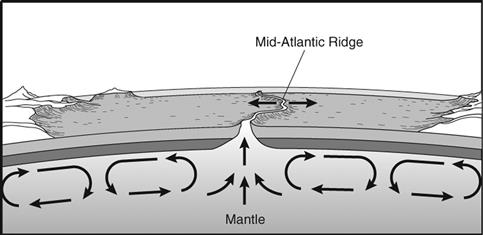
The diagram represents the movement of the mantle under the earth's crust. Which process is represented by the diagram?
a)
rotation
b)
conduction
c)
radiation
d)
convection
26.
What happens to the mass, volume, and density of an object if it is broken into smaller pieces?
a)
each piece has the same mass and volume, but its density decreases
b)
the mass and volume of each piece decrease, and so does their density
c)
the mass and volume of each piece decrease, but the density remains the same
d)
the mass, volume, and density of each piece remain the same
27.
Which of the following best describes what we mean by "evidence" for a scientific theory?
a)
evidence is information about the independent variable
b)
evidence is a theory that has already been proven
c)
evidence is any true statement about the subject the theory describes
d)
evidence is something you can observe that supports the theory's explanation
28.
For most materials, when they are cooled their density
a)
decreases because the molecules contract, or move closer together
b)
increases because the molecules contract, or move closer together
c)
decreases because the molecules expand, or move farther apart
d)
increases because the molecules expand, or move farther apart
29.
When the temperature of something increases, most materials' density
a)
decreases because the molecules contract, or move closer together
b)
decreases because the molecules expand, or move farther apart
c)
increases because the molecules contract, or move closer together
d)
increases because the molecules expand, or move farther apart
30.

Which substance is the MOST dense? ** Use the key
a)
A
b)
B
c)
C
31.

What is the density of this substance?
a)
5 grams
b)
5 ml
c)
5 g/ml
d)
10 g/ml
32.
If the density of a bar of gold is 19.3 g/cm3and you cut it into 4 pieces, what is the density of each piece of gold?
a)
4.825 g/cm3
b)
9.65 g/cm3
c)
19.3 g/cm3
d)
38.6 g/cm3
33.

This graph shows how the density of our bone tends to change over time. Which of the following best describes the changes in bone density according to this graph?
a)
Bone density is not predictable for individuals.
b)
Bone density increases in childhood but begins to decrease after the age of 45.
c)
Bone density increases steadily until the age of 50, but then begins to decrease.
d)
Bone density decreases as we get older.
34.

According to this graph, what is happening to bone density between the ages of 5 and 15?
a)
These ages are not represented on the graph.
b)
Bone density is staying the same.
c)
Bone density is increasing.
d)
Bone density is decreasing.
35.
Mr. S normally uses praise as a reward to train his dog. He wants to know the best way to train his dog, so he sets up an experiment to find out if there is a better way to get his dog to respond to commands. What is his independent variable?
a)
Type of reward
b)
Praise
c)
Type of dog
d)
Amount of time the dog follows commands
36.
Mr. S normally uses praise as a reward to train his dog. He wants to know the best way to train his dog, so he sets up an experiment to find out if there is a better way to get his dog to respond to commands. What is his dependent variable?
a)
Type of reward
b)
Praise
c)
Type of dog
d)
Amount of time the dog follows commands
37.
A student wants to test the effects of type of exercise on heart rate. What is the dependent variable?
a)
heart rate
b)
type of exercise
c)
amount of exercise
d)
time of day exercise occurs
38.
Why do we want to test one variable at a time?
a)
Because it is hard to setup a data table with more
b)
To know what is causing the changes
c)
It is what has always been done
d)
No one really knows
39.
An experiment is performed on plants to see how different liquids affect plant growth. Each plant in the experiment is given a different liquid; water, apple juice, or milk. Each plant has the same amount of soil, sunlight, and listens to the same music. In this investigation, what is the dependent variable?
a)
Type of plant
b)
Water, apple juice, milk
c)
Plant growth
40.
This part of the experiment serves as a basis of comparison; the one variable being tested has been omitted.
a)
experimental group
b)
control group
c)
data
d)
variables
41.
Jessie is concerned about how tired his classmates seem. He created a drink that he thinks will boost their energy. He recruits 100 classmates with a history of tiredness. He has 50 of them drink his new special energy drink. The other 50 drink a beverage that looks like the special energy drink, but is just water and food coloring. Both groups were told that they were getting the special drink that would boost energy. After 2 hours, 30 classmates in the first group reported having more energy and 8 classmates in the second group reported having more energy.
What is the independent variable?
What is the independent variable?
a)
Amount of energy
b)
Special energy drink
c)
The food coloring
42.
Students experiment on wilting. They take 2 plants of the same size. They put one in full sunlight and leave one in the classroom. After 2 hours, the plant in the sun has drooped.
Students conclude that sunlight causes wilting. How could this experiment be improved?
Students conclude that sunlight causes wilting. How could this experiment be improved?
a)
Do more trials. Only 1 plant in each spot isn't much repetition.
b)
They should put both plants in the same location.
c)
They should leave the plants in the location for less time so the plant isn't hurt by the sun.
d)
They should make sure to water both plants first.
43.
Mr. S. uses a new spray cleaner to remove the green slime left by students on the tables. Identify the control trial
a)
type of cleaner
b)
test with a new cleaner
c)
test with the old cleaner
d)
the green slime
44.

How many variables can be tested in a controlled experiment?
a)
one
b)
two
c)
three
d)
as many as possible
45.
How many variables can be tested in a controlled experiment?
a)
one
b)
two
c)
three
d)
as many as possible
46.
How are scientific theories different from scientific laws?
a)
Scientific theories are well-supported ideas that can be modified, but are rarely discarded.
b)
Scientific theories are laws that have not been proven yet.
c)
Scientific theories are claims that a few scientists believe.
d)
Scientific theories are educated guesses.
47.

Sarah conducted an experiment to determine whether salt added to a cup of water affects its boiling point. Water samples were prepared containing equal quantities of water at the same temperature. Each sample received a different amount of salt and was placed onto a heat source. The temperature of the water once it reached a rapid boil was recorded. Which conclusion correctly interprets the information from Sarah's table?
a)
Doubling the amount of salt doubled the boiling point.
b)
Increasing the amount of salt lowered the boiling point.
c)
Doubling the amount of salt decreased the boiling point.
d)
Increasing the amount of salt increased the boiling point.
48.

Two students are going to run a mile and measure their heart rate before and after their run. Student A is very athletic and is a part of the school's undefeated track team. Student B enjoys going home after school to play video games all night and is not physically fit. According to the data from the chart, how does a person's physical fitness change the way the circulatory system responds to exercise?
a)
After running, the heart rate will increase by about 60 beats per minute.
b)
After running the heart rate will increase by about 80 beats per minute.
c)
The more physically fit a person is, the less the heart rate will increase after exercise.
d)
The more physically fit a person is, the more the heart rate will increase after exercise.
49.

Two students are debating whether playing video games increases a person's reaction time. To test this they decide to perform an experiment. One student spends an hour playing an intense video game while the other student watches. Afterward, they test their reaction times by seeing how quickly they can catch a ruler as it falls between their fingers. Based on the data they collected, what conclusion can be drawn about reaction times?
a)
playing video games increases reaction times
b)
playing video games decreases reaction times
c)
more trials should be conducted to be able to draw an accurate conclusion
50.

What is the volume of the water in this graduated cylinder?
a)
8.8 mL
b)
8.6 mL
c)
9.2 mL
d)
9 mL
100 %

