
 Worksheets
Chapter 5: Ancient Egypt
Total questions: 70
Worksheet time: 23mins
Name
Class
Date
1.
Besides providing a stable food diet, what other advantage did Egypt's location provide for early Egyptians?
a)
Temples to worship in
b)
Sumerian artwork
c)
Natural barriers to protect them
d)
Two dynasties to celebrate religious tradtion
2.
What is a dynasty?
a)
a collection of queens
b)
a collection of kingdoms
c)
series of rulers from different families
d)
series of rulers from the same family
3.
Who would the people blame if crops did not grow or if disease struck?
a)
the farmers
b)
the mummies
c)
the pharaoh
d)
the dynasty that was in power
4.
Who was the most famous pharaoh of the Old Kingdom?
a)
Horus
b)
Sinai
c)
Menes
d)
Khufu
5.
Which of the following beliefs was central to Egyptian religion?
a)
the afterlife
b)
the pyramids
c)
the pharaohs
d)
the heavens
6.
Describe the burial practices of Egyptians?
a)
They used a funeral pyre for the dead.
b)
They carried the dead to a nearby country.
c)
They preserved bodies as mummies.
d)
They were buried in the river.
7.
Why were tombs filled with art, jewelry, etc.....?
a)
Tombs were museums.
b)
Tombs were private storage for the pharaoh.
c)
Tombs were the safest place in the kingdom.
d)
They believed the dead enjoyed their materials in the afterlife.
8.
Pyramids are
a)
warehouses to store food surplus
b)
temples where people are allowed to come and pray
c)
tombs with 2 rectangle-shaped sides
d)
tombs with 4 triangle-shaped sides that meet in a point at the top
9.
The first pharaoh and rulers after him wore a double crown to symbolize
a)
their rule of the queens
b)
their rule over upper and lower Egypt
c)
the Nile flowed 2 ways
d)
both farming and herding were important
10.
How was Egypt able to build pyramids and temples?
a)
The pharaohs family paid the cost.
b)
Egypt collected taxes from the people.
c)
Egypt collected taxes from Sumer.
d)
The priests held religious festivals.
11.
The worship of many gods.
a)
monotheism
b)
irrigation
c)
polytheism
d)
epic
12.
Pharaoh means
a)
great king
b)
great house
c)
great family
d)
great friend
13.
Who would write and record information?
a)
slaves
b)
scribes
c)
farmers
d)
craftspeople
14.
Egyptian writing system
a)
papyrus
b)
alphabet
c)
cuneiform
d)
hieroglyphics
15.
Where is the most fertile soil in Egypt?
a)
Nile Delta
b)
desert
c)
far south
d)
cataracts
16.
What is papyrus?
a)
mud used in building
b)
plant from which paper is made
c)
rock used to make tools
d)
animal skin
17.
Rich soil carried and mixed with water is
a)
pebbles
b)
silt
c)
dust
d)
clouds
18.
Why was the Rosetta Stone so important?
a)
It helped archaeologists decipher Egyptian writing?
b)
It gave clues about building.
c)
It was a book of the dead.
d)
It told how pharaoh's rules.
19.
The queen that ruled as pharaoh and traded with Punt
a)
Khufu
b)
Menes
c)
Pianki
d)
Hatsheput
20.
Who is at the top of the Egyptian social hierarchy?
a)
slaves
b)
pharaoh
c)
scribe
d)
merchant
21.
This device helped lift water from the river
a)
ladle
b)
scoop
c)
shaduf
d)
jar
22.
Steep waterfalls or river rapids, almost impossible to sail by boat
a)
delta
b)
canal
c)
dam
d)
cataracts
23.
The Nile River flows through two important regions in Egypt called
a)
Mesopotamia
b)
Upper and Lower Egypt
c)
Eastern and Western Egypt
d)
Nubia and Cairo
24.
Whose tomb was discovered in 1922?
a)
Tutankhamen
b)
Ahmose
c)
Ramses II
d)
Hatshepsut
25.
What were Egyptian kings called?
a)
Emperors
b)
Lords
c)
Pharaohs
d)
Queens
26.
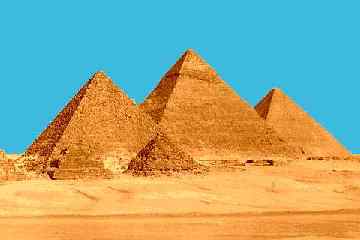
This pharaoh had the Great Pyramid built as a monument to his greatness.
a)
Hatsheput
b)
Narmer
c)
Djoser
d)
Khufu
27.
Hatshepsut and Ramses II ruled during this kingdom.
a)
Old
b)
Middle
c)
New
d)
Ancient
28.
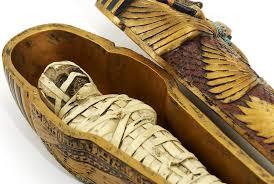
Why did ancient Egyptians make mummies?
a)
to prepare for burial in the river
b)
to protect the body from decay
c)
to ward off evil spirits
d)
to honor the gods
29.
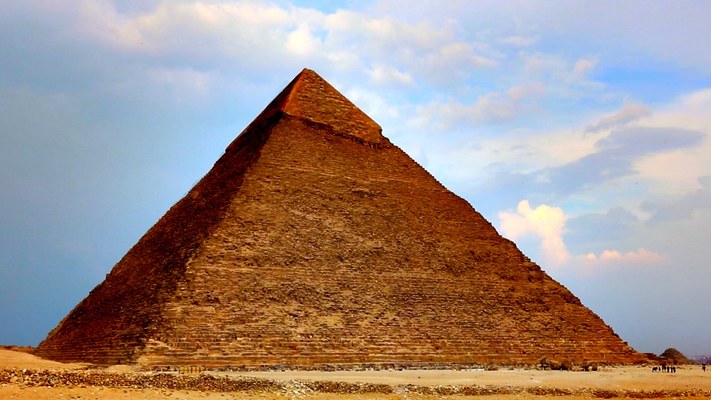
The great pyramids were built during what kingdom?
a)
Old Kingdom
b)
Middle Kingdom
c)
New Kingdom
d)
Hellenistic Times
30.
What was the special salt used to dry the body during mummification
a)
Sea
b)
Morton
c)
Natron
d)
Iodized
31.
The jars that hold the internal organs of the deceased are called
a)
Canopic
b)
Bell
c)
Ziploc
d)
Mason
32.
The large stone coffin that holds the other wooden coffins is called a
a)
Shaduf
b)
Shenti
c)
Masoleum
d)
Sarcophagus
33.

Who was the youngest Egyptian Pharaoh?
a)
Hatshepsut
b)
King Tut
c)
Ramses II
d)
Khufu
34.
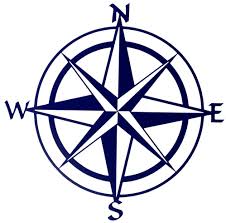
Which way did the Nile flow?
a)
North to South
b)
South to North
c)
East to West
d)
West to East
35.
Hatshepsut was the FIRST pharaoh who was
a)
a god.
b)
a child.
c)
a priest.
d)
a woman.
36.
Of these four groups, which one had the LOWEST social status?
a)
priests
b)
scribes
c)
artisans
d)
government officials
37.
The Nile River is the _____________ river in the world.
a)
widest
b)
shortest
c)
fastest
d)
longest
38.
What did the Egyptians invent that was based on the sun and helped them with their farming?
a)
dikes
b)
dams
c)
canals
d)
calendars
39.
An obelisk is a ______-sided pillar that is pointed on the top.
a)
2
b)
3
c)
4
d)
5
40.
What continent is Egypt on?
a)
South America
b)
Africa
c)
North America
d)
Asia
41.
Which is NOT one of the 3 primary kingdoms used to define periods of Ancient Egypt?
a)
Old Kingdom
b)
Middle Kingdom
c)
New Kingdom
d)
Intermediate Kingdom
42.
The soil of the Nile River Valley is best characterized as
a)
fertile
b)
dry
c)
rocky
d)
barren
43.
From their work with mummies, Egyptians learned much about ________, or the structure of the human body.
a)
mathematics
b)
anatomy
c)
farming
d)
transportation
44.
Why did embalmers use natron salt?
a)
dry out body
b)
to make it rot faster
c)
better taste
d)
to make it smell better
45.
This pharaoh is mainly know for the very good condition in which his tomb was discovered
a)
Ahmose
b)
Thutmose III
c)
Tutankhamen
d)
Hatshepsut
46.

What is the invention in the picture called?
a)
Shadoof
b)
Wheel
c)
Crane
d)
Thing-a-ma-jig
47.
Egyptian pharaoh who reigned for 66 years and constructed numerous temples.
a)
Ramses II
b)
Tutankhamen
c)
Amenhotep
d)
Ahmose
48.
Which female was the last ruler of ancient Egypt?
a)
Cleopatra
b)
Hatshepsut
c)
Narmer
d)
Nefertiti
49.
Why was Upper Egypt located in the South, or upriver?
a)
The land was at a higher elevation, containing mountains and hills.
b)
The land was at a lower elevation, meaning it was flat land.
c)
The land in Upper Egypt was the same elevation as the land in Lower Egypt.
d)
The land in Upper Egypt and Lower Egypt had the same elevation.
50.
What is the Red Land?
a)
The river
b)
The rich, fertile farmland
c)
The lifeless desert
d)
The mountains and hills
51.
What is the Black Land?
a)
The lifeless desert
b)
The river
c)
The mountains and hills
d)
The rich, fertile farmland
52.
How did Queen Hatshepsut bring wealth to Egypt?
a)
She conquered other lands.
b)
She traveled and stole goods from other lands.
c)
She expanded trade.
d)
She sold many of her riches.
53.
How did King Ramses expand Egypt?
a)
He expanded trade.
b)
He decreased the size of Egypt's boundaries.
c)
He had his son and daughter take over other lands.
d)
He conquered neighboring lands.
54.
What was King Ramses the first ruler to do in Egypt?
a)
He signed a declaration of war with his enemies.
b)
He signed a peace treaty with his enemies.
c)
He was the first pharaoh of Egypt.
d)
He was the first pharaoh to expand trade.
55.
What internal organ is left inside the body during the mummification process?
a)
lungs
b)
brain
c)
heart
d)
stomach
56.
Which pharaoh was King Tut's father?
a)
Thutmose
b)
Akhenaten
c)
Ramses
d)
Tutankhamun
57.
He is famous for changing the traditional religion of Egypt from the worship of many gods to the worship of a single god named Aten.
a)
Cleopatra
b)
Ramses
c)
Imenhotep
d)
Akhenaten
58.
a specially treated body wrapped in cloth
a)
mummy
b)
sarcophagus
c)
obelisk
d)
canopic jar
59.
Queen of Egypt, built many monuments and greatly expanded trade
a)
Cleopatra
b)
Hatshepsut
c)
Ramses
d)
King Tut
60.
This person/people were at the bottom of the social structure in Ancient Egypt:
a)
Pharaohs
b)
Craftsmen
c)
Merchants
d)
Farmers and slaves
61.
How many days did the entire burial process for a pharaoh take?
a)
1 day
b)
1 week
c)
30 days
d)
70 days
62.
The order in which members of a royal family inherit the throne is known as __________.
a)
succession
b)
dynasty
c)
delta
d)
exile
63.
Egyptians wore clothing made of a fabric called __________.
a)
cotton
b)
linen
c)
silk
d)
wool
64.
The process of __________ was used to preserve bodies.
a)
burial
b)
cremation
c)
freezing
d)
embalming
65.
Which pharaoh conquered Nubia?
a)
Akhenaton
b)
Ramses II
c)
Hatshepsut
d)
Thutmose III
66.
Egyptian doctors were able to perform surgery on living patients.
a)
True
b)
False
67.
Geometric shapes were NOT sacred to Egyptians.
a)
True
b)
False
68.
Egyptians used geometry to measure property lines.
a)
True
b)
False
69.
Egyptian doctors used herbal medicine.
a)
True
b)
False
70.
Which items did Hatshepsut NOT receive from Punt?
a)
rare herbs and spices
b)
slaves
c)
monkeys
d)
potted trees for making incense
100 %

