
 Worksheets
chemical reaction
Total questions: 30
Worksheet time: 17mins
Name
Class
Date
1.
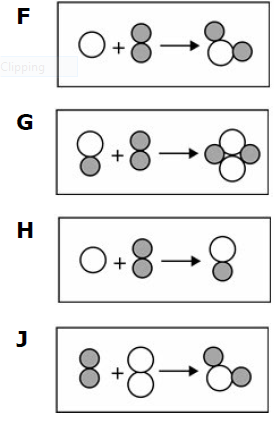
Which of the following models best demonstrates a balanced chemical equation?
a)
F
b)
G
c)
H
d)
J
2.
The formula below represents the most common carbohydrate known as glucose. Which information can be determined from the chemical formula?
C6H12O6
C6H12O6
a)
The structural arrangement of the atoms in a glucose molecule
b)
The color of a glucose molecule
c)
The size of a glucose molecule
d)
The number of atoms of each element in a glucose molecule
3.

For an investigation a student poured a blue solution of CuSO4 into a beaker. The student placed a shiny, silver-colored strip of zinc metal in the solution and observed the changes.
The student inferred that a chemical reaction occurred. What evidence supports this inference?
The student inferred that a chemical reaction occurred. What evidence supports this inference?
a)
A dark solid formed on the zinc metal.
b)
The zinc metal remained silver-colored and shiny
The zinc metal remained silver-colored and shiny
c)
The CuSO4 solution turned blue when the zinc metal was added.
d)
None of these
4.
The chemical formula for glucose, a simple sugar, is C6H12O6. The formula for ethanol is C2H6O. What accounts for the differences in these compounds?
a)
The elements that make up glucose are different than the elements that make up ethanol
b)
The ratio of the elements is different in ethanol than in glucose
c)
The chemical properties of the elements are different in glucose and ethanol
d)
Glucose has more elements than ethanol
5.
The reactants are on the left side of the chemical equation.
a)
True
b)
False
c)
It depends
6.

Which of these formulas contain equal numbers of nitrogen atoms?
a)
Formulas I and III
b)
Formulas I and IV
c)
Formulas II and III
d)
Formulas I, II and V
7.
Two clear colorless solutions were combined.
The student observed that the temperature changed from 25 •C to 23 •C when the solutions were combined and that a white substance rapidly formed and settled to the bottom of the container. What most likely happened to produce these results?
The student observed that the temperature changed from 25 •C to 23 •C when the solutions were combined and that a white substance rapidly formed and settled to the bottom of the container. What most likely happened to produce these results?
a)
One of the original compounds came out of solution
b)
The solutions reacted chemically
c)
Some of the water froze into ice crystals
d)
Rapid evaporation of water occurred, leaving a solid
8.
Coal contains carbon and other elements. Carbon dioxide forms when coal burns in the presence of oxygen. Which of these is the best evidence that a chemical reaction occurs when coal burns?
a)
The shape of the coal changes
b)
Oxygen is present
c)
A new substance is produced
d)
Coal is made up of more than one element
9.

All of the following reactions are correctly balanced except-
a)
A
b)
B
c)
C
d)
D
10.

What is the mass of H2O in the reaction above?
a)
70.01
b)
24.11
c)
21.44
d)
48.22
11.
Which of the following BEST describes a chemical reaction?
a)
A compound is crushed into a fine powder.
b)
Atoms break apart into even smaller particles.
c)
Existing electron bonds break and reattach to other atoms
d)
Molecules move faster until they fly apart from each other
12.

A scientist performed four investigations using eight different liquids. In each investigation, the scientist combined two of the liquids under a fume hood and recorded observations in the table below.In which investigation is it least likely that the liquids reacted chemically?
a)
1
b)
2
c)
3
d)
4
13.

This appears on the left side of a chemical formula, and represents how many molecules there are.
a)
An Atom
b)
The Subscript
c)
A Molecule
d)
The Coefficient
14.

How many hydrogen atoms are in this chemical formula:
a)
4 hydrogen atoms
b)
1 hydrogen atom
c)
2 hydrogen atoms
d)
3 hydrogen atoms
15.

How many oxygen atoms are in this chemical formula?
a)
7 oxygen atoms
b)
4 oxygen atoms
c)
3 oxygen atoms
d)
1 oxygen atoms
16.
What is the right part of a chemical equation called?
H2 + O → H2O
H2 + O → H2O
a)
Reactants
b)
Products
c)
Yields
d)
Chemical Equation
17.
Is this balanced?
Al + O2 → 2Al2O3
Al + O2 → 2Al2O3
a)
Yes
b)
No
18.
A substance that increases speed of chemical reaction without being being changed is called:
a)
Catalyst
b)
Acid
c)
Base
d)
pressure
19.
Reactions that give out heat to the surrounding are classified as one of the following:
a)
Spontaneous
b)
Sluggish
c)
Exothermic
d)
Endothermic
20.
Why must chemical equations be balanced?
a)
So that the equation doesn't explode
b)
The reaction won't happen until it is balanced
c)
Matter cannot be created or destroyed
d)
None of these
21.
What coefficient should be used to make the following equation balanced?
N2+O2--> _NO
N2+O2--> _NO
a)
1
b)
2
c)
3
d)
4
22.
Which of the following shows the correct way to balance the chemical equation?
Fe + O2 -> Fe2O3
Fe + O2 -> Fe2O3
a)
4Fe + 3O2 -> 2Fe2O3
b)
2 Fe + 3O2 -> Fe2O6
c)
4 Fe + O6 -> 2Fe2O3
d)
None of the options are correctly balanced.
23.
The energy needed to start a chemical reaction is the _____________________.
a)
Activation Energy
b)
Products
c)
Reactants
d)
Enzymes
24.
Which type of reaction will feel cold?
a)
exothermic
b)
exergonic
c)
endothermic
d)
none of these
25.
At the end of a chemical reaction a completely new substance is formed.
a)
TRUE
b)
FALSE
26.
All of the following EXCEPT for which one is evidence of a chemical reaction.
a)
Precipitate Formation
b)
Gas Production
c)
Light Production
d)
Changes in State of Matter
27.
How many atoms of aluminum are on each side of the following equation: 4Al + 3O2 --> 2Al2 O3
a)
2
b)
6
c)
1
d)
4
28.
To get a total number of atoms in an equation, you must _________ coefficients by subscripts.
a)
add
b)
subtract
c)
multiply
d)
divide
29.
Balance this reaction: ____ Na3PO4 + ____ KOH ---> ____ NaOH + ____ K3PO4
a)
1,3,3,1
b)
1,3,2,1
c)
2,3,3,1
d)
1,1,3,1
30.
Balance this reaction: ____ NaF + ____ Br2 ---> ____ NaBr + ____ F2
a)
3,1,2,1
b)
1,2,3,4
c)
2,1,2,1
d)
1,2,1,2
100 %

