
NEW
Font size
S
M
L
XL
 Worksheets
Oceanography Quiz 1
Total questions: 50
Worksheet time: 36mins
Name
Class
Date
1.

Which layer?
"Fluid rock: iron and nickel, responsible for Earth’s magnetic field. Powerful electric currents form as the iron is moved around the Earth’s axis. This field protects the Earth from harmful particles emitted by the Sun."
"Fluid rock: iron and nickel, responsible for Earth’s magnetic field. Powerful electric currents form as the iron is moved around the Earth’s axis. This field protects the Earth from harmful particles emitted by the Sun."
a)
Inner Core
b)
Outer Core
c)
Mantle
d)
Crust
2.

Which layer?
"Solid on bottom and liquid at top. Substances sometimes emitted by volcanoes so scientists can study them. Makes up 84% of Earth’s volume."
"Solid on bottom and liquid at top. Substances sometimes emitted by volcanoes so scientists can study them. Makes up 84% of Earth’s volume."
a)
Inner Core
b)
Outer Core
c)
Mantle
d)
Crust
3.

The deepest hole humans have ever built was how deep?
a)
2km
b)
5km
c)
7km
d)
12km
4.
What is one thing that scientists found and did NOT expect to find in the Great Bore Hole of Russia?
a)
fairies
b)
salmon
c)
water
d)
rock
5.
The Name of this theory:
"The idea that the Earth’s Crust can be broken up into large pieces or plates that consist of both continents and pieces of oceanic crust moving together over the face of the Earth”
"The idea that the Earth’s Crust can be broken up into large pieces or plates that consist of both continents and pieces of oceanic crust moving together over the face of the Earth”
a)
Crust
b)
Geology
c)
Plate Tectonics
d)
Igneous Rock Formation
6.
______________ boundary happens when 2 plates collide or come together.
a)
divergent
b)
transform
c)
convergent
d)
penelope
7.
The Andes Mountains were formed because of this type of boundary.
a)
convergent
b)
divergent
c)
transform
d)
insurgent
8.

occurs along mid-ocean ridges where new crust is being added
a)
divergent
b)
convergent
c)
transform
d)
flying gurnards
9.
As 2 oceanic plates pull apart a crack in the ocean floor appears and magma oozes up from the mantle to fill in the space between the plates. What type of boundary is this?
a)
divergent
b)
convergent
c)
transform
d)
magma
10.
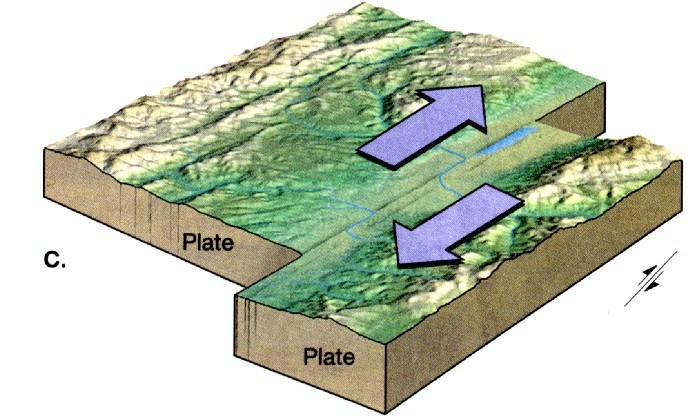
What type of plate boundary is this?
a)
Transform
b)
Convergent
c)
Divergent
d)
Plate
11.

Name the boundary
a)
convergent boundary
b)
divergent boundary
c)
transform boundary
d)
sergent boundary
12.
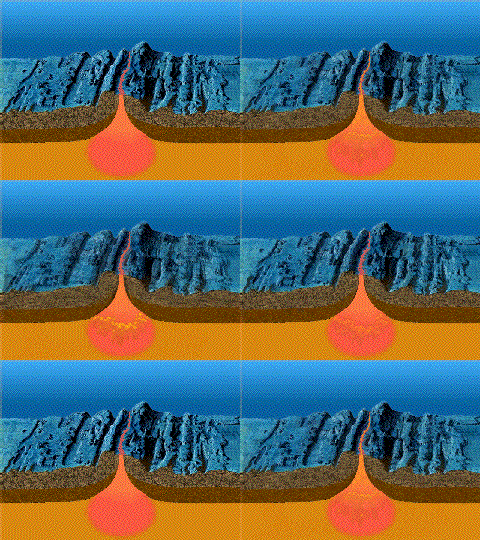
What type of boundary creates new seafloor?
a)
Oceanic - Oceanic Convergent
b)
Oceanic - Continental convergent
c)
Continental - Continental Divergent
d)
Oceanic - Oceanic Divergent
13.
What ocean floor feature may eventually turn into a volcanic island, like Hawaii?
a)
Trench
b)
Mid-ocean ridge
c)
Rift Valley
d)
Seamount
14.

What feature is B?
a)
Seamount
b)
Abyssal plain
c)
Continental shelf
d)
Volcanic Island
15.

What feature is A?
a)
Continental shelf
b)
Continental slope
c)
Trench
d)
Mid-ocean ridge
16.

What feature is E?
a)
Volcanic island
b)
Seamount
c)
Mid-ocean ridge
d)
Abyssal plain
17.

What feature is C?
a)
Abyssal plain
b)
Seamount
c)
Continental shelf
d)
Continental slope
18.

What feature is D?
a)
Trench
b)
Mid-ocean ridge
c)
Trench
d)
Continental rise
19.
The shallow area at the edges of the continents
a)
continental shelf
b)
continental rise
c)
continental slope
d)
guyot
20.
An underwater mountain range
a)
trench
b)
seamount
c)
abyssal plain
d)
mid-ocean ridge
21.
An isolated flat-topped mountain is known as a
a)
trench
b)
mid-ocean ridge
c)
abyssal plain
d)
guyot
22.

This seafloor feature (in dark blue) is found in Monterey Bay, CA:
a)
Blue Hole
b)
Trench
c)
Submarine Canyon
d)
Continental shift
23.
Fringing and barrier reefs develop:
a)
Along a coast
b)
In the open ocean far from land
c)
Around islands in temperate regions
d)
Near atolls
24.
Generally, an important distinction between barrier and fringing reefs is that barrier reefs
a)
Are found only in the Pacific Ocean
b)
Develop farther away from land
c)
Are found only in the Caribbean
d)
Do not have a reef flat
25.
A ringed shaped reef
a)
fringing reef
b)
barrier reef
c)
atoll
d)
archipelago
26.
O'ahu Island is considered what type of reef:
a)
Barrier
b)
Fringing
c)
Atoll
d)
Late-Middle age
27.

Bora Bora is considered to have a mostly:
a)
Fringing reef
b)
Barrier reef
c)
Patch reef
d)
Soft Coral Reef
28.

What is a Patch Reef?
(best answer)
(best answer)
a)
A reef of coral running roughly parallel to the shore past a deep channel.
b)
An isolated coral growth forming a small platform in a lagoon, barrier reef, or atoll
c)
A coral reef close to and along the land.
d)
A reef used to patch up empty reef.
29.
What was James Cameron's mission in building the Deep Sea Challenger?
a)
To sunbathe in Papua New Guinea
b)
To explore the Mariana Trench
c)
To explore the Maria Trench
d)
To explore the Marinara Trench
30.
Waters further from land; basically open ocean area.
a)
intertidal zone
b)
pelagic zone
c)
benthic zone
d)
abyssal zone
31.
Where 98% of sea life lives:
a)
Benthic Zone
b)
The Abyssal Zone
c)
The Littoral Zone
d)
The Auto Zone
32.

A represents:
a)
The Abyssal Zone
b)
The Bathyal Zone
c)
The Hadal Zone
d)
The Littoral Zone
33.
B represents:
a)
The Abyssal Zone
b)
The Bathyal Zone
c)
The Hadal Zone
d)
The Littoral Zone
34.
C represents:
a)
The Abyssal Zone
b)
The Bathyal Zone
c)
The Hadal Zone
d)
The Littoral Zone
35.
D represents:
a)
The Abyssal Zone
b)
The Bathyal Zone
c)
The Hadal Zone
d)
The Littoral Zone
36.
As depth increases in the ocean, so does the:
a)
Amount of light
b)
Pressure
c)
Amount of living things
d)
Temperature
37.
What are common organisms in the pelagic zones?
a)
Manta Rays and Jellyfish
b)
Sea cucumbers and Goblin Sharks
c)
Coral and White Spotted Morays
d)
Anemones and Sea Stars
38.
What does Aphotic mean in the term "Aphotic zone?"
a)
Brightly lit
b)
Dimly lit
c)
Without light
d)
No photo was taken
39.

This animal is mostly found in the _______ zone, also known as the "Twilight" zone.
a)
Hadopelagic Zone
b)
Bathypelagic zone
c)
Epipelagic zone
d)
Mesopelagic zone
40.

This animal is mostly found in the _______ zone.
a)
Hadopelagic Zone
b)
Bathypelagic zone
c)
Epipelagic zone
d)
Mesopelagic zone
41.

The honu is mostly found in the _______ zone.
a)
Hadopelagic Zone
b)
Bathypelagic zone
c)
Epipelagic zone
d)
Mesopelagic zone
42.

This Giant Squid is likely the inspiration for "The Kraken" and is mostly found in the _______ zone.
a)
Abyssopelagic Zone
b)
Bathypelagic zone
c)
Epipelagic zone
d)
Mesopelagic zone
43.

The Photic Zone around Hawai'i is:
a)
Greater than 200 m
b)
50 m
c)
500 m
d)
800 m
44.
What is a common organism that lives around Hydrothermal vents in the Hadal zone?
a)
Opihi
b)
Holothurians
c)
Tubeworms
d)
Fish
45.
Bathymetry means:
a)
The study of measuring hadal zones only.
b)
The study of measuring the deep
c)
The study of measuring space-time
d)
The study of measuring water temperature
46.

In what zone would you expect to find a coral reef community?
a)
Neritic Zone
b)
Hadal Zone
c)
Bathyal Zone
d)
Abyssal Zone
47.
About how wide is the Pacific Ocean (from East to West)?
a)
30,000 km
b)
16,000 km
c)
1,600 miles
d)
10,000 fathoms
48.

What percent of the Pacific Ocean is land?
a)
Less than 1%
b)
20%
c)
15%
d)
25%
49.

This is what:
a)
An atoll
b)
A fringing reef
c)
A barrier reef
d)
A shoal
50.

How many tons of tuna are illegally caught per year in the world?
a)
5 tons
b)
300,000 tons
c)
200 tons
d)
5,000 tons
Reset

