
NEW
Font size
S
M
L
XL
 Worksheets
Continental Drift
Total questions: 10
Worksheet time: 7mins
Name
Class
Date
1.
Who is the German Scientist that came up with the theory of the Continental Drift?
a)
Albert Einstein
b)
Ms. Stukel
c)
Galileo
d)
Alfred Wegener
2.
What are the three types of Evidence that supports Alfred Wegener's Theory?
a)
Fossils, Fish, and Land
b)
Sedimentary, Magma, and Climate
c)
Fossils, Land forms, and Climate
d)
Climate, Land forms, and Metamorphic rock
3.
Where did Wegener find plant fossils that today would not be able to survive on that type of land?
a)
North America
b)
Antarctica
c)
China
d)
India
4.
When Wegener looked at maps he noticed Africa and South America ____________ lined up.
a)
Lakes
b)
islands
c)
Hills
d)
Mountain Ranges
5.
What is the force that moves the continents?
a)
Conduction
b)
Convection
c)
Radiation
d)
Conveyor belts
6.
Originally the Continental drift theory was not well received by other scientist. Why?
a)
There was a competing theory at the time that was more believable.
b)
There was no data showing the continents ever moved.
c)
The scientists did not know the force responsible for moving the continents.
d)
The scientist presenting the data was unreliable.
7.
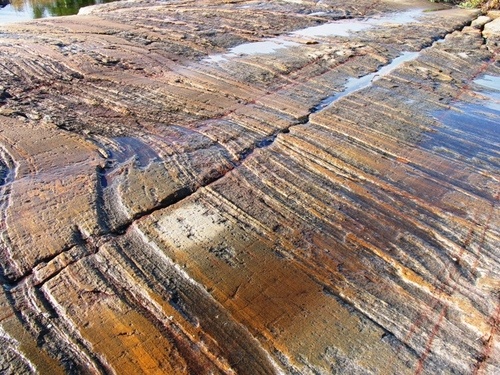
This is a picture of glacier scars found in Africa. What are these evidence for?
a)
Africa has always been near the equator
b)
Africa was once in an area of the Earth that had a very cold climate
c)
The continents have not moved
d)
sea floor spreading
8.
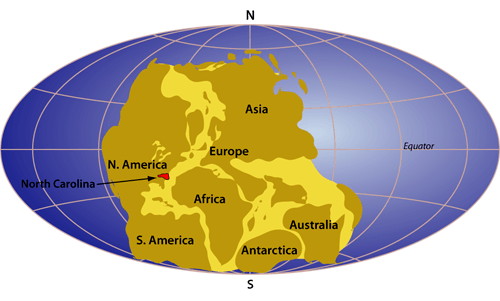
What is this a picture of?
a)
plate tectonics
b)
continental drift
c)
pangea
d)
glacier scaring
9.
What evidence did Wegener use to support his theory?
a)
Continents and fossils fitting together/matching-up like puzzle pieces
b)
glacier scars and other climate evidence from temperature
c)
mountain ranges and rocks line up across continents
d)
all of the above
10.
The following are animal fossil evidences of the Continental Drift theory except?
a)
Glossopteris
b)
Cynognathus
c)
Lystrosaurus
d)
Mesosaurus
Reset

