
 Worksheets
Periodic Table - H/GT
Total questions: 30
Worksheet time: 19mins
Name
Class
Date
1.
In the modern periodic table elements are arranged in order of increasing _________.
a)
atomic mass
b)
atomic number
c)
valence electrons
d)
number of isotopes
2.
Each column in the periodic table is called a
a)
period
b)
group
c)
cluster
d)
unit
3.
The atomic number tells you what?
a)
number of electrons
b)
number of protons
c)
number of neutrons
d)
the sum of electrons and protons in an atom.
4.
Which group of the periodic table is composed of inert (not reactive) gases?
a)
alkali metals
b)
alkaline earth metals
c)
halogens
d)
noble gases
5.
Elements which are shiny, conduct electricity and heat are called
a)
metal
b)
nonmetal
c)
metalloid
d)
nonexistent
6.
Which element is not a metal?
a)
Au
b)
Re
c)
Al
d)
B
7.
Which is a halogen?
a)
Helium
b)
Chlorine
c)
Oxygen
d)
Neptune
8.
Which is an alkali metal?
a)
Magnesium
b)
Iron
c)
Sodium
d)
Europium
9.

a)
energy levels
b)
valence electrons
c)
protons
d)
neutrons
10.
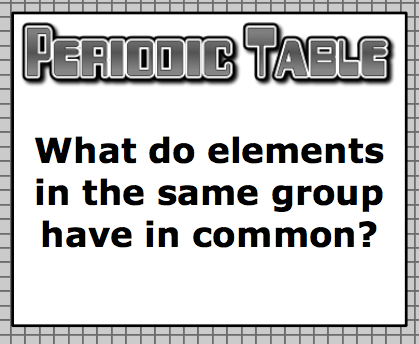
a)
energy levels
b)
valence electrons
c)
protons
d)
neutrons
11.
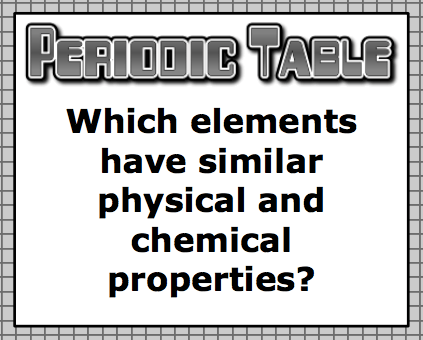
a)
Same group
b)
Same period
12.
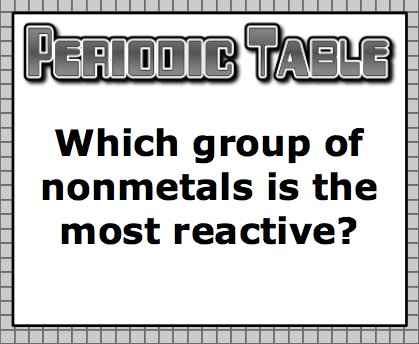
a)
Group 1
b)
Group 17
c)
Group 18
d)
Group 2
13.
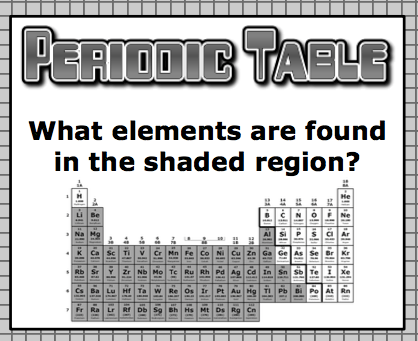
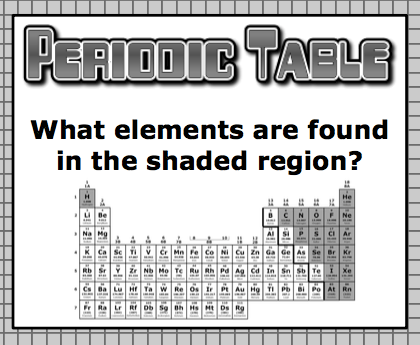
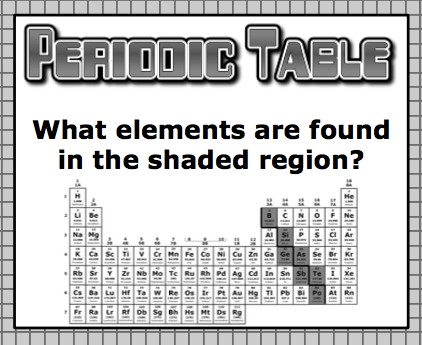
a)
Metals
b)
Nonmetals
c)
Metalloids
14.
a)
Metals
b)
Nonmetals
c)
Metalloids
15.
a)
Metals
b)
Nonmetals
c)
Metalloids
16.
a)
Metals
b)
Nonmetals
c)
Alkali metals
d)
Noble gases
17.
Calcium is most like which of the following?
a)
Barium
b)
Potassium
c)
Cesium
d)
Nitrogen
18.
The alkali metals have how many valence electrons?
a)
1
b)
2
c)
7
d)
8
19.
The noble gases have how many valence electrons?
a)
1
b)
7
c)
8
d)
18
20.
Membership in a family is based on the number of
a)
electrons
b)
valence electrons
c)
protons
d)
neutrons
21.

What does the 1.00794 stand for?
a)
Hydrogen
b)
atomic number
c)
atomic mass
d)
atomic explosion
22.
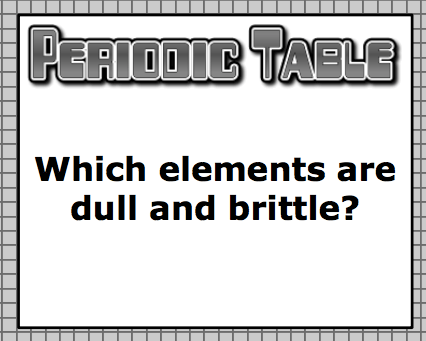
Which of the following is not a property of metals?
a)
brittle
b)
malleable
c)
lustrous
d)
conductive
23.
If a material can easily be drawn into the shape of a wire, it is
a)
Ductile
b)
Magnetic
c)
Malleable
d)
Reactive
24.

Beryllium is in group number______.
a)
Group 2
b)
Group 3
c)
Group 4
d)
Group 7
25.

The period for Bromine is ___________.
a)
3
b)
2
c)
4
26.
What part of the atom is the densest?
a)
the nucleus
b)
the electron cloud
c)
protons
d)
valence electrons
27.
What part of the atom has the largest volume?
a)
nucleus
b)
electron cloud
c)
proton
d)
valence electron
28.
How do you find the mass number for an element?
a)
it's on the PTE
b)
subtract the atomic number
c)
round the atomic mass
29.
What particle do you count to identify an element?
a)
proton
b)
neutron
c)
electron
d)
valence electron
30.
What particle determines how reactive an element is?
a)
proton
b)
neutron
c)
electron
d)
valence electron
100 %

