
 Worksheets
M2 Core Sci S1 Final Review
Total questions: 75
Worksheet time: 51mins
Name
Class
Date
1.
Is silicon an element, compound, or mixture?
a)
Element
b)
Compound
c)
Mixture
2.
Is pure water an element, compound or a mixture?
a)
Element
b)
Compound
c)
MIxture
3.
What type of a mixture is Coffee?
a)
Homogeneous
b)
Heterogeneous
4.
Your blood, when magnified, reveals several different kinds of cells. Based on this information, your blood is an example of a
a)
compound
b)
homogeneous mixture
c)
heterogeneous mixture
d)
element
5.
What is an example of a physical property?
a)
reactivity
b)
color
6.
ability for a solid to be hammered without shattering
a)
Density
b)
Conductivity
c)
Malleability
d)
Viscosity
7.
ability to allow heat to flow
a)
Viscosity
b)
Conductivity
c)
Density
d)
Melting/Boiling Point
8.
Definition of Physical property
a)
properties are those that can be observed without changing the identity of the substance
b)
Properties that describe how a substance changes into a completely different substance
9.
Pull of gravity on an object:
a)
Gravity
b)
mass
c)
weight
d)
volumer
10.
An attractive force for some metals.
a)
Conductivity
b)
Solubility
c)
Magnetism
d)
Mass
11.
A small particle that makes up matter.
a)
Atom
b)
Molecule
c)
Ion
d)
Bond
12.
A substance's ability to be pulled into thin wires is.....
a)
Conductivity
b)
Malleability
c)
Ductility
d)
Hardness
13.
Is melting butter for popcorn a chemical or physical change?
a)
chemical
b)
physical
14.
What kind of properties can only be observed when a substance changes into a different substance?
a)
physical properties
b)
chemical properties
c)
liquid properties
d)
real properties
15.
Which of the following is a sign that a chemical reaction has occurred?
a)
change in shape
b)
melting
c)
formation of a gas
d)
dissolving
16.
A change in the size, shape, or state of matter.
a)
chemical change
b)
physical change
c)
chemical reaction
d)
electron change
17.
Which of the following is a chemical property of water?
a)
Reacts with pure sodium.
b)
Boils at 100 oC.
c)
Dissolves sugar easily.
d)
Has a density of 1 gm/mL
18.

The number in the upper corner of an element tile (7 for nitrogen) is called _____
a)
the proton number
b)
the atomic number
c)
the electron number
d)
the mass number
19.

Dalton proposed that atoms _____
a)
could be created and destroyed
b)
could be created but not destroyed
c)
could be destroyed but not created
d)
could neither be created nor destroyed
20.

Rutherford referred to the center of the atom, where the mass was concentrated, as _____
a)
the kernel
b)
the nucleus
c)
the focus
d)
the heart
21.

Who stipulated that electrons orbit the nucleus at fixed energies and distances?
a)
Albert Einstein
b)
Max Planck
c)
Ernest Rutherford
d)
Niels Bohr
22.

The electron was discovered in 1897. Who discovered it?
a)
Ernest Rutherford
b)
John Dalton
c)
J. J. Thomson
d)
Niels Bohr
23.

How many protons (+p) does this atom have?
a)
2
b)
7
c)
8
d)
16
24.
If an atom has an equal amount of Protons and electrons, what will its’ charge be?
a)
Positive
b)
Negative
c)
Neutral
d)
Infinite
25.
Which determines the mass of an element?
a)
Protons
b)
Neutrons
c)
Electrons
d)
Only Protons and Neutrons
26.

The smallest particle of an element that still retains all the properties of that element.
a)
atom
b)
cathode ray
c)
electron
d)
compound
27.
Cations are
a)
positive
b)
negative
c)
on the right side of the periodi table.
d)
nonmetals
28.
In the modern periodic table elements are arranged by:
a)
atomic mass
b)
atomic number
c)
valence electrons
d)
number of isotopes
29.
Each column in the periodic table is called a
a)
period
b)
group
c)
cluster
d)
unit
30.
Which group of the periodic table is composed of inert (not reactive) gases?
a)
alkali metals
b)
alkaline earth metals
c)
halogens
d)
noble gases
31.
Elements which are shiny, conduct electricity and heat are called
a)
metal
b)
nonmetal
c)
metalloid
d)
nonexistent
32.
Elements which are considered semiconductors are
a)
metal
b)
nonmetal
c)
metalloid
d)
nonexistent
33.
Which of the following is not a property of metals?
a)
brittle
b)
malleable
c)
lustrous
d)
conductive
34.
All the elements on the right side of the periodic table are called..
a)
Metals
b)
Metalloid
c)
Nonmetals
35.

Which of these element is the least metallic?
a)
Potassium (K)
b)
Carbon (C)
c)
Sulfur (S)
d)
Neon (Ne)
36.
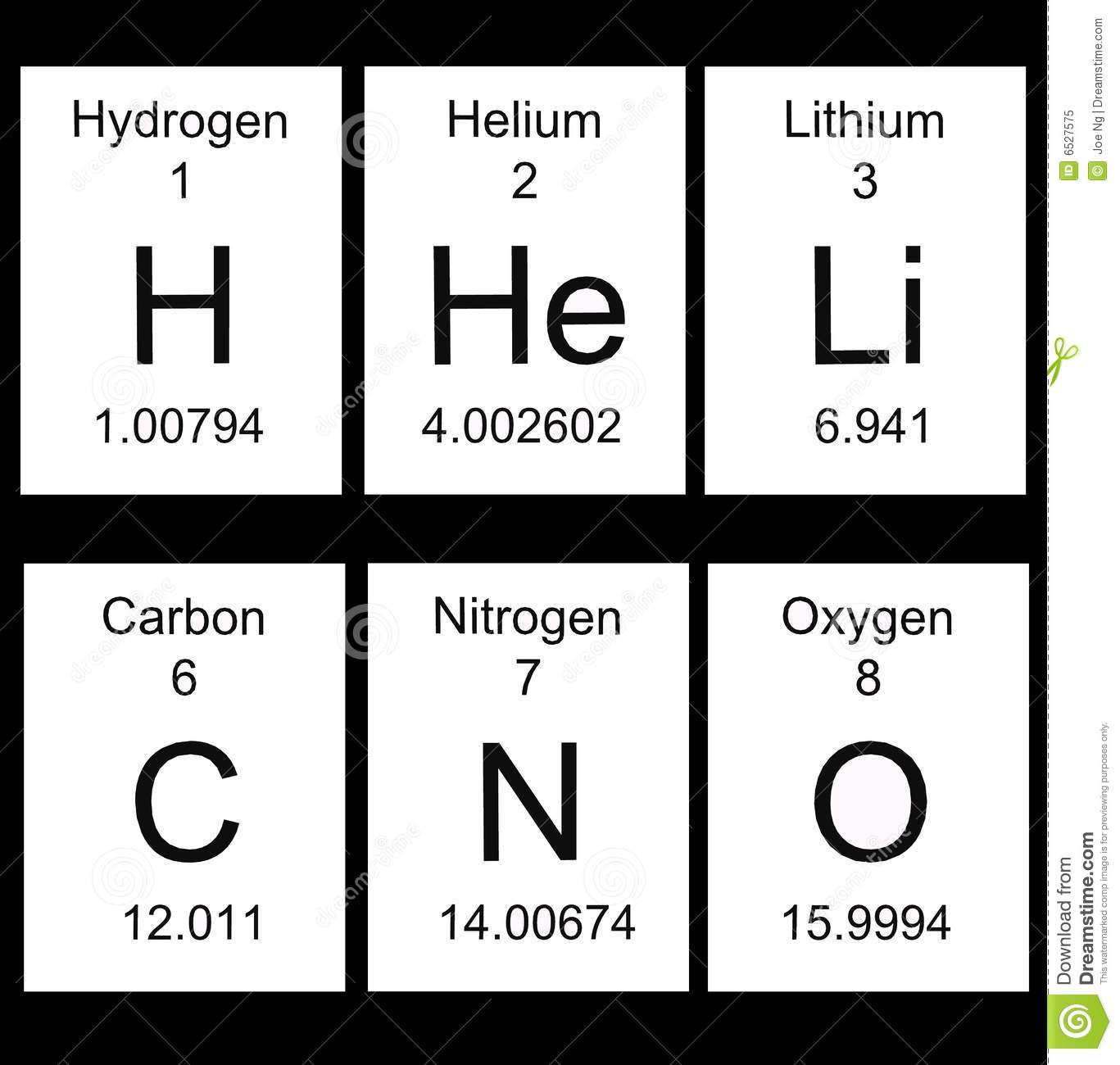
What is the chemical symbol for Lithium?
a)
H
b)
He
c)
Li
d)
N
37.
Covalent bond forms between....
a)
Nonmetals
b)
Metals
c)
Nonmetal and a Metal
d)
Metal and a Nonmetal
38.
Ionic bonds can be formed between two nonmetals.
a)
True
b)
False
39.
All chemical bonds involve two atoms sharing electrons.
a)
True
b)
False
40.
How many electrons are shared in a triple bond?
a)
6
b)
3
c)
6 pairs
d)
5
41.
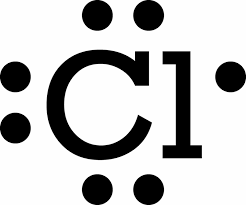
How many valence electrons in this structure?
a)
6
b)
5
c)
4
d)
7
42.
Ionic Bonding involves...
a)
The transfer of protons
b)
The transfer of nuetrons
c)
The transfer of electrons
d)
None Of the above
43.
Metallic bonds explain why the metals are good conductors of electricity.
a)
True
b)
False
44.
Metallic bonds form between metals and nonmetals.
a)
True
b)
False
45.
In a ___________change, a substance changes into a different substance.
a)
Physical
b)
Chemical
46.
In a chemical reaction, bonds are broken and new bonds are formed that create new substances. The bonds that are broken are called what?
a)
Reactants
b)
Products
c)
Atoms
d)
Catalysts
47.
The Law of Conservation of Mass states
a)
that matter exists in all states and reacts the same
b)
that matter can only be changed into new substances by introducing a catalyst
c)
that matter exists in the same state throughout any chemical change
d)
that matter cannot be created or destroyed and that the mass of the products must equal the mass of the reactants
48.
The Law of Conservation of Mass states
a)
that matter exists in all states and reacts the same
b)
that matter can only be changed into new substances by introducing a catalyst
c)
that matter exists in the same state throughout any chemical change
d)
that matter cannot be created or destroyed and that the mass of the products must equal the mass of the reactants
49.
How many F atoms are in this compound?
6MgF2
6MgF2
a)
2
b)
6
c)
8
d)
12
50.
___________________ are the elements are compounds that leave (are formed in) a chemical
reaction.
reaction.
a)
Polymers
b)
Bonds
c)
Reactants
d)
Products
51.
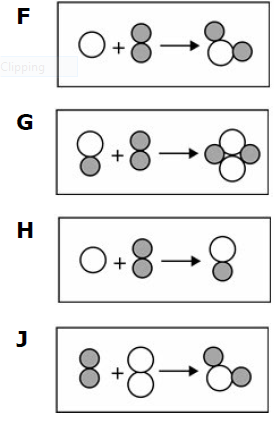
Which of the following models best demonstrates a balanced chemical equation?
a)
F
b)
G
c)
H
d)
J
52.

All of the following reactions are correctly balanced except-
a)
A
b)
B
c)
C
d)
D
53.
In the equation, 2Mg + O2 ---> 2MgO, which are the reactants?
a)
Mg and O
b)
MgO
c)
Mg and MgO
d)
O and MgO
54.
In a chemical reaction, everything to the rightof the arrow is called ______________.
a)
Products
b)
Yields
c)
Molecules
d)
Reactants
55.

The blue numbers in the image below represent ________
a)
I don't know, and don't want to try
b)
coefficients
c)
subscripts
d)
none of the answers are correct
56.

The red numbers in the image below represent ________
a)
subscripts
b)
coefficients
c)
I don't know, and don't want to try
d)
None of the answers are correct
57.
Name this reaction, Cl2 + 2KI --> I2 + 2KCl
a)
Synthesis
b)
Single Replacement
c)
Double Replacement
d)
Decomposition
58.

What type of reaction involves the breaking down of a substance into simpler substances?
a)
Single Displacement Reaction
b)
Double Displacement Reaction
c)
Synthesis Reaction
d)
Decomposition Reaction
59.

What type of reaction involves 2 substances combining to form 1 new compound?
a)
Decomposition Reaction
b)
Single Displacement Reaction
c)
Double Displacement Reaction
d)
Synthesis Reaction
60.
What type of reaction involves ions from 2 compounds exchanging places to form 2 completely new compounds?
a)
Single Displacement Reaction
b)
Double Displacement Reaction
c)
Synthesis Reaction
d)
Decomposition Reaction
61.

What do we call a substance that increases the rate of a reaction without participating in the reaction?
a)
catalyst
b)
inhibitor
c)
accelerator
d)
decelerator
62.

What type of reaction is shown in image?
a)
exothermic reaction
b)
endothermic reaction
c)
single displacement reaction
d)
double displacement reaction
63.

In an exothermic reaction energy is ...
a)
released
b)
absorbed
c)
protons
d)
electrons
64.

In an endothermic reaction energy is...
a)
released
b)
absorbed
c)
protons
d)
neutrons
65.
Which of the following will increase the rate of a reaction?
a)
raising the temperature of reactants
b)
grinding the reactants into a powder
c)
increasing the concentration of reactants
d)
all of the above
66.
This type of force is an attraction between two objects
a)
contact
b)
gravity
c)
friction
67.
This type of force resist motion between two surfaces that are pressed together
a)
contact
b)
gravity
c)
friction
68.
If the net force is equal to zero, the forces acting on the object are
a)
balanced
b)
unbalanced
69.
The unit of force is
a)
m/s
b)
m/s^2
c)
newton
d)
kg
70.
What is defined as a push or pull?
a)
force
b)
motion
c)
vector
d)
speed
71.
All objects in the universe have a gravitational attraction to each other.
a)
True
b)
False
72.

When mass increases then gravity
a)
Decreases
b)
Increases
c)
Stays the same
73.
Find the net force: 15 N to the right, and another 15 newtons to the right.
a)
0 N Right
b)
0 N Left
c)
30 N Left
d)
30 N Right
74.
If there are two forces going in the same direction how would you find the net force?
a)
Subtract
b)
Add
c)
Neither
d)
Multiply
75.
8 N to the left , and 4 N to the right. Find the net force. Is this balanced
a)
12 N Right No
b)
4 N Left No
c)
12 N Right Yes
d)
4 N Left Yes
100 %

