
NEW
Font size
S
M
L
XL
 Worksheets
Chemistry Atomic Structure
Total questions: 42
Worksheet time: 2hrs 53mins
Name
Class
Date
1.
A(n) is the smallest basic unit of matter.
a)
proton
b)
atom
c)
electron
d)
isotope
2.
Which of the following is NOT a type of subatomic particle?
a)
Neutron
b)
Electron
c)
Proton
d)
Nucleus
3.

CALCIUM
a)
C
b)
Ca
c)
Cu
d)
Cl
4.
Elements which are shiny, conduct electricity and heat are called
a)
metal
b)
nonmetal
c)
metalloid
d)
nonexistent
5.
What is something called if it is only made of one type of atom?
a)
compound
b)
element
c)
isotope
6.

SILVER
a)
Au
b)
Ag
c)
Al
d)
Ar
7.
What is the charge of a proton?
a)
positive
b)
negative
c)
neutral
d)
salty
8.
What is the charge of a neutron?
a)
positive
b)
negative
c)
neutral
d)
sweet
9.
What is the charge of an electron?
a)
positive
b)
negative
c)
neutral
d)
bitter
10.
Which TWO subatomic particles are located in the nucleus of an atom?
a)
protons & electrons
b)
protons & neutrons
c)
neutrons & electrons
d)
electrons & protoons
11.
An atom that has a different number of neutrons than it does protons.
a)
isotope
b)
element
c)
atom
d)
compound
12.
Which scientist developed the atomic theory?
a)
JJ Thomson
b)
Ernest Rutherford
c)
John Dalton
d)
James Chadwick
13.

What does this image represent
a)
Billiard Ball
b)
Solar System
c)
Plum Pudding
d)
Electron Cloud
14.
JJ Thomson's theory was nicknamed _______.
a)
Billiard Ball Theory
b)
Solar System Theory
c)
Electron Cloud
d)
Plum Pudding
15.

The Gold Foil experiment was done by __________.
a)
Chadwick
b)
Bohr
c)
Rutherford
d)
Thomson
16.
What scientist first developed 4 rules for atomic theory, and helped kick start modern chemistry?
a)
Thomson
b)
Rutherford
c)
Dalton
d)
Democritus
17.
Who was the first person to study atomic theory?
a)
Dalton
b)
Democritus
c)
Chadwick
d)
Miller
18.
True or False? John Dalton believed that moving electrons exist in electron clouds around the nucleus.
a)
False
b)
True
19.
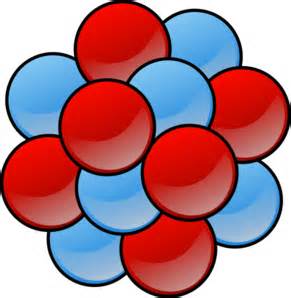
What does the nucleus of an atom contain?
a)
Electrons and neutrons
b)
Protons and neutrons
c)
Neutrinos and positrons
d)
DNA and RN
20.
In the modern periodic table elements are arranged by:
a)
atomic mass
b)
atomic number
c)
valence electrons
d)
number of isotopes
21.
What does the Bohr model suggest?
a)
Atoms are small, hard, indivisible objects.
b)
That protons in the nucleus are attracted to electrons in the electron clouds.
c)
That electrons travel around the nucleus of an atom in orbits or definite paths.
22.

The atoms along the staircase are called
a)
metals
b)
nonmetals
c)
metalloids
d)
noble gases
23.

The blue atoms are called
a)
metals
b)
nonmetals
c)
metalloids
d)
noble gases
24.

What does the 1.00794 stand for?
a)
Hydrogen
b)
atomic number
c)
atomic mass
d)
atomic explosion
25.
The atomic number tells you what?
a)
number of electrons
b)
number of protons
c)
number of neutrons
d)
both electrons and protons in an atom.
26.
If a material can easily be drawn into the shape of a wire, it is
a)
Ductile
b)
Magnetic
c)
Malleable
d)
Reactive
27.
Which element is not in the Alkali metal family?
a)
Li
b)
H
c)
Fr
d)
Cs
28.
How many Valance electrons does Iodine Have?
a)
6
b)
16
c)
7
d)
17
29.
Which element on the periodic table has a total of 16 protons?
a)
germanium (Ge)
b)
phosphorus (P)
c)
oxygen (O)
d)
sulfur (S)
30.
Which statement BEST describes the Bohr model of the atom?
a)
Electrons are arranged in energy clouds.
b)
Electrons have properties similar to waves.
c)
Electrons orbit around the nucleus in set paths.
d)
Electrons make up most of the mass of an atom.
31.
Isotopes of an element have different numbers of
a)
protons.
b)
neutrons.
c)
electrons.
d)
positrons.
32.
Early in the history of the periodic table, a scientist observed the relationships between element characteristics and atomic mass. The scientist used this information to predict the existence of unknown elements with specific atomic masses and characteristics. How was this information applied by modern scientists?
a)
Scientists wer able to predict the properties of new elements.
b)
Scientists were able to change the atomic makeup of elements.
c)
Scientists were able to make computer parts because of the unpredictable properties of silicon.
d)
Scientists were able to create new elements with unpredictable physical and chemical properties.
33.
Which of these describes how gallium forms 3+ ion?
a)
The gallium loses 3 electrons.
b)
The gallium loses 3 protons.
c)
The gallium gains 3 electrons.
d)
The gallium gains 3 protons.
34.
The approximate number of elements we know about today is .......
a)
18
b)
48
c)
118
d)
1018
35.
The correct way to write the symbol for the metal chromium is .......
a)
Ch
b)
CH
c)
Cr
d)
CR
36.
The list which best describes the properties of metals is .......
a)
strong, good conductor of heat and electricity, solid
b)
strong, poor conductor of heat and electricity, shiny
c)
weak, ductile, good conductor of heat and electricity
d)
weak, low melting point, poor conductor of heat
37.
Mg
a)
Metal
b)
Non-metal
38.

What is the atomic number of this nucleus?
a)
1
b)
3
c)
4
d)
7
39.
What is the mass number?
a)
the number of protons
b)
the number of protons and neutrons
c)
the number of neutrons
d)
the number of protons and electrons
40.
Cations are _______ that form ____________ ions and __________ electrons.
a)
nonmetals, positive, lose
b)
nonmetals, negative, gain
c)
metals, positive, gain
d)
metals, positive, lose
41.
Anions are _______ that form ____________ ions and __________ electrons.
a)
nonmetals, positive, lose
b)
nonmetals, negative, gain
c)
metals, positive, gain
d)
metals, positive, lose
42.
Will phosphorus gain or lose electrons to become stable?
a)
gain
b)
lose
c)
neither
Reset

