
 Worksheets
CHEMICAL KINETICS - Reaction Rates
Total questions: 38
Worksheet time: 24mins
Explain why all chemical reactions need activation energy.
Energy is needed for the heat of reaction.
Energy is needed to break the bonds between atoms and ions in the reactants.
Only endothermic chemical reactions require activation energy.
Forming the activated complex releases energy.
A high activation energy means the rate of the reaction will be...
fast because more particles will have the required energy needed for the reaction to occur.
slow because fewer particles will have enough energy for the reaction to occur.
fast because fewer particles will have enough energy for the reaction to occur.
slow because more particles will have the required energy needed for the reaction to occur.
In order for a chemical reaction to be fruitful, two particles must (a) with sufficient (b) and proper (c)
Why don't all collisions between particles cause a reaction?
the particles also need to collide with a catalyst
not all the particles collide with enough energy
not all the particles collide at a high enough temperature
the particles need to collide with each other twice

Which of the following is TRUE for the graph?
The amount of energy released when making bonds is more than the amount of energy absorbed to break the bonds; therefore, ΔH is negative.
The amount of energy released when making bonds is less than the amount of energy absorbed to break the bonds; therefore, ΔH is negative.
The amount of energy released when making bonds is more than the amount of energy absorbed to break the bonds; therefore, ΔH is positive.
The amount of energy released when making bonds is less than the amount of energy absorbed to break the bonds; therefore, ΔH is positive.

Calculate the change in potential energy between the reactants and the products. (a)

B represents
Potential Energy of Products
Potential Energy of Reactants
Change in Enthalpy
Activation Energy
D represents
Potential Energy of Products
Potential Energy of Reactants
Change in Enthalpy
Activation Energy
A represents
Potential Energy of Products
Potential Energy of Reactants
Change in Enthalpy
Activation Energy

Which of the following correctly identifies the reactants of the reaction?
carbon dioxide (CO2) and methane (CH4)
Oxygen gas (O2) only
Methane (CH4) and oxygen gas (O2)
Water (H2O) and carbon dioxide (CO2)
Methane (CH4) only
What is the rate of reaction?
How much energy is needed for a reaction to occur.
The energy required to break a bond.
The time it takes for a reaction to occur.
How hard particles collide with one another.
What are ways to measure the rate of the reaction? [Select all that apply]
To measure the rate of reaction, measure the disappearance of the products.
To measure the rate of reaction, measure the appearance of the products.
To measure the rate of reaction, measure the disappearance of the reactants.
To measure the rate of reaction, measure the appearance of the reactants.
The rate of the reaction increases as the frequency of (a) collisions increases.
If the reactant particles collide with less than the activation energy, the particles will be rebound, and no reaction will occur.
true
false
What factors affect the rate of a reaction?
Temperature, Concentration, Pressure and Energy
Surface Area, Concentration, humidity, catalysts, and Pressure
Temperature, Pressure, Concentration, Surface area, and catalysts
Pressure, Surface area, Density and Energy
Why do reactions occur at faster rates if the temperature is higher?
At higher temperatures, the particles are moving slower and have less energy; therefore, they are less collisions which causes the reaction to go faster.
At higher temperatures, the particles are more organized; therefore, it is easier for them to react causing the rate to be faster.
At higher temperatures, the particles are moving faster and have higher energy; therefore, there are more collisions with sufficient energy.
Which of the following correctly defines concentration?
Concentration is the measure of how reactive the particles are in a given volume (space).
Concentration is the measure of how fast the particles are moving in a given volume (space).
Concentration is the measure of the amount of particles in a given volume (space).
What are ways to increase concentration? [Select all that apply]
Decrease the number of particles and increase the volume.
Increase the number of particles while keeping the volume the same.
Keep the number of particles the same but increase the volume.
Keep the number of particles the same but decrease the volume.
How does concentration affect the reaction rate?
The lower the concentration, the faster the reaction rate.
The concentration does not affect the reaction rate.
The higher the concentration, the faster the reaction rate.
The higher the concentration, the slower the reaction rate.
The amount of a substance in a given volume.
concentration
temperature
surface area
catalyst
Some chemical reactions require a substance called a catalyst. The main purpose of a catalyst is
To warm up the reaction by being consumed in the chemical reaction.
To speed up the reaction without being consumed in the chemical reaction.
To create more reactants without being consumed in the chemical reaction.
To stop the reaction by being consumed in the chemical reaction.
How does a catalyst work in speeding up a reaction?
By lowering the activation energy or reaction
by making them more available
by giving them more energy
Which of the following is TRUE about pressure?
Pressure only affects liquids.
Pressure only affects gasses and liquids.
Pressure only affects gasses.
Pressure only affects gasses and plasma.

Which factor that affects reaction rate is represented in the image?
Temperature
Catalyst
Surface Area
Concentration

Read the graph carefully. Line B represents a chemical reaction under standard conditions. If we run the reaction again at a higher temperature, which line of data would likely be recorded?
A
B, again
C
No reaction occurs
Exposing more particles for collisions is an increase in
concentration
surface area
temperature
catalyst
Increasing the concentration increases the speed of reaction by
lowering activation energy
increasing collisions
speeding up the reactants
exposing more reactant
Which of the following slows down the rate of a chemical reaction?
Place the reactants in hot water
Place the products in ice bath
Place the reactants in a ice bath
Keep stirring the reactants with a stirring rod
If more reactants are used in a chemical reaction, more products will be produced. This is because
More reactants cause the reaction to heat up
More reactants take up the same volume
More reactants have more atoms to react to form more products
Too many products can slow down the reaction
Smaller particle size allows for a (a) surface area to be exposed for the reaction.
Which of these will NOT speed up the rate of reaction between a strip of magnesium and hydrochloric acid?
tightly coil up the strip of magnesium
cut up the strip of magnesium
increase the concentration of the hydrochloric acid
increase the temperature of the hydrochloric acid
Na2S + 2 HCl → 2NaCl + H2S
What would happen if we increased the volume of the container where the above reaction occurs?
More NaCl would be produced
Less H2S would would be produced
More reactions would occur
More HCl would be needed

In which container would you expect a higher reaction rate, and why? (Note: The number of particles is the same in both containers.)
The left would have a higher reaction rate because it has a greater volume and more collisions will happen.
The right would have a higher reaction rate because it has a greater volume and more collisions will happen.
The left would have a higher reaction rate because it has a lesser volume and more collisions will happen.
The right would have a higher reaction rate because it has a lesser volume and more collisions will happen.
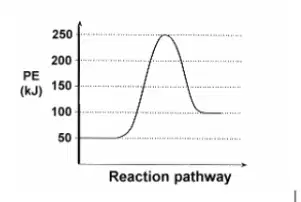
The change in enthalpy, ΔH, for the forward reaction is
+200 kJ
-50 kJ
+150 kJ
+50 kJ
The activation energy, Ea, for the reaction is
+200 kJ
-50 kJ
+150 kJ
+50 kJ

Analyze the table below and select the statement that best explains the change that occurs.
Due to an increase in temperature from trial 1 to trial 2, the rate of reaction was faster because the color change took less time
Due to an decrease in temperature from trial 1 to trial 2, the rate of reaction was faster because the color change took less time
Due to an increase in temperature from trial 1 to trial 2, the rate of reaction was faster because the color change took more time
Due to an decrease in temperature from trial 1 to trial 2, the rate of reaction was slower because the color change took more time
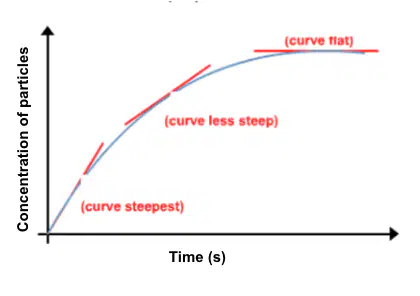
Read the graph carefully. What does a horizontal (flat line) on a reaction graph tell us?
The reaction in slowing down
The reaction is speeding up
The reactant has been used up
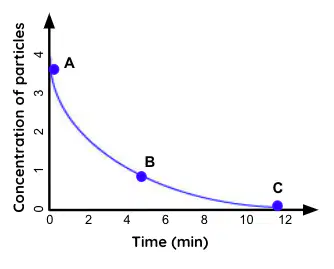
Read the graph carefully. Which of the following correctly describes the progression of the chemical reaction and the reaction rate at point B?
The reactants are decreasing in concentration as the chemical reaction progresses. The reaction is quickly producing products, therefore, the reaction rate is increasing.
The reactants are increasing in concentration as the chemical reaction progresses. The reaction has ended because all of the reactants have been used up, therefore the reaction rate is 0.
The reactants are decreasing in concentration as the chemical reaction progresses. The reaction rate is decreasing as the reactants are being used up.

