
 Worksheets
Chapter 13/14 Test Review Quizzizz
Total questions: 35
Worksheet time: 9hrs 45mins
In the spontaneous reaction between gold ions and silver metal, the reducing agent is
gold ions
silver metal
silver ions
gold metal

Electrons flow in the external circuit from B to A
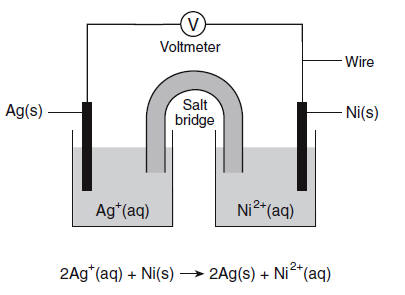
Which of the following represents oxidation?
C → CH4
Fe3+ → Fe2+
Cl2 → 2Cl-
Zn → ZnO
Which of the following half reactions correctly represents a reduction half reaction?
Fe →Fe2+ + 2e-
Pb4+ + 2e- →Pb2+
2O2- →O2 + 4e-
Fe + 3e- →Fe3+

Is it Spontaneous? Aluminum metal reacts with aluminum ions.
Spontaneous
Non Spontaneous
Is it Spontaneous? Lithium metal reacts with sodium ions.
Spontaneous
Non Spontaneous
Is it Spontaneous? Copper(II) nitrate reacts with zinc chloride.
Spontaneous
Non Spontaneous
According to this series of reactions, what is the weakest oxidizing agent?
A + B+ --> no reaction
A + C+ --> C + A+
D+ + B --> no reaction
A+
B+
C+
D+
According to this series of reactions, what is the weakest reducing agent?
A + B+ --> no reaction
A + C+ --> C + A+
D+ + B --> no reaction
A
B
C
D

Which observations would indicate the following reaction has occurred. (Select all that apply)
pH increase
pH decrease
metal erroding
gas evolving
colour change
In order for nitrate ions to take part in a redox reaction, it needs to be
heated up
at the anode
the strongest reducing agent
acidified
When sulfuric acid is mixed with sodium chloride, the SRA is ______ and the reaction will be _________.
Na(s), spontaneous
H2O, non-spontaneous
Cl-, non-spontaneous
H2O, spontaneous
How much of a 0.100 mol/L solution of potassium permanganate would need to be titrated in order to reach the endpoint when reacting with a 10.0 mL sample of acidified chromium(II) nitrate with a concentration of 0.750 mol/L
75 mL
0.15 mL
15 mL
375 mL
NO3- + H+ + Al(s) --> Al3+ + N2O4 + H2O
When the above chemical equation is balanced, the whole number ratio of the reactants will be
6, 12, 2
2, 4, 1
2, 4, 3
3, 6, 1
You want to plate a silver necklace in 1.00 g of gold. You are using 1.50 A. How long will this take you?
1.81 minutes
16.3 minutes
29.8 minutes
36.7 minutes
Do the following happen at the anode or cathode?
oxidation
reduction
loss of mass
increase in mass
SRA found here
SOA found here
negative ions move here
electrons move here
can be inert electrode
can be sacrificial
Do the following apply to Voltaic Cells, Electrolytic cells, or both.
chemical --> electrical
electrical --> chemical
spontaneous reactions
non-spontaneous
positive cell potential
negative cell potential
e- move anode --> cathode
anode is negative
cathode is negative
reduction at the cathode
needs porous barrier
redox reactions
PbCl2 + 2 CuO --> 2 CuCl + PbO2
Redox reaction or not?
Redox
Non-redox
PbCl2 + 2 CuO --> 2 CuCl + PbO2
Which substance acts as the oxidizing agent?
PbCl2
CuO
CuCl
PbO2
By convention, what is the reference half reaction?
2 H+ + 2e- ⇌ H2(g)
F2(g) + 2 e– ⇌ 2 F–(aq)
Li+(aq) + e– ⇌ Li(s)
25oC and 101 kPa
What would be the reduction potential of
Cr2+(aq) + 2 e– ⇌ Cr(s)
if the new reference half reaction was
Fe2+(aq) + 2 e– ⇌ Fe(s)
-0.46V
+ 0.46 V
-1.36 V
+ 1.36V
What would be the reduction potential of
Cr2+(aq) + 2 e– ⇌ Cr(s)
if the new reference half reaction was
Cu2+(aq) + 2 e– ⇌ Cu(s)
-0.57V
+ 0.57 V
-1.25 V
+ 1.25V
In order for water to be both oxidized and reduced in an electrolytic cell, what minimum voltage would need to be applied?
0.00 V
2.06 V
0.40 V
2.46 V
What minimum voltage would need to be applied for the electrolysis if CuBr2?
0.73 V
1.41 V
0.34 V
1.07 V
A student attempted to identify an unknown electrode metal using electrochemical cells. She first places the metal in CuCl2 solution and it did not spontaneously react. She then hooked it up to the positive terminal of a voltmeter with a carbon electron on the negative terminal. She found she had to apply about 0.46 V to get the reaction to occur. What is a possible identity of the metal?
silver
lead
mercury
gold
Why is magnesium metal a good candidate for a sacrificial anode?
because it won't react spontaneously with water
because it is a stronger OA than the metal it protects
because it can be found abundantly in nature
because it is a stronger RA than the metal it protects
What metal would be a good candidate for a sacrificial anode on a ship made of iron?
sodium
nickle
zinc
aluminum
In order to plate a belt buckle in silver, the buckle should be attached at the
anode
cathode
In order to purify a metal, the impure metal should be placed at the ______ and a _____ voltage should be used.
anode, low
anode, high
cathode, low
cathode, high
What amount of electrons is passing through your phone when you charge it for 1 hour on a 15 A charger?
0.56 mol
2.5x10⁻³ mol
1.8 mol
9.3x10⁻³ mol
You recharge a lithium battery with 30 A of current for 2.5 hours. What mass of lithium ions will become solid lithium?
0.065 g
1.94 g
0.18g
0.23 g

