wayground logo

Free Printable Worksheets

NEW

Font size

S
M
L
XL
Worksheets

Phase Diagram, Entropy, Enthalpy Review

Total questions: 36

Worksheet time: 20mins

Name
Class
Date
1.
What state of matter is X?
a)
solid 
b)
liquid
c)
gas
d)
supercritical fluid
2.
What is point A?
a)
triple point
b)
critical point
c)
equilibrium point
d)
normal melting point
3.
What state of matter is Y?
a)
solid 
b)
liquid
c)
gas
d)
supercritical fluid
4.
What state of matter is Z?
a)
solid 
b)
liquid
c)
gas
d)
supercritical fluid
5.
What is point B?
a)
triple point
b)
critical point
c)
equilibrium point
d)
normal melting point
6.

What phase change occurs at letter F?

a)

Melting

b)

Freezing

c)

Vaporization

d)

Sublimation

7.

What phase change occurs at letter B?

a)

Deposition

b)

Melting

c)

Freezing

d)

Condensation

8.

What phase change occurs at letter C?

a)

Vaporization

b)

Sublimation

c)

Melting

d)

Condensation

9.

What phase change occurs at letter E?

a)

Freezing

b)

Deposition

c)

Condensation

d)

Melting

10.

What phase change occurs at letter A?

a)

Freezing

b)

Condensation

c)

Melting

d)

Deposition

11.

Bonus Question: What change occurs from D to C?

a)

condensation

b)

vaporization

c)

melting

d)

sublimation

12.
ΔH value in an endothermic reaction is a positive number.
a)
True
b)
False
13.

How do you calculate the Heat of Reaction?

a)

ΔH = ΔHproducts - ΔHreactants

b)

ΔT = q / mC

c)

q=mCΔT

d)

ΔH = ΔHreactants- ΔHproducts

14.

Which of the following has a ΔHfo value of 0?

a)

Br2(g)

b)

N(g)

c)

CO(g)

d)

Ne(g)

15.
ΔH value in an endothermic reaction is a positive number.
a)
True
b)
False
16.

ΔHrxn

a)

symbol for enthalpy of reaction

b)

symbol for enthalpy

c)

exothermic reaction

d)

difference in altitude

17.

exothermic reaction

a)

A + B \rightarrow AB + 25 kJ

b)

AB + 25 kJ \rightarrow A + B

c)

A + B \rightarrow AB

d)

AX + B \rightarrow A + BX

18.

endothermic reaction

a)

2NO2 --> N2O4

ΔH = -57.6 kJ

b)

N2 + O2 --> 2NO

ΔH = +181 kJ

19.
In an exothermic reaction, heat is ...
a)
taken in or absorbed
b)
given out or released
20.
In an endothermic reaction, heat is ...
a)
taken in or absorbed
b)
given out or released 
21.

Identify whether the following result in an increase or decrease in entropy:


Gas --> Liquid --> solid

a)

increase

b)

decrease

22.

Which phase change represents a decrease in entropy?

a)

solid to liquid

b)

gas to liquid

c)

liquid to gas

d)

solid to gas

23.

What phase of matter has the most entropy?

a)

solid

b)

liquid

c)

gas

24.
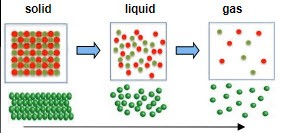
Entropy increases from solid, liquid to gas. Why?
a)
Molecular disorder increases
b)
Molecular randomness decreases
c)
Molecules are more energetic
d)
Molecules are more reactive
25.

Entropy of a system increases when a reaction increases the number of particles.

a)

True

b)

False

26.

5. What is it called when a solid turns directly into a gas?

a)

Sublimation

b)

Condensation

c)

Liquid

d)

Deposition

27.
Change from Gas to Solid is called........
a)
Sublimation
b)
Deposition
c)
Fusion
d)
condensation
28.
Change from gas to liquid...
a)
condensation
b)
evaporation
c)
expansion
d)
movement
29.
Change from Liquid to Solid is call......
a)
fusion
b)
Freezing
c)
sublimation
d)
evaporation
30.
change from liquid to gas is called....
a)
expansion
b)
evaporation
c)
condensation
d)
sublimation
31.
Melting is ...
a)
liquid to solid
b)
solid to liquid
c)
solid to gas
d)
gas to liquid
32.
Boiling is ...
a)
liquid to gas
b)
gas to solid
c)
gas to liquid
d)
solid to liquid
33.

Boiling is a _______ process.

a)

Endothermic

b)

Exothermic

34.

Freezing is a _______ process.

a)

Endothermic

b)

Exothermic

35.

Sublimation is a _______ process.

a)

Endothermic

b)

Exothermic

36.

Condensation is a _______ process.

a)

Endothermic

b)

Exothermic