
 Worksheets
UCEA Particle Model
Total questions: 32
Worksheet time: 19mins
Name
Class
Date
1.
Can Solids be compressed?
a)
No
b)
Yes
c)
Sometimes (it depends what it's made of)
d)
Generally no
2.
Which of the following is a property of a liquid
a)
Can't be compressed
b)
Can be compressed
c)
Particles are far appart
d)
Particles hold the object's shape
3.

How do gases behave in a container?
a)
Cluster together
b)
form a solid
c)
They take the shape of their container
d)
leak out
4.
Which states allow easy flow of particles
a)
Gas and Solid
b)
Gas and Liquid
c)
Solid and Liquid
d)
Gas only
5.
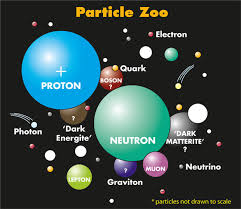
How do materials change from one state of matter to another?
a)
They gain or lose energy
b)
They break appart
c)
The particles get stickyer
d)
They are magnetised to themselves
6.
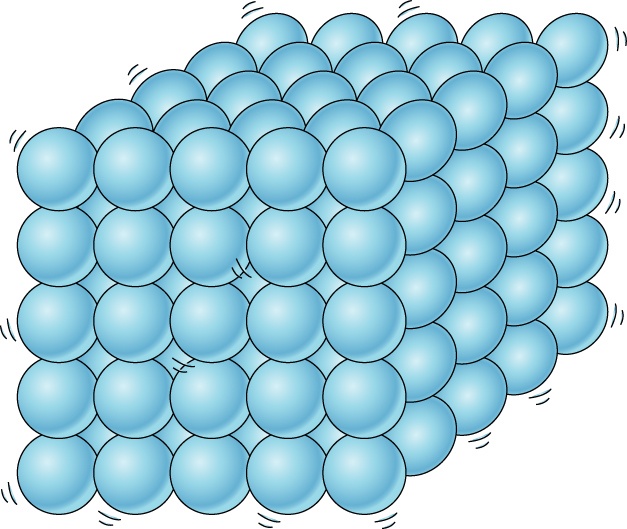
Which description best matches this particle model?
a)
Closely packed and can't move a lot.
b)
Particles are close together but can move a little.
c)
Particles have lots of energy and can move around.
7.
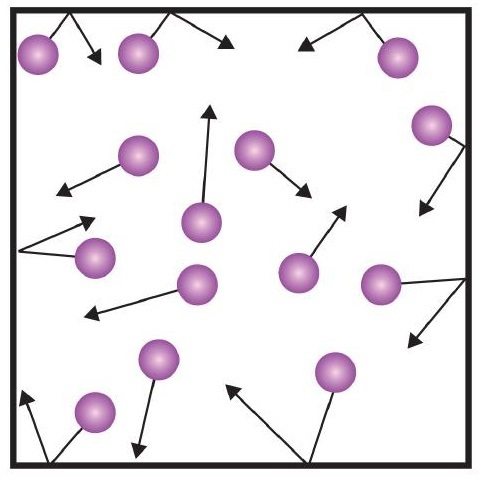
Which description best matches this particle model?
a)
Closely packed and can't move a lot.
b)
Particles are close together but can move a little.
c)
Particles have lots of energy and can move around.
8.
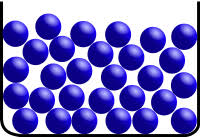
Which description best matches this particle model?
a)
Closely packed and can't move a lot.
b)
Particles are close together but can move a little.
c)
Particles have lots of energy and can move around.
9.
Which state of matter can be compressed?
a)
Solid
b)
Liquid
c)
Gas
10.

What change of state does this image show?
a)
Freezing
b)
Evaporation
c)
Condensation
11.

What change of state does this image show?
a)
Freezing
b)
Evaporation
c)
Condensation
12.

What change of state does this image show?
a)
Freezing
b)
Evaporation
c)
Condensation
13.

Which of the following occurs when a liquid becomes a gas?
a)
the particles slow down
b)
the particles beak away from one another
c)
the particles move closer together
14.

How will the pressure of the gas change from the first to second image
a)
pressure will go up
b)
pressure will go down
c)
pressure will not change
d)
cannot be determined
15.

A gas
a)
has a definite shape but no definite volume
b)
has a definite volume but no definite shape
c)
has fast-moving particles
16.
The mass after a physical change in a closed system, such as ice melting into water, stays the same
a)
True
b)
False
17.
Which description best matches this particle model?
a)
Particles are closely packed, vibrate fixed position, strong intermolecular forces.
b)
Particles are closely packed, no movement, strong intermolecular forces
c)
Particles are closely packed, move around each other, medium intermolecular forces
18.
Which description best matches this particle model?
a)
Particles are closely packed, randomove around each other, strong/medium intermolecular forces
b)
Particles are loosely packed, move around each other, strong/medium intermolecular forces
c)
Particles are closely packed, move randomly around each other and have weak intermolecular forces.
19.
Which description best matches this particle model?
a)
Particles move fast in specific directions, weak intermolecular force
b)
Particles have a lot of space between them and move fast in random directions.
c)
Particles have lots of energy and have a medium intermolecular forces between them.
20.

Which box has a higher density?
a)
Box A
b)
Box B
c)
cannot be determined
d)
they are the same
21.
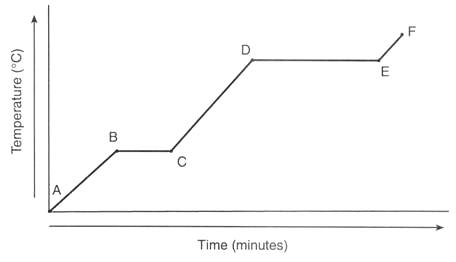
Between which points is the substance changing state?
a)
A-B only.
b)
A-B, C-D, E-F
c)
B-C only.
d)
B-C, D-E
22.

How do the particles of matter move as the matter changes state in the diagram?
a)
The particles released energy and move as matter changed state?
b)
The particles released energy and moved more quickly.
c)
The particles gained energy and moved more slowly.
d)
The particles gained energy and moved more quickly.
23.

A piece of chocolate is left in a hot car. Based on the diagram. What phase change is occurring?
a)
boiling
b)
melting
c)
condensing
d)
freezing
24.

The diagram shows the change of state of water. What process is represented by Y?
a)
Melting
b)
Freezing
c)
Condensation
d)
Evaporation
25.
What happens when my glass of water is sitting in the sun and disappears into a gas?
a)
evaporation
b)
burning
c)
melting
d)
freezing
26.
Freezing
a)
Solid to gas
b)
Liquid to solid
c)
Gas to solid
d)
Liquid to gas
27.
My glass of ice water has droplets of water on the outside of the glass. What is it called when gas turns into a liquid?
a)
condensation
b)
evaporation
c)
melting
d)
freezing
28.
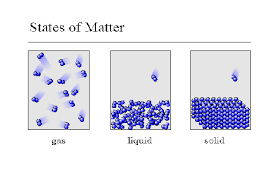
At higher temperatures
a)
particles in an object have less energy
b)
particles in an object move faster
c)
a gas contracts
29.
When the temperature of matter decreases the particles ...
a)
speed up and move farther apart
b)
speed up and move closer together
c)
slow down and move farther apart
d)
slow down and move closer together
30.

The steam coming off the pot of boiling water is an example of....
a)
a solid becoming a liquid
b)
a liquid becoming a solid
c)
a liquid becoming a gas
d)
a gas becoming a liquid
31.
The slower the particles in a substance move,
a)
the colder it is.
b)
the warmer it is.
c)
the more energy it has.
d)
the less energy it has.
32.
True or False: Matter can changes states by adding heat or cooling.
a)
True
b)
False
100 %

