
 Worksheets
Forces and Motion Class Review
Total questions: 101
Worksheet time: 1hrs 14mins
Name
Class
Date
1.
The Law of Inertia
a)
Newton's
1st
Law of Motion
1st
Law of Motion
b)
Newton's
2nd
Law of Motion
2nd
Law of Motion
c)
Newton's
3rd
Law of Motion
3rd
Law of Motion
2.
F=ma
a)
Newton's
1st
Law of Motion
1st
Law of Motion
b)
Newton's
2nd
Law of Motion
2nd
Law of Motion
c)
Newton's
3rd
Law of Motion
3rd
Law of Motion
3.
For every action, there is an equal and opposite reaction.
a)
Newton's
1st
Law of Motion
1st
Law of Motion
b)
Newton's
2nd
Law of Motion
2nd
Law of Motion
c)
Newton's
3rd
Law of Motion
3rd
Law of Motion
4.
An automobile you are riding in suddenly stops, but you continue to go forward.
a)
Newton's
1st
Law of Motion
1st
Law of Motion
b)
Newton's
2nd
Law of Motion
2nd
Law of Motion
c)
Newton's
3rd
Law of Motion
3rd
Law of Motion
5.
When the force on a car is doubled, the acceleration is doubled.
a)
Newton's
1st
Law of Motion
1st
Law of Motion
b)
Newton's
2nd
Law of Motion
2nd
Law of Motion
c)
Newton's
3rd
Law of Motion
3rd
Law of Motion
6.
A stationary bumper car is set in motion by the outside force of another bumper car colliding with it.
a)
Newton's
1st
Law of Motion
1st
Law of Motion
b)
Newton's
2nd
Law of Motion
2nd
Law of Motion
c)
Newton's
3rd
Law of Motion
3rd
Law of Motion
7.
A rocket in outer space continues to move.
a)
Newton's
1st
Law of Motion
1st
Law of Motion
b)
Newton's
2nd
Law of Motion
2nd
Law of Motion
c)
Newton's
3rd
Law of Motion
3rd
Law of Motion
8.
A magician pulls a table cloth from under a table of dishes.
a)
Newton's
1st
Law of Motion
1st
Law of Motion
b)
Newton's
2nd
Law of Motion
2nd
Law of Motion
c)
Newton's
3rd
Law of Motion
3rd
Law of Motion
9.
A skater pushes another skater forward, but the one pushing moves backwards.
a)
Newton's
1st
Law of Motion
1st
Law of Motion
b)
Newton's
2nd
Law of Motion
2nd
Law of Motion
c)
Newton's
3rd
Law of Motion
3rd
Law of Motion
10.
The harder you hit a baseball, the faster it accelerates.
a)
Newton's
1st
Law of Motion
1st
Law of Motion
b)
Newton's
2nd
Law of Motion
2nd
Law of Motion
c)
Newton's
3rd
Law of Motion
3rd
Law of Motion
11.
You push against a wall and the wall is pushing back on you.
a)
Newton's
1st
Law of Motion
1st
Law of Motion
b)
Newton's
2nd
Law of Motion
2nd
Law of Motion
c)
Newton's
3rd
Law of Motion
3rd
Law of Motion
12.
The acceleration of a 4 kg bowling ball will be greater than the acceleration of a 6 kg bowling ball if the same force is applied to both.
a)
Newton's
1st
Law of Motion
1st
Law of Motion
b)
Newton's
2nd
Law of Motion
2nd
Law of Motion
c)
Newton's
3rd
Law of Motion
3rd
Law of Motion
13.
As the fuel in a rocket ignites, the force of gas expansion and explosion pushes out the back of the rocket and pushes the rocket forward.
a)
Newton's
1st
Law of Motion
1st
Law of Motion
b)
Newton's
2nd
Law of Motion
2nd
Law of Motion
c)
Newton's
3rd
Law of Motion
3rd
Law of Motion
14.
You step from a boat to a dock. The boat moves backwards as you move forwards and you fall in the water.
a)
Newton's
1st
Law of Motion
1st
Law of Motion
b)
Newton's
2nd
Law of Motion
2nd
Law of Motion
c)
Newton's
3rd
Law of Motion
3rd
Law of Motion
15.
You push against the floor when you walk and the floor pushes back on you.
a)
Newton's
1st
Law of Motion
1st
Law of Motion
b)
Newton's
2nd
Law of Motion
2nd
Law of Motion
c)
Newton's
3rd
Law of Motion
3rd
Law of Motion
16.
You are carrying a lunch tray when you bump into the edge of a table. Although the tray did not tip, your milk falls off of the front of the tray.
a)
Newton's
1st
Law of Motion
1st
Law of Motion
b)
Newton's
2nd
Law of Motion
2nd
Law of Motion
c)
Newton's
3rd
Law of Motion
3rd
Law of Motion
17.
You slide towards the window when a car makes a sudden turn.
a)
Newton's
1st
Law of Motion
1st
Law of Motion
b)
Newton's
2nd
Law of Motion
2nd
Law of Motion
c)
Newton's
3rd
Law of Motion
3rd
Law of Motion
18.
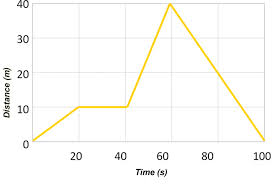
How long did it take this object to travel 10 m?
a)
0 s
b)
10 s
c)
15 s
d)
20 s
19.

How long did it take this object to travel back to its reference/starting point?
a)
20 s
b)
30 s
c)
60 s
d)
100 s
20.

At 60 seconds, how far had this object traveled?
a)
0 m
b)
10 m
c)
20 m
d)
40 m
21.
A football is thrown and travels 50 feet in 5 seconds. What is its velocity?
a)
55 ft/s
b)
50 ft/s
c)
5 ft/s
d)
10 ft/s
22.
If you travel 10 miles in 5 minutes, what is your speed?
a)
10 mi/min
b)
15 mi/min
c)
50 mi/min
d)
2 mi/min
23.

How many times does this object STOP moving?
a)
None
b)
Once
c)
Twice
d)
Three times
24.

What is this graph showing?
a)
Constant Speed
b)
Acceleration (speeding up)
c)
Deceleration (slowing down)
d)
No motion
25.

What is this graph showing?
a)
Constant Speed
b)
Acceleration (speeding up)
c)
Deceleration (slowing down)
d)
No motion
26.

What is this graph showing?
a)
Constant Speed
b)
Acceleration (speeding up)
c)
Deceleration (slowing down)
d)
No motion
27.
If you run around the football field (which is 2 miles) 3 times, what is your distance?
a)
0 miles
b)
3 miles
c)
6 miles
d)
9 miles
28.

Which runner had a head start?
a)
A
b)
B
c)
C
29.

At what time did runner A pass runner B?
a)
0 seconds
b)
1 second
c)
2 seconds
d)
3 seconds
30.
What is the speed of an object that travels 60 meters in 4 seconds?
a)
240 m/s
b)
15 m/s
c)
0.067 m/s
d)
15 mph
31.

Marta rides her bike 10 miles in 5 hours. Joel rides his bike 11 miles in 5 hours. Avery rides her bike 15 miles in 5 hours. Which child rides her bike faster?
a)
Marta
b)
Avery
c)
Joel
32.

What is happening at C?
a)
Stationary
b)
Accelerating
c)
Fast steady speed; moving away from the starting position
d)
Slower steady speed; moving away from the starting position
33.

What is happening at D?
a)
Stationary
b)
Accelerating
c)
Fast steady speed; moving away from the starting position
d)
Slower steady speed; moving away from the starting position
34.

What is the net force?
a)
40 N left
b)
0 N Balalnced
c)
400 N right
d)
40 N right
35.
The tendency of an object at rest to stay at rest unless it is acted upon by a force is called ___________________
a)
inertia
b)
motion
c)
gravity
d)
lubricant
36.

A wheeled cart is moving to the right at a constant speed. Two forces of equal magnitude are acting upon the cart. Which of the following best describes the forces and motion of the cart?
a)
Balanced Forces, Constant Speed
b)
Balanced Forces, Acceleration
c)
Unbalanced Forces, Constant Speed
d)
Unbalanced Forces, Acceleration
37.
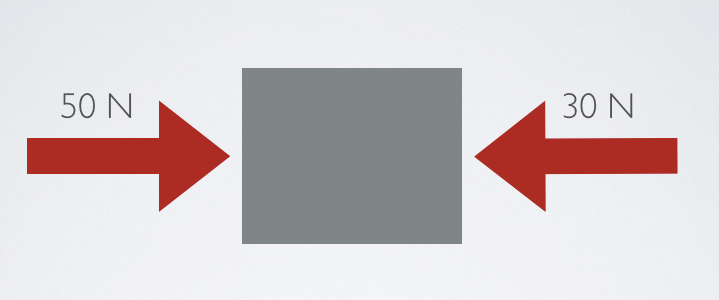
How will this object move?
a)
It won't move.
b)
It will move to the right.
c)
It will move to the left.
d)
It will move up.
38.

How will this object move?
a)
It won't move.
b)
It will move to the right.
c)
It will move to the left.
d)
It will move in both directions.
39.

What is the net force?
a)
30 N left
b)
25 N right
c)
5 N left
d)
55 N right
40.
Which could be an example of a balanced force?
a)
An asteroid moving at a constant speed through space
b)
A car accelerating from a stop sign
c)
A box of dishes falling from a counter
d)
A rocket taking off
41.
Which could be an example of an unbalanced force?
a)
A plate sitting on a dining table
b)
A ball at the top of a hill that is not moving
c)
Earth orbiting the Sun
d)
A baseball that has been thrown to home plate.
42.
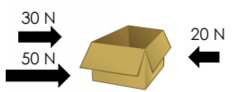
Calculate the Net Force.
a)
60N, Left
b)
40N, Right
c)
0N
d)
60N, Right
43.

Calculate the Net Force.
a)
40N, Left
b)
40N, Right
c)
0N, Balanced
d)
75N, Right
44.
You and your dad are moving the couch from one side to another. Your dad pushes with a force of 35 N to the right and you push with a force of 25 N right. What is the net force on the couch?
a)
60 N right
b)
10 N left
c)
60 n right
d)
50 N left
45.

What is the net force?
a)
10 N
b)
0 N
c)
25 N
d)
1 N
46.
The sum of all forces acting on an object.
a)
Contact Force
b)
Balanced Force
c)
Unbalanced Force
d)
Net Force
47.
What will cause an object to move?
a)
Applied forces
b)
Balanced forces
c)
Unbalanced forces
48.

Balanced or Unbalanced?
a)
Balanced
b)
Unbalanced
49.

This is an example of what kind of force?
a)
Balanced Force
b)
Pushing Force
c)
Gravity Force
d)
Unbalanced Force
50.

If an object is not moving the forces acting upon it are _____________
a)
unbalanced
b)
weak
c)
balanced
d)
Hulk Smash!
51.
A push or pull that causes a change in motion
a)
Friction
b)
Gravity
c)
Force
d)
Mass
52.
The force that pulls objects towards Earth.
a)
Gravity
b)
Friction
c)
Inertia
d)
Force
53.
Examples of forces that make something move are...
a)
pushes
b)
pulls
c)
both pushes and pulls
54.

What is the net force?
a)
400 N Up
b)
400 N Down
c)
- 400 N Down
d)
800 N Down
55.
What is the unit of force?
a)
Kilogram
b)
Meter
c)
Pascal
d)
Newton
56.
Why does a book on a table not move?
a)
No forces are acting on the book
b)
Gravity is the only force acting on the book
c)
Forces of the table pushing up and gravity pulling down are balanced
57.

What is the net force?
a)
5000 N right
b)
4000 N right
c)
40 N left
d)
4000 N left
58.

Determine the forces and motion of the car.
a)
Balanced Forces, Constant Speed
b)
Balanced Forces, Acceleration
c)
Unbalanced Forces, Constant Speed
d)
Unbalanced Forces, Acceleration
59.

Based on the chart provided, which statement is true about the motion of the car down the ramp.
a)
The force against the car remains the same for each material.
b)
The force against the car changes based on the material.
c)
The force pulling the car down the ramp changes based on the material.
d)
The force pulling the car down the ramp increases for each material.
60.

What force causes the acceleration at Section 4?
a)
Force of Gravity Increases the Speed
b)
Force of Gravity Decreases the Speed
c)
Force of Friction Increase the speed
d)
Force of Wind resistance Increases the Speed
61.

In a tug of war the left team pulls with a force of 200N. The right team pulls with a force of 150N.What is the resultant force?
a)
50N to the left.
b)
350N to the left.
c)
350N to the right.
d)
50N to the right.
62.

Which force is so low that it causes the man to slip and fall?
a)
Gravity
b)
Friction
c)
Air Resistance
d)
Motion
63.

If these boys are pulling with the same amount of force. What will happen?
a)
The boy in blue will win.
b)
They will not move at all.
c)
The boy in red will win.
d)
Both will fall down.
64.
Which law explains why when you put a book on a table the table pushes on the book
a)
3rd law
b)
4th law
c)
1st law
d)
2nd law
65.
If a 10 kilogram object accelerates suddenly at 15 m/s2, how much force was applied to the object?
a)
150 Newtons
b)
15 Newtons
c)
150 kilograms
d)
100 kilograms
66.

Why is the net force 0 in the image?
a)
Because the elephants are the same size
b)
Because they are both pulling the same amount of force in opposite directions
c)
Because they are elephants
d)
Because they are pulling away from each other.
67.
What is the speed of an object that travels 20 meters in 4 seconds?
a)
80 m/s
b)
0.2 m/s
c)
5 m/s
d)
24 m/s
68.
Newton's 1st law is often called the _______.
a)
Newton's 2nd law
b)
action-reaction law
c)
law of equality
d)
law of inertia
69.
An object and rest will stay at rest and an object in motion will stay in straight line motion unless acted on by a force, is which one of Newton's Laws of Motion?
a)
4th Law of Motion
b)
1st Law of Motion
c)
3rd Law of Motion
d)
2nd Law of Motion
70.
Which law explains when a magician pulls a tablecloth out from under dishes and glasses on a table without disturbing them.
a)
Law 1
b)
Law 3
71.

A person steps out of the boat and onto the dock. As the person moves forward onto the dock, the boat moves backward. Which statement best describes the backward motion of the boat as the person steps forward?
a)
For every action there is an equal and opposite reaction.
b)
Every mass exerts a force on every other mass.
c)
An object at rest tends to stay at rest.
d)
Friction opposes the motion of an object.
72.

Speed in a direction is called
a)
Momentum
b)
Velocity
c)
Speed
d)
Inertia
73.

a)
Newton's 1st Law
b)
Newton's 2nd Law
c)
Newton's 3rd Law
74.

a)
Newton's 1st Law
b)
Newton's 2nd Law
c)
Newton's 3rd Law
75.

a)
an object's resistance to change in motion - Newton's 1st Law
b)
objects with more mass accelerate faster - Newton's 2nd Law
c)
all forces are always balanced - Newton's 3rd Law
d)
Friction is a lie! Newton's 4th law
76.

a)
Newton's 1st Law
b)
Newton's 2nd Law
c)
Newton's 3rd Law
77.

a)
force is equal to the product of an object's mass and acceleration.
b)
For every action there is an equal and opposite reaction.
c)
An object at rest or in motion will stay that way unless acted on by an unbalanced force
78.

a)
Newton's 1st Law
b)
Newton's 2nd Law
c)
Newton's 3rd Law
79.

a)
Newton's 1st Law
b)
Newton's 2nd Law
c)
Newton's 3rd Law
80.

a)
Newton's 1st Law
b)
Newton's 2nd Law
c)
Newton's 3rd Law
81.

a)
Newton's 1st Law
b)
Newton's 2nd Law
c)
Newton's 3rd Law
82.

a)
Newton's 1st Law
b)
Newton's 2nd Law
c)
Newton's 3rd Law
83.

a)
Newton's 1st Law
b)
Newton's 2nd Law
c)
Newton's 3rd Law
84.

a)
Newton's 1st Law - inertia
b)
Newton's 2nd Law - less mass = less required force
c)
Newton's 3rd Law - equal and opposite forces
d)
Newton's 4th Law - Summer, Fall, Winter, Spring.
85.

a)
Newton's 1st Law
b)
Newton's 2nd Law
c)
Newton's 3rd Law
86.

a)
Newton's 1st Law - friction
b)
Newton's 2nd Law - more mass = more required force
c)
Newton's 3rd Law - equal / opposite forces
d)
Newton's 4th law - P.E.C.S.B.
87.
Forces always occur in pairs
a)
True
b)
False
88.
Speed in a direction is called
a)
Momentum
b)
Velocity
c)
Speed
d)
Inertia
89.
When an object resits change, like a body in a turning car, it is called ________________.
a)
inertia
b)
force
c)
friction
d)
drag force
90.
The scientist who is most famous for developing the Laws of Motion is _____.
a)
Albert Einstein
b)
Stephen Hawking
c)
Sir Isaac Newton
d)
Galileo Galilei
91.

During the second segment, which is between 50 seconds and 70 seconds, which direction as Tom moving?
a)
Tom was moving back towards his house
b)
Tom was moving down a hill
c)
Tom was moving towards the bus stop
d)
Tom was not moving
92.

Every morning, Tom walks along a straight road from his home to the bus stop. Below, is a graph representing Tom’s trip to school.
- What is the distance covered through the second segment, which is between 50 seconds, and 70 seconds?
- What is the distance covered through the second segment, which is between 50 seconds, and 70 seconds?
a)
40 meters
b)
60 meters
c)
80 meters
d)
20 meters
93.

Every morning, Tom walks along a straight road from his home to the bus stop. Below, is a graph representing Tom’s trip to school.
- What is the average speed of Tom’s complete journey?
- What is the average speed of Tom’s complete journey?
a)
1.6 m/s
b)
1.3 m/s
c)
2.3 m/s
d)
2.8 m/s
94.

Which graph shows the object standing still?
a)
A
b)
B
c)
C
d)
D
95.
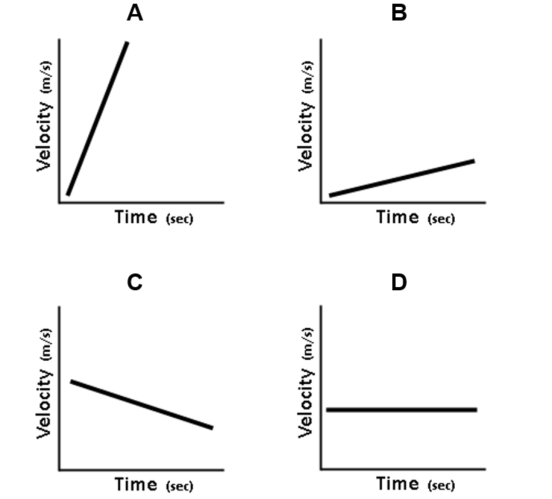
Which graph represents the greatest acceleration?
a)
A
b)
B
c)
C
d)
D
96.

which line represents the constant acceleration?
a)
A
b)
B and D
c)
C
d)
A, B, and D
97.

What is the speed this motion?
a)
constant speed
b)
not moving
c)
speed increasing
d)
speed increasing at a constant rate
98.

During which interval is the object speeding up?
a)
A to B
b)
B to C
c)
D to E
d)
E to F
99.

During which interval are the forces on the object BALANCED (Net Force= 0 N)?
a)
A to B
b)
B to C
c)
D to E
d)
F to G
100.
A car driving at 50 miles per hour drives for 2 hours. What distance did it cover?
a)
50 miles
b)
25 miles
c)
100 miles
d)
75 miles
101.
A truck driving at 60 miles per hour travels 150 miles. How long is it driving for?
a)
9000 hours
b)
0.4 hours
c)
210 hours
d)
2.5 hours
100 %

