
 Worksheets
Wave Parts
Total questions: 24
Worksheet time: 1hrs 2mins
Name
Class
Date
1.
What do all waves carry?
a)
energy only
b)
matter only
c)
energy and matter
d)
neither
2.
Which answer best explains what causes a wave?
a)
Shaking
b)
Potential energy
c)
Light
d)
Vibrations
3.
A mechanical wave cannot travel through...
a)
a vacuum (outer space)
b)
liquids
c)
gases
d)
media
4.
The number of waves that pass a given point per second is called what?
a)
frequency
b)
wavelength
c)
longitudinal
d)
transverse wave
5.
What two factors effect the amount of energy a wave has?
a)
Frequency and wavelength
b)
Frequency and amplitude
c)
Amplitude and rest
d)
Wavelength and crest
6.
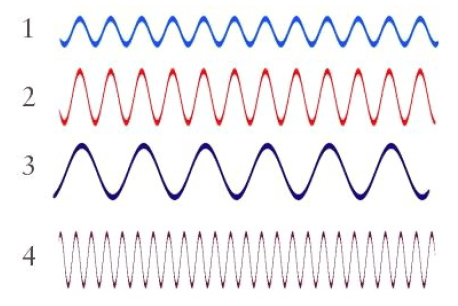
Which wave in the diagram has the highest frequency?
a)
1
b)
2
c)
3
d)
4
7.

Which wave in the diagram has the longest wavelength?
a)
1
b)
2
c)
3
d)
4
8.
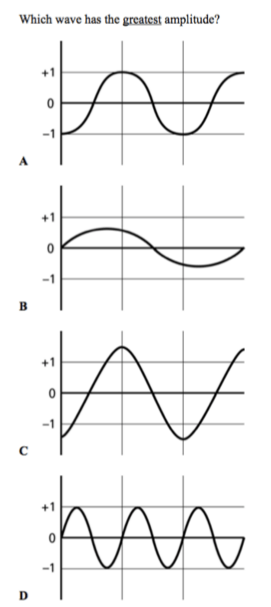
Which wave has the greatest amplitude?
a)
A
b)
B
c)
C
d)
D
9.
When the amplitude of a wave increases, what happens to the wavelength?
a)
The frequency increases.
b)
The wavelength increases.
c)
The wavelength decreases.
d)
Nothing happens, the two are not related.
10.
When the frequency of a wave increases, what happens to the wavelength?
a)
The wavelength and amplitude both increase.
b)
The wavelength increases.
c)
The wavelength decreases.
d)
Nothing happens, the two are not related.
11.
What do all mechanical waves require to be able to move?
a)
A high frequency
b)
A medium
c)
A resting point
d)
A vacuum
12.

The wavelength is represented by which letter?
a)
A
b)
B
c)
C
d)
D
13.

The wave crest is represented by which letter?
a)
A
b)
B
c)
C
d)
E
14.

The wave trough is represented by which letter?
a)
A
b)
B
c)
C
d)
D
15.

The amplitude of a wave is represented by which letter?
a)
A
b)
B
c)
C
d)
D
16.
The rest/line of origin of a wave is represented by which letter?
a)
A
b)
C
c)
D
d)
E
17.
Which type of wave only has movement that is perpendicular to the direction of the wave?
a)
Transverse wave
b)
longitudinal wave
c)
surface wave
d)
none of the above
18.
Which type of wave only has movement that is parallel to the direction of the wave?
a)
transverse wave
b)
longitudinal wave
c)
surface wave
d)
none of the above
19.

It is the part of the wave where the particles are close together. It is part A on this picture.
a)
Compression
b)
Amplituide
c)
Rarefaction
d)
Wavelength
20.

It is the part of the wave where the particles are spread out. It is part B in this picture.
a)
Compression
b)
Rarefaction
c)
Amplitude
d)
Wavelength
21.

What kind of wave is pictured?
a)
Transverse Wave
b)
Longitudinal Wave
c)
compressional wave
d)
none of the above
22.

What kind of wave is pictured?
a)
Transverse
b)
Longitudinal
c)
Surface
d)
Electromagnetic
23.

What kind of wave is pictured?
a)
Transverse
b)
Longitudinal
c)
surface
d)
none of the above
24.

Which answer choice best describes sound waves?
a)
Transverse waves
b)
Longitudinal waves
c)
Surface waves
d)
Electromagnetic waves
100 %

