
 Worksheets
All About Cells
Total questions: 29
Worksheet time: 12mins
Name
Class
Date
1.

I am the protein packaging and shipping machine for the cell! Who am I?
a)
vacuole
b)
ribosome
c)
endoplasmic reticulum
d)
golgi apparatus
2.
Sac within the cytoplasm that is full of fluid; In plants it is large; it stores food, water, etc.
a)
vacuole
b)
cell wall
c)
lysosome
d)
ribosome
3.
Gives the cell a rigid, box-like shape; it is outside of the cell membrane; gives structure and support to the cell
a)
cytoplasm
b)
chromatin
c)
cell wall
d)
plasma membrane
4.
Consists of a jellylike substance that contains many organelles.
a)
ribosomes
b)
cytoplasm
c)
chloroplasts
d)
cell wall
5.
Which organelle uses energy from sunlight to make food?
a)
mitochondria
b)
nucleus
c)
chloroplast
d)
vacuole
6.
Which structure is found in plant cells but not in animal cells?
a)
cell wall
b)
centriole
c)
nucleus
d)
plasma membran
7.
Which part of the cell is often called "the brain of the cell"?
a)
nuclear membrane
b)
endoplasmic reticulum
c)
nucleus
d)
ribosome
8.

I am the outer most layer of an animal cell. What am I?
a)
cell wall
b)
nucleus
c)
plasma membrane
d)
nuclear membrane
9.

I make proteins for the cell. Who am I?
a)
ribosome
b)
mitochondria
c)
chloroplast
d)
lysosome
10.

You might think of me as the trash collector - but one might also say I'm the organelle that recycles. What am I?
a)
cytoplasm
b)
lysosme
c)
vacuole
d)
ribosome
11.

I store water in both plant and animal cells. What am I?
a)
cytoplasm
b)
ribosomes
c)
vacuole
d)
lysosomes
12.
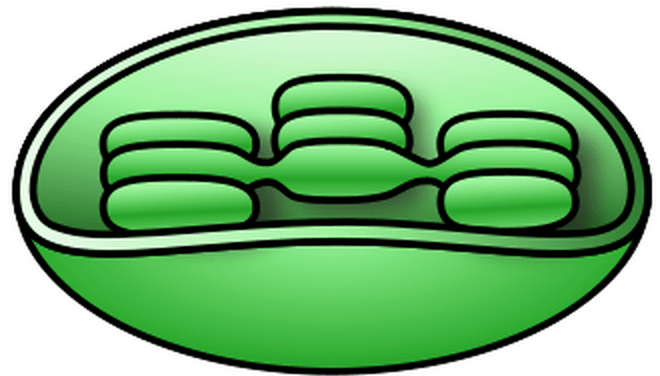
I am only found in a plant cell. What am I?
a)
cell wall
b)
mitochondria
c)
cytoplasm
d)
chloroplast
13.

What is this?
a)
mitochondria
b)
golgi apparatus
c)
chloroplast
d)
endoplasmic reticulum
14.

What does this structure do?
a)
supports the cell
b)
cell's control center
c)
converts energy to food
d)
makes proteins
15.

What organelle is this a picture of?
a)
ribosome
b)
nucleus
c)
cell wall
d)
mitochondrion
16.

What is the green pigment called which captures the sunlight necessary for plants to undergo photosynthesis?
a)
grana
b)
thalakoid spaces
c)
chlorophyll
d)
chloroplast
17.
Who discovered and named cells?
a)
Captain Hook
b)
Robert Hooke
c)
Zacharias Janssen
d)
Rudolf Virchow
18.
What did Hooke first examine?
a)
Pond water
b)
Plant cells
c)
Cork
d)
Animal fat
19.
The endosymbiotic theory most directly explains which of the following
a)
Mitochondria and chloroplast have small, prokaryotic ribosomes
b)
DNA in chloroplasts code for some proteins
c)
Some bacteria develop resistance to antibiotics
d)
Bacteria contain a single circular chromosome
20.
What did Leeuwenhoek examine?
a)
Cork
b)
Pond water
c)
Plant cells
d)
Animal fat
21.
What was Schleiden convinced of?
a)
All plants are made of cells
b)
All animals are made of cells
c)
All cells form spontaneously
d)
None of the above
22.
Who noted that animals are made of cells and concluded that all living things are made of cells and cell products?
a)
Rudolf Virchow
b)
Anton van Leeuwenhoek
c)
Theodor Schwann
d)
Robert Hooke
23.
Who discovered that cells come from preexisting cells and whose research lead to the major principles of cell theory?
a)
Matthias Schleiden
b)
Robert Hooke
c)
Zacharias Janssen
d)
Rudolf Virchow
24.
Which is not a part of cell theory?
a)
All organisms are made of cells
b)
All existing cells come from preexisting cells
c)
All matter is composed of living cells
d)
The cell is the most basic unit of life
25.
Which of the following controls movement of materials in and out of a cell?
a)
Cell wall
b)
Cell membrane
c)
Cytoplasm
d)
Nucleus
26.
The jellylike substance that contains proteins, nucleic acids, minerals, ions, and organelles is what?
a)
Prokaryote
b)
Nucleus
c)
Cytoplasm
d)
Eukaryote
27.
Which organelle is the protein factory?
a)
Ribosomes
b)
Mitochondria
c)
Centriole
d)
Lysosomes
28.
Microscopic single-cells that do not have a nucleus or other membrane-bound organelles.
a)
DNA
b)
RNA
c)
Eukaryotes
d)
Prokaryotes
29.
Genetic information is stored in the nucleus of all single or multicellular cells called
a)
Eukaryotes
b)
Prokaryotes
c)
Organelles
d)
Cytoplasm
100 %

