
 Worksheets
Diffusion and Osmosis
Total questions: 25
Worksheet time: 19mins
Name
Class
Date
1.
What is diffusion?
a)
when molecules move
b)
when molecules move from a high concentration to a low.
c)
no movement
d)
molecules move everywhere
2.
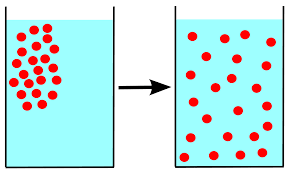
The picture below is an example of _________________.
a)
osmosis
b)
isotonic
c)
diffusion
d)
active transport
3.
Osmosis is the movement of _____ across a membrane.
a)
food
b)
energy
c)
oxygen
d)
water
4.
During osmosis
a)
water moves from high to low concentration
b)
large or oddly shaped molecules move across a cell membrane
c)
water moves when energy is used
d)
proteins are built
5.
When both inside and outside of a cell have the same amount of water it is said that the cell has reached a state of
a)
Osmosis
b)
Diffusion
c)
Equilibrium
6.
Passive transport requires no
a)
concentration gradients
b)
osmosis
c)
motion
d)
energy
7.

_______ regulates what enters and leaves a cell.
a)
Cell Membrane
b)
Nucleus
c)
Mitochondria
d)
Cytoplasm
8.

Equilibrium?
a)
a large amount of substance on side of the cell and a small amount on the other side
b)
a small amount of substance on side of the cell and a large amount on the otherside
c)
equal amount of substance on either side of the membrane
d)
no particles on either side of the a cell membrane
9.

Which way will the water molecules move during osmosis?
a)
Out of the cell, so the cell shrinks.
b)
Out of the cell, so the cell swells.
c)
Into the cell, so the cell shrinks.
d)
Into the cell, so the cell swells.
10.

Which diagram best shows the end result of diffusion?
a)
F
b)
G
c)
H
d)
J
11.

The picture is an example of _________________.
a)
isotonic
b)
diffusion
c)
osmosis
d)
active transport
12.

The cell membrane is
a)
permeable
b)
semi permeable
c)
impermeable
13.

In what direction will the water molecules (the red/blue ones) flow?
a)
Out of the cell via diffusion
b)
Into the cell via osmosis
c)
Out of the cell via osmosis
14.

In what direction will the water molecules and glucose molecules flow?
a)
The glucose (grey) will flow into the cell, the water will flow out.
b)
The glucose (grey) will flow out of the cell, the water will flow in.
c)
Both will flow out.
d)
Both will flow in.
e)
Neither, because the cell & solution are at equilibrium
15.
Diffusion and Osmosis are examples of...
a)
Active Transport
b)
Passive Transport
16.
Passive transport requires no
a)
concentration gradients
b)
osmosis
c)
motion
d)
energy
17.
Permeable means
a)
things can pass through
b)
the concentration levels are different
c)
it is permanent
d)
things are stuck
18.
If there is 5 percent water inside a cell and 5 percent water outside a cell
a)
more water will move inside the cell
b)
more water will move outside the cell
c)
There will be no movement of water cells
19.
What is diffusion?
a)
when molecules move
b)
when molecules move from a high concentration to a low.
c)
no movement
d)
molecules move everywhere
20.
The diffusion of water through a semi-permeable membrane is called?
a)
Osmosis
b)
Cell wall
c)
Diffusion
d)
Respiration
21.
During osmosis
a)
water moves from high to low concentration
b)
large or oddly shaped molecules move across a cell membrane
c)
water moves when energy is used
d)
proteins are built
22.
When both inside and outside of a cell have the same amount of water it is said that the cell has reached a state of ___________.
a)
osmosis
b)
equilibrium
c)
diffusion
d)
hypertonic
23.
A steady state or equilibrium that cells maintain internally is
a)
homestasis
b)
osmosis
c)
diffusion
d)
active transport
24.
What is another word that can be used to describe "homeostasis"?
a)
STABLE
b)
EQUAL
c)
COMPLETE
d)
CORRECT
25.
What colors are the Steelers?
a)
Orange and Silver
b)
Orange and Black
c)
Silver and Black
d)
Black and Gold
100 %

