
 Worksheets
Air Masses and Fronts
Total questions: 30
Worksheet time: 24mins
Name
Class
Date
1.
How do we name air masses?
a)
Water and temperature
b)
Air pressure
c)
Humidity and temperature
d)
Cold and warm
2.
What types of air masses form over oceans?
a)
Maritime
b)
Continental
c)
Polar
d)
Tropical
3.
What's the humidity and temperature of a continental tropical air mass?
a)
Wet and cold
b)
Dry and warm
c)
Wet and warm
d)
Dry and cold
4.
What's the humidity and temperature of a maritime tropical air mass?
a)
Wet and cold
b)
Dry and warm
c)
Wet and warm
d)
Dry and cold
5.
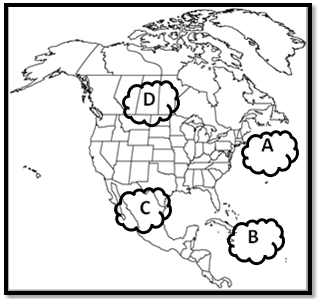
Which type of air would you find at air mass A?
a)
cold, dry
b)
warm, humid
c)
warm, dry
d)
cold, humid
6.
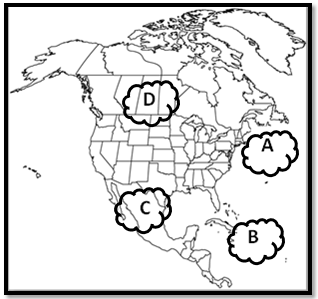
Which type of air would you find at air mass B?
a)
cold, dry
b)
warm, humid
c)
warm, dry
d)
cold, humid
7.
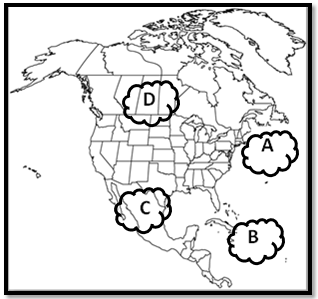
Which type of air would you find at air mass C?
a)
cold, dry
b)
warm, humid
c)
warm, dry
d)
cold, humid
8.
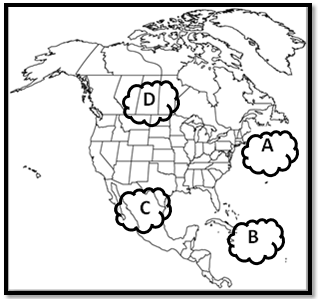
Which type of air would you find at air mass D?
a)
cold, dry
b)
warm, humid
c)
warm, dry
d)
cold, humid
9.
Where would you find a tropical maritime air mass?
a)
over the ocean, near the equator
b)
over the ocean, near the poles
c)
over a continent, near the equator
d)
over a continent, near the poles
10.
When a cold front is approaching, what happens?
a)
warm air is pushing under cold air causing humid weather and lower temperatures
b)
warm air is pushing under cold air causing humid weather and higher temperatures
c)
warm air rises, cools, and causes rain and thunderstorms
d)
cold air is pushed over warm air causing rain and thunderstorms
11.

This is the symbol for which type of front?
a)
cold front
b)
warm front
c)
occluded front
d)
stationary front
12.

This is the symbol for which type of front?
a)
cold front
b)
warm front
c)
stationary front
d)
occluded front
13.

Which type of front is near Seattle?
a)
cold front
b)
warm front
c)
occluded front
d)
stationary front
14.
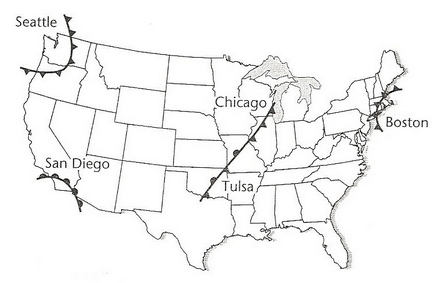
Which type of front is located near Chicago?
a)
warm front
b)
cold front
c)
occluded front
d)
stationary front
15.

What type of storm front is this?
a)
warm front
b)
cold front
c)
stationary front
d)
occluded front
16.
What is a boundary area where air masses meet but do not mix?
a)
low pressure system
b)
super cell
c)
front
d)
high pressure system
17.
What type of weather would you expect to see after a cold front has passed through an area?
a)
cool and clear skies
b)
warm and humid
c)
thunderstorms
d)
foggy
18.
what is an air mass?
a)
a large body of air that is made of the same temperature and moisuture
b)
when two air masses meet
19.
What front brings several days of rain or snow?
a)
Cold
b)
Warm
c)
Stationary
d)
Occluded
20.
Why would a stationary front possibly make us miss days of school?
a)
It brings storms
b)
It brings several days of precipitation
c)
It brings blizzards
21.

Identify the type of front that is shown in the image.
a)
Occluded Front
b)
Cold Front
c)
Stationary Front
d)
Warm Front
22.

Identify the type of front that is shown in the image.
a)
Occluded Front
b)
Cold Front
c)
Stationary Front
d)
Warm Front
23.

Identify the type of front that is shown in the image.
a)
Occluded Front
b)
Cold Front
c)
Stationary Front
d)
Warm Front
24.
Which description best matches a cold front?
a)
warm air is pushed up by cooler air and thunderstorms or ice storms are present
b)
cold air is pushed up by cooler air and thunderstorms or ice storms are present
c)
warm air is pushed up by cooler air and dry air is present along the front
d)
cold air is replaced by warm air and thunderstorms are present
25.
Which is true about the way air flows?
a)
from high pressure to low pressure
b)
from cold air to hot air
c)
from low pressure to high pressure
d)
from top to bottom only
26.
the state of the atmosphere at a particular time and place
a)
climate
b)
weather
c)
weather front
d)
cold front
27.
What is precipitation?
a)
The part of the water cycle when the sun heats up water, turning it from a liquid into water vapor or steam. It rises from the ground into the air.
b)
The part of the water cycle when the water vapor in the air gets cold. The water turns back into a liquid and forms clouds.
c)
The part of the water cycle when clouds get heavy and can no longer hold the liquid water. This causes the water to fall from the sky to the earth as rain, snow, sleet, or hail.
28.
What is condensation?
a)
The part of the water cycle when the sun heats up water, turning it from a liquid into water vapor or steam. It rises from the ground into the air.
b)
The part of the water cycle when the water vapor in the air gets cold. The water turns back into a liquid and forms clouds.
c)
The part of the water cycle when clouds get heavy and can no longer hold the liquid water. This causes the water to fall from the sky to the earth as rain, snow, sleet, or hail.
29.
What is evaporation?
a)
The part of the water cycle when the sun heats up water, turning it from a liquid into water vapor or steam. It rises from the ground into the air.
b)
The part of the water cycle when the water vapor in the air gets cold. The water turns back into a liquid and forms clouds.
c)
The part of the water cycle when clouds get heavy and can no longer hold the liquid water. This causes the water to fall from the sky to the earth as rain, snow, sleet, or hail.
30.
Which of these is not an example of precipitation?
a)
rain
b)
clouds
c)
sleet
d)
snow
100 %

