
 Worksheets
Forces - par
Total questions: 75
Worksheet time: 1hrs 11mins
Name
Class
Date
1.
The law of universal gravitation is credited to whom?
a)
Einstein
b)
Galileo
c)
Darwin
d)
Newton
2.
Two factors effecting the magnitude of the force of gravity between 2 objects are...
a)
mass and distance
b)
mass and matter
c)
distance and weight
d)
weight and mass
3.
Gravity attracts all objects towards one another.
a)
False
b)
True
c)
It depends
4.
If Earth's mass was cut in half, what would happen to your mass?
a)
increase because gravitational force increases
b)
decrease because gravitational force decreases
c)
decrease because gravitational force increases
d)
nothing, mass is not affected by gravitational force
5.
If Earth's mass was cut in half, what would happen to your weight?
a)
Increase because gravitational force increases
b)
decrease because gravitational force decreases
c)
decrease because gravitational force increases
d)
nothing, weight is not affected by gravitational force
6.

What does this tool measure?
a)
weight
b)
meters
c)
mass
d)
force
7.

What does this tool measure?
a)
weight
b)
meters
c)
mass
d)
force
8.

Is the force of gravity on the diver a push or a pull?
a)
push
b)
pull
9.
Any object with mass has gravity.
a)
True
b)
Sometimes
c)
False
d)
Never
10.
As distance between two objects increase the pull of gravity
a)
Increases
b)
Decreases
c)
Stays the same
11.
The force of gravity acting on an object is the object's ______.
a)
mass
b)
matter
c)
weight
d)
friction
12.
Which of the following never changes no matter where in the universe?
a)
weight
b)
force
c)
mass
d)
pounds
13.
The amount of matter in an object is
a)
pressure
b)
weight
c)
mass
d)
force
14.
A person would weigh less on on the Moon than on the Earth because . . .
a)
Moon has more mass, and therefore more gravity
b)
Moon has less mass, and therefore more gravity
c)
Moon has more mass, and therefore less gravity
d)
Moon has less mass and therefore less gravity
15.
An example of a gravitational interaction is that the Earth. . .
a)
orbits the Sun.
b)
orbits the moon.
16.
A person weighs _____ on the moon than they do on Earth.
a)
less
b)
more
c)
the same
17.
A person would weigh more on Jupiter than on the Earth because . . .
a)
Jupiter has more mass, and therefore more gravity
b)
Jupiter has less mass, and therefore more gravity
c)
Jupiter has more mass, and therefore less gravity
d)
Jupiter has less mass and therefore less gravity
18.
If a person weighs 100 pounds on Earth, calculate how much that person would weight on Jupiter. (Jupiter has 3 times the amount of gravity that Earth does.)
a)
33.3 pounds
b)
100 pounds
c)
300 pounds
d)
Not enough information given
19.
Mercury has ______ gravity than Earth.
a)
less
b)
more
c)
the same
20.
________ hold all of the planets in orbit around the sun.
a)
gravity
b)
string
c)
Bill Nye
d)
duct tape
21.
Gravity on Mars’ surface is much lower than it is here on Earth. This is because the mass of mars is ______ than Earth.
a)
less
b)
more
c)
the same
22.
Who said that falling objects fall at the same rate?
a)
Galileo
b)
Kepler
c)
Brahe
d)
Copernicus
23.
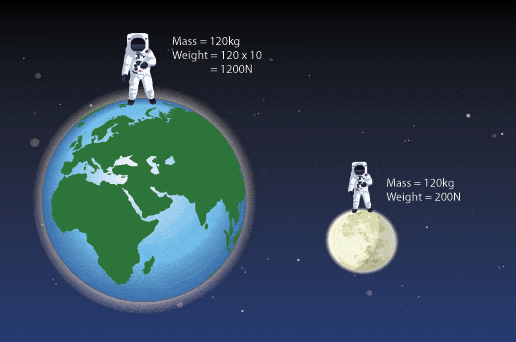
Which of the following will not change in different gravitational fields?
a)
weight
b)
force
c)
mass
d)
pounds
24.
Where would you have to travel to reduce your weight but not lose any mass?
a)
The moon
b)
The Sun
c)
Jupiter
d)
Saturn
25.
Both of these are measured in Netwons
a)
Force and acceleration
b)
Force and weight
c)
Mass and weight
d)
Mass and acceleration
26.
Gravity on Mars’ surface is much lower than it is here on Earth. This is because the mass of mars is ______ than Earth.
a)
less
b)
more
c)
the same
27.

As the distance between 2 objects increases, what happens to gravitational force?
a)
increases
b)
decreases
c)
stays the same
d)
i don't know
28.

As mass increases, what happens to gravitational force?
a)
increases
b)
decreases
c)
stays the same
d)
i don't know
29.
The force of gravity on Jupiter is a little more than 2 times the gravitational force on Earth. If an object has a mass of 50 kg and a weight of 490 N on Earth, what would be the object's approximate mass and weight on Jupiter?
a)
50 kg and 490 N
b)
100 kg and 490 N
c)
50 kg and 980 N
d)
100 kg and 980 N
30.
What subject is attracted to a magnet?
a)
Silver
b)
Water
c)
Metal
d)
Iron
31.
What characteristics do magnetic substances have?
a)
They can give you a "shock" when you touch them
b)
They can push or pull objects without touching them
c)
They are always black and cold to touch
d)
They fall faster than other objects when you drop them
32.
What happens when two north poles of a magnet are placed together?
a)
they repel
b)
they attract
c)
they cancel each other out
d)
the strength of the magnet is doubled
33.

Why does a compass needle point north?
a)
The compass is a bar magnet
b)
Because north is up
c)
Because it's magic
d)
It lines up with the Earth's magnetic field
34.
When two magnets attract, they ______________
a)
push apart
b)
change color
c)
get colder
d)
pull together
35.
When two magnets repel, they ________________
a)
change color
b)
pull together
c)
push apart
d)
get colder
36.
True or False: All metals stick to magnets.
a)
True
b)
False
37.
What do magnets stick to?
a)
copper
b)
wood
c)
iron
d)
plastic
38.
How is a permanent magnet DIFFERENT from a temporary magnet?
a)
A permanent magnet attracts materials made of iron.
b)
A permanent magnet has poles.
c)
A permanent magnet has a magnetic field.
d)
A permanent magnet keeps its magnetism for a long time.
39.
A north pole and a south pole will attract.
a)
True
b)
False
40.
Where is the force of attraction the strongest on a magnet?
a)
at the poles
b)
in the middle
c)
above the magnet
d)
below the magnet
41.
True or False:
Most rocks are magnetic.
Most rocks are magnetic.
a)
True
b)
False
42.
Ancient people discovered magnetic rocks called lodestone. What did they use them for?
a)
fires
b)
compasses
c)
sculptures
d)
weapons
43.
How is Earth's magnetic field similar to that of a magnet?
a)
It is hundreds of miles long
b)
It has north and south poles
c)
It is made in Earth's core
d)
It is shaped like a horseshoe
44.
What is our best evidence that Earth has a magnetic field?
a)
All things fall toward Earth's center
b)
A compass needle lines up with it
c)
Winds blow from east to west
d)
Earth's oceans all have currents
45.

Where is Earth's magnetic field strongest?
a)
Along the outside lines
b)
Along the inside lines on either side
c)
Where the lines are close together at the poles
d)
In the space outside of the lines
46.
A magnet cannot not move which of the following objects?
a)
a paper clip
b)
a nail
c)
a toothpick
d)
a staple
47.
Which of the following is true of a bar magnet?
a)
Its magnetic field is strongest near its center.
b)
It is surrounded by a magnetic field.
c)
The north pole is stronger than the south pole.
d)
The south pole is stronger than the north pole.
48.
The needle of a compass always points to which direction?
a)
south
b)
east
c)
west
d)
north
49.
Earth acts like a giant magnet because its center is made up MOSTLY of
a)
granite
b)
limestone
c)
iron
d)
nickel
50.
Magnets have a north and a south ___________
a)
shape
b)
color
c)
pole
d)
region
51.

Magnets that are arranged like this will _______.
a)
move away from each other (repel)
b)
move towards each other (attract)
52.

Magnets that are arranged like this will _______.
a)
move away from each other (repel)
b)
move toward each other (attract)
53.

What device is made of coils of wire with an electrical current passing through it in order to generate a magnetic field?
a)
Electromagnet
b)
Generator
c)
Electron Magnet
d)
Motor
54.

Surrounding every magnet is a __________ __________.
a)
magnetic field
b)
electrical current
c)
another magnet
d)
an enemy
55.

This substance is
a)
magnetizecd
b)
unmagnetized
c)
positively charged
d)
negatively charged
56.

You know this substance is magnetized because
a)
all the domains have right angles
b)
the arrows are drawn in red
c)
the domains are aligned
d)
the domains are random
57.

Where are the magnetic force the strongest in this picture?
a)
Location 1
b)
Location 2
c)
Location 3
d)
Location 4
58.

Two N-S magnets are glued to a sheet of paper. Iron fillings are sprinkled and the table is tapped several times. Which image matches what the filling should look like?
a)
A
b)
B
c)
C
d)
D
59.

Based on the magnetic field lines shown, what is the orientation of the mystery magnet?
a)
S-S
b)
N-S
c)
N-N
d)
S-N
60.
Compared to insulators, metals are better conductors of electricity because metals contain more free
a)
protons
b)
electrons
c)
positive ions
d)
negative ions
61.
The accumulation of excess electric charge on an object is called
a)
Static electricity
b)
Electric discharge
c)
Resistance
d)
Circuit
62.
A material in which electrons are able to move easily
a)
Circuit
b)
Insulator
c)
Resistance
d)
Conductor
63.
The process of transferring charge by touching or rubbing
a)
Induction
b)
Conduction
c)
Friction
d)
Conductor
64.
During a physics lab, a plastic strip was rubbed with cotton and became positively charged. The correct explanation for why the plastic strip becomes positively charged is that ...
a)
the plastic strip acquired extra protons from the cotton.
b)
the plastic strip acquired extra protons from the charging process
c)
protons were created as the result of the charging process
d)
the plastic strip lost electrons to the cotton during the charging process
65.
Insulators are different than conductors in that insulators ____.
a)
do not contain electrons or protons
b)
do not contain any charge
c)
have a weaker affinity for electrons
d)
do not allow charge to freely move
66.

Consider the conduction charging shown.
a)
Electrons move from the insulating stand into the sphere.
b)
Protons move from the bar into the sphere.
c)
Electrons move from the charged metal bar into the sphere.
d)
Protons move from the sphere into the negatively charged bar.
67.
A glass rod becomes positively charged when it is rubbed with silk. This net positive charge accumulates because the glass rod
a)
gains electrons
b)
loses electrons
c)
gains protons
d)
loses protons
68.
A balloon is rubbed against a student's hair and then touched to a wall. The balloon sticks to the wall due to
a)
magnetic forces between the particles of the balloon and the particles of the wall
b)
electrostatic forces between the particles of the balloon and the particles of the wall
c)
magnetic forces between the particles of the wall
d)
electrostatic forces between the particles of the balloon
69.
A negatively charged plastic comb is brought close to, but does not touch, a small piece of paper. If the comb and the paper are attracted to each other, the charge on the paper
a)
must be positive
b)
must be negative
c)
may be neutral or negative
d)
may be neutral or positive
70.
When a plastic rod is rubbed with wool, the wool acquires a positive charge because
a)
protons are transferred from the wool to the rod
b)
protons are transferred from the rod to the wool
c)
electrons are transferred from the rod to the wool
d)
electrons are transferred from the wool to the rod
71.
What are the two types of charges that objects may possess?
a)
+ and +
b)
+ and -
c)
+ and neutral
d)
- and neutral
72.
Which of the following is not a good insulator?
a)
Copper
b)
Glass
c)
rubber
d)
wool
73.
Which of the following is not a good conductor of electricity?
a)
copper
b)
silver
c)
Glass
d)
aluminum
74.
Opposite charges ______ each other
a)
Attract
b)
Repel
c)
Do nothing
75.

Rubbing a balloon on hair is an example of static charge build up created by....
a)
conduction
b)
friction
c)
induction
d)
hairduction
100 %

