
 Worksheets
Year 10 Physics Quiz
Total questions: 74
Worksheet time: 2hrs 33mins
Name
Class
Date
1.
What is the type of friction caused when an object falls through air?
a)
air resistance
b)
inertia
c)
rolling friction
d)
terminal velocity
2.
The force of gravity on a person on Earth is called
a)
free fall
b)
terminal velocity
c)
mass
d)
weight
3.
The tendency of an object to resist change in its motion is known as
a)
mass
b)
inertia
c)
balance
d)
force
4.
The SI (metric) unit for force is the
a)
meter
b)
kilogram
c)
pound
d)
newton
5.
One way to increase acceleration is by
a)
decreasing force
b)
increasing both force and mass
c)
decreasing mass
d)
increasing mass
6.
What happens when two forces act in the same direction?
a)
They add together
b)
The stronger one prevails
c)
They cancel each other out
7.
Balanced forces acting on an object
a)
can change the object's motion
b)
always change the object's motion
c)
never change the object's motion
d)
have nothing to do with the motion of an object
8.
The force that pulls falling objects towards Earth is called
a)
gravity
b)
acceleration
c)
free fall
d)
air resistance
9.
If the teacher puts a force of 20N to move a desk to the right at the same time a student puts a force of 30N to move the desk to the left the
a)
desk will not move
b)
the desk will move to the right
c)
the desk will move to the left.
10.
Newton's second law of motion says WHAT depends on an object's mass the the net force acting on the object
a)
mass
b)
acceleration
c)
gravity
d)
weirght
11.
The unit used for force is
a)
m/s
b)
m/s2
c)
N
d)
gram
12.
What is the formula for force?
a)
f = m / a
b)
f = (m)(a)
c)
f = a/m
13.
Energy of motion is which type of energy?
a)
Potential
b)
Kinetic
c)
Sound
d)
Gravitational
14.

What type of energy is in this picture?
a)
Kinetic
b)
Potential
c)
Chemical
d)
Sound
15.

What kind of energy does this device use?
a)
Chemical
b)
Electrical
c)
Thermal
d)
Chemical
16.

A battery converts what type of energy to another?
a)
sound to kinetic
b)
light to heat
c)
mechanical to electrical
d)
chemical to electrical
17.
Work is:
a)
A transfer of energy by a force to move and object
b)
Something you get paid for
c)
Something you take home
d)
Makes you sweat
18.
On a roller coaster, where is maximum potential energy?
a)
At the bottom of a big hill
b)
When going around a corner
c)
When going upside down
d)
At the top of a big hill
19.
On a roller coaster, where is maximum kinetic energy?
a)
At the bottom of a big hill
b)
When going around a corner
c)
When going upside down
d)
At the top of a big hill
20.
The formula for work is:
a)
d = r x t
b)
p = m x v
c)
f = m x a
d)
w = d x f
21.
GRAVITATIONAL POTENTIAL ENERGY DEPENDS ON
a)
MASS AND VELOCITY
b)
MASS AND WEIGHT
c)
WEIGHT AND HEIGHT
d)
HEIGHT AND DISTANCE
22.
AS A ROLLER COASTER MOVES DOWN A HILL, POTENTIAL ENERGY IS CONVERTED INTO KINETIC ENERGY, THERMAL ENERGY, AND SOUND ENERGY. WHAT IS TRUE ABOUT THE TOTAL ENERGY OF THIS SYSTEM?
a)
ENERGY IS GAINED (CREATED) AS THE ROLLER COASTER MOVES
b)
ENERGY IS LOST (DESTROYED) AS THE ROLLER COASTER MOVES
c)
THE TOTAL ENERGY REMAINS THE SAME AS THE ROLLER COASTER MOVES
d)
THE TOTAL ENERGY CONSTANTLY CHANGES AS THE ROLLER COASTER MOVES
23.
what is kinetic energy?
a)
movement
b)
being still
24.
What is an example of kinetic energy?
a)
walking across the classroom
b)
sleeping
c)
a ball sitting in the grass
25.
A book sitting on a shelf is an example of ______________.
a)
potential energy
b)
kinetic energy
26.

A box sliding down an inclined plane attains a velocity of 27 m/s in 3 seconds from rest. Find the acceleration.
a)
30 m/s
b)
24 m/s2
c)
9 m/s2
d)
81 km/hr
27.
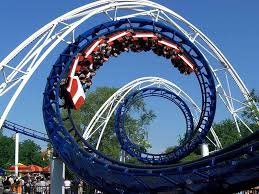
A roller coasters accelerates from an initial velocity of of 6.0 m/s to a final velocity of 70 m/s over 4 seconds. What's the acceleration?
a)
24 m/s2
b)
18 m/s2
c)
16 m/s2
d)
16 m/s
28.

How fast is the car traveling at 30 seconds?
a)
5m/s
b)
10m/s
c)
20m/s
d)
30m/s
29.
A car starts from rest at a stop light and reaches 20 m/s in 3.5 s. Determine the acceleration of the car.
a)
2.2m/s2
b)
7.0m/s2
c)
5.7m/s2
d)
70m/s2
30.
Acceleration is defined as the CHANGE in
a)
time it takes for one place to move to another place.
b)
velocity of an object.
c)
distance divided by the time interval
d)
velocity divided by the time interval
31.

Which graph shows the object standing still?
a)
A
b)
B
c)
C
d)
D
32.

Which graph demonstrates the greatest positive speed?
a)
A
b)
B
c)
C
d)
D
33.

Which graph represents zero acceleration (constant velocity)?
a)
A
b)
B
c)
C
d)
D
34.

What is the formula to calculate speed?
a)
S = t/d
b)
S = d/t
c)
S = d x t
d)
S = t x d
35.

What is speed?
a)
how far you go
b)
how much distance is covered over a period of time
c)
how fast you accelerate
d)
the change in the location of a object
36.

A runner races in the 100 meter dash. It takes her 10 seconds to finish. What is her average speed?
a)
10 m/s
b)
1000 m/s
c)
100 seconds
d)
10 seconds
37.

Total distance divided by total time is
a)
average speed
b)
constant speed
c)
instantaneous speed
d)
acceleration
38.

The correct equation to calculate speed is
a)
distance/time
b)
time/distance
c)
distance x time
d)
distance/time2
39.

Shona cycles at an average speed of 8km/h. How far has she travelled if she cycles for 4 hours?
a)
55km
b)
32km
c)
43km
d)
32miles
40.

Which is correct?
a)
speed = distance x time
b)
speed = speed divided time
c)
speed = Distance divide time
d)
Speed = time x speed
41.

What is the net force?
a)
20 N
b)
0 N
c)
400 N
d)
40 N
42.

Forces that have a net force of zero
a)
Balanced force
b)
Unbalanced force
43.
What will cause an object to move?
a)
Applied forces
b)
Balanced forces
c)
Unbalanced forces
44.
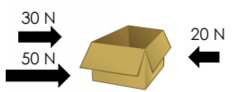
Calculate the Net Force.
a)
60N, Left
b)
40N, Right
c)
0N
d)
60N, Right
45.

If you are an astronaut slowly drifting away from the space station, you might be able to drift back to the station by throwing a 555-kg tool rapidly in the direction that you are traveling (away from the station).Please choose from one of the following options.
a)
True
b)
False
46.

A person steps out of the boat and onto the dock. As the person moves forward onto the dock, the boat moves backward. Which statement best describes the backward motion of the boat as the person steps forward?
a)
For every action there is an equal and opposite reaction.
b)
Every mass exerts a force on every other mass.
c)
An object at rest tends to stay at rest.
d)
Friction opposes the motion of an object.
47.
A book rests on a table. The force of gravity pulls down on the book with a force of 20 newtons. What prevents the books from accelerating downward at 9.8 m/sec2
a)
The table presses back up on the book with an equal and opposite force of 20 newtons.
b)
The table presses back up on the book with a force greater than 20 newtons.
c)
The table and the book together are accelerating downwards at 9.8 m/sec2
d)
The inertia of the book holds it up
48.
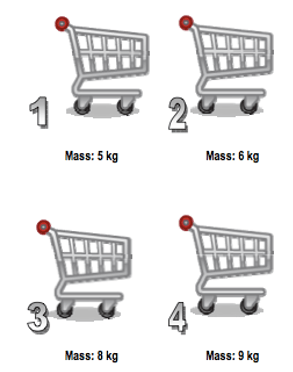
A force of 90N is applied to each cart below, which one will accelerate the fastest?
a)
Cart 1
b)
Cart 2
c)
Cart 3
d)
Cart 4
49.
The unit used to measure work is the
a)
Watt
b)
Newton
c)
Joule
d)
meter
50.
A 5000N block is lifted 10 m. How much work was done?
a)
50000 J
b)
5000 J
c)
500 J
d)
50 J
51.
Work done = Force x _________
a)
a. distance
b)
b. acceleration
c)
c. velocity
d)
d. speed
52.
If you do 40 joules of work lifting a 10N box, how high is the shelf you move it to.
a)
400m
b)
40m
c)
50m
d)
4m
53.
if you push a cart with a force of 60 N for 2 m... how much work have you done
a)
120 J
b)
30 J
c)
120 N
d)
30 N
54.
How much work is produced when 350 N is used to move a car 5 m?
a)
70 J
b)
1750 J
c)
355 J
d)
175 J
55.
What is the equation for power?
a)
P = Work/time
b)
P = Force/time
c)
P = time/distance
d)
P = Work * time
56.
How is power defined?
a)
transfer a force through a distance
b)
the rate of speed
c)
the rate of work being done
d)
transfer of space over time
57.
What is the unit of measurement for Power?
a)
Joules
b)
Newtons
c)
Watts
d)
Meters
58.
If a crane lifts a small car 15 meters using 25,000 joules of work in 5 seconds, how much power was generated by the crane?
a)
5, 000 Watts
b)
1,667 Watts
c)
75 Watts
d)
375,000 Watts
59.
A large slingshot uses 100 newtons of force to pull a bowling ball 3 meters in 2 seconds, how much power was generated?
a)
150 watts
b)
1.5 watts
c)
6 watts
d)
300 wats
60.
What is the kinetic energy of a 9 kg book that has a speed of 4 m/s?
a)
18 J
b)
36 J
c)
72 J
d)
144 J
61.
What is the potential energy done in lifting a 50 kg barbell 6 m above the floor?
a)
150 J
b)
300 J
c)
1470 J
d)
2940 J
62.

During which interval is the object not moving?
a)
B to C
b)
C to D
c)
D to E
d)
only at point A
63.

During which interval is the object traveling at a constant velocity?
a)
B to C
b)
D to E
c)
F to G
d)
it traveling at a constant velocity during all of the intervals shown.
64.

During which interval is the object speeding up?
a)
A to B
b)
B to C
c)
D to E
d)
E to F
65.

During which interval is the object slowing down?
a)
A to B
b)
D to E
c)
E to F
d)
G to H
66.

Calculate the acceleration for segment A.
a)
2 m/s2
b)
20 m/s2
c)
-2 m/s2
d)
0 m/s2
67.

What is the objects speed from 0-20 seconds?
a)
0.5m/s
b)
10m/s
c)
2m/s
d)
10m
68.

What is the total distance that the object travels?
a)
40m
b)
80m
c)
100
d)
100m
69.

How long did it take this object to travel 10 m?
a)
0 s
b)
10 s
c)
15 s
d)
20 s
70.

At 60 seconds, how far had this object traveled?
a)
0 m
b)
10 m
c)
20 m
d)
40 m
71.
Calculate the KE of a moving 4 kilogram object traveling at a velocity of 3 m/s.
a)
18 J
b)
36 J
c)
12 J
d)
6 J
72.
How much KE does a moving 6 kilogram object have if it moves with a velocity of 3 m/s?
a)
27 J
b)
18 J
c)
9 J
d)
2 J
73.
What is the mass of a moving object that has 100 Joules of KE and moves at a velocity of 2 m/s?
a)
50 kg
b)
200 kg
c)
25 kg
d)
100 kg
74.
What is the velocity of a moving object that travels 12 meters in 3 seconds?
a)
4 m/s
b)
36 m/s
c)
15 m/s
d)
9 m/s
100 %

