
NEW
Font size
S
M
L
XL
 Worksheets
Review AP Quiz
Total questions: 40
Worksheet time: 39mins
Name
Class
Date
1.
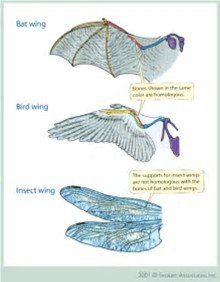
a)
Homologous
b)
Vesitigial
c)
Analogous
2.

a)
Homologous
b)
Vestigial
c)
Analogous
3.

a)
homologous
b)
Vestigial
c)
Analogous
4.
What type of speciation involves isolation due to behavior such as sexual selection or habitat differentiation?
a)
Allopatric
b)
Sympatric
c)
Both
5.
What type of speciation involves geographic isolation?
a)
Allopatric
b)
Sympatric
c)
Both
6.

What type of selection is this?
a)
Directional Selection
b)
Stabilizing Selection
c)
Disruptive Selection
d)
Natural Selection
7.

What type of selection is this?
a)
Directional Selection
b)
Stabilizing Selection
c)
Disruptive Selection
d)
Natural Selection
8.

What type of selection is this?
a)
Directional Selection
b)
Stabilizing Selection
c)
Disruptive Selection
d)
Natural Selection
9.
A population of 150 individuals has an allele frequency of 0.3 for the dominant allele (B) and a frequency of 0.7 for the recessive allele (b). Use the Hardy-Weinberg equation to determine f(Bb).
a)
0.09
b)
0.42
c)
0.49
d)
0.21
10.

What does the image represent?
a)
Gene flow
b)
Genetic drift
c)
Mutation
d)
Adaptation
11.
In a population of squirrels, the allele that causes bushy tail (B) is dominant, while the allele that causes bald tail is recessive (b). If 64% of the squirrels have a bushy tail, what is the frequency of the dominant allele?
a)
0.8
b)
0.6
c)
0.4
d)
0.36
12.
One general pattern that will maintain two related groups as separate species requires their gametes to not combine. These are called prezygotic barriers. Select the one example here that does not describe this type of isolating barrier:
a)
Hybrid breakdown
b)
Behavioral isolation
c)
Temporal isolation
d)
Mechanical isolation
13.
In a particular bird species, individuals with average-sized wings survive severe storms more successfully than other birds in the same population with longer or shorter wings. This illustrates which mode of selection:
a)
directional selection
b)
stabilizing selection
c)
diversifying selection
d)
artificial selection
14.
The condition in which there are barriers to reproduction between individuals of the same species because they are separated by a portion of a mountain range would be referred to as
a)
mechanical isolation
b)
geographic isolation
c)
gametic isolation
d)
temporal isolation
15.

The five-factors of speciation are gene flow, genetic drift, mutation, natural selection and ....
a)
sexual selection
b)
controlled mating
c)
emigration
d)
immigration
16.

If an organism has a vestigial structure, that structure likely once had a function in a(n)
a)
close relative
b)
early ancestor
c)
unrelated organism
d)
embryological stage
17.

Using the cladogram: a common ancestor of amphibians and ray-finned fish would have
a)
a bony skeleton
b)
four limbs
c)
scaly skin
d)
eggs with shells
18.
which of the following is NOT a requirement for Hardy-Weinberg equilibrium?
a)
small population
b)
no gene flow
c)
no mutations
d)
no selection
19.

The two extant species that are closely related to each other are __.
a)
A and B
b)
B and C
c)
C and D
d)
D and E
20.

A common ancestor for both C and E could be at position __.
a)
1
b)
2
c)
3
d)
4
21.
Which statement correctly explains how resistance to penicillin appeared after a few years of its widespread use to fight bacterial infection?
a)
in order to survive exposure to penicillin, bacteria developed a resistance to the drug
b)
a few bacteria became resistant to penicillin, and through sexual reproduction , most bacteria acquired the resistance
c)
penicillin never really successfully wiped out populations of bacteria, scientist did not use proper controls in their studies
d)
some bacteria were resistant to penicillin and their population spread rapidly, without competition from bacteria that were killed by penicillin
22.
The wing of a bat and a humans' arm have different functions and appear very different. Yet, the underlying anatomy is basically the same. therefore, these structures are examples of
a)
geographic isolation
b)
analogous structures
c)
homology
d)
reproductive isolation
23.
In a population that is in Hardy-Weinberg equilibrium, the frequency of a particular recessive allele a is .4. What is the percentage of the population heterozygous for this allele?
a)
4 percent
b)
16 percent
c)
32 percent
d)
48 percent
24.
The population of peppered moths in England changed from white to black in 50 years
a)
stabilizing selection
b)
sexual selection
c)
directional selection
d)
disruptive selection
25.

Which of the three graphs shows stabilizing selection?
a)
A
b)
B
c)
C
26.

Which of the three graphs shows disruptive selection?
a)
A
b)
B
c)
C
27.

What type of selection?
a)
Directional
b)
Stabilizing
c)
Disruptive
28.

What type of natural selection is this?
a)
Disruptive Selection
b)
Directional Selection
c)
Stabilizing Selection
d)
Sexy Selection
29.

What is the correct explanation for what is happening in this graph?
a)
There are a lot of average-sized beaks
b)
There are no beaks
c)
There are a lot of small beaks only
d)
There are a lot of small and large beaks, but not average-sized ones
30.
Human babies don't do well if they are born too small. If they are too big complications can occur during birth. Baby size should then be selected for by which method?
a)
stabilizing
b)
directional
c)
disruptive
d)
Beyonce is having twins
31.
Which Hardy-Weinberg equation represents the genotype frequencies in a population?
a)
p + q = 1
b)
p2 + 2pq + q2 = 1
c)
p2 + pq2 + q2 = 1
d)
p + 2pq + q3 = 1
32.
Genetic drift is likely to be seen in a population
a)
That has a low mutation rate
b)
In which natural selection is occurring
c)
That is very small
d)
For which environmental conditions are changing
33.
If a population has the following genotype frequencies: AA = 0.42, Aa = 0.46, and aa = 0.12, what are the allele frequencies?
a)
A = 0.42, a = 0.12
b)
A = 0.6, a = 0.4
c)
A = 0.65, a = 0.35
d)
A = 0.84, a = 0.24
34.
Gene flow involves
a)
Natural disasters killing most of the members of a population
b)
Individuals moving into and out of the population
c)
Selective mating
d)
Small changes because of the environment
35.
In a population of bears, the frequency of q is 0.44. What is the frequency of p?
a)
0.1936
b)
0.44
c)
0.56
d)
0.22
36.
A population of 150 individuals has an allele frequency of 0.7 for the recessive allele. Use the Hardy-Weinberg equation to determine the heterozygous genotype frequency.
a)
0.09
b)
0.42
c)
0.49
d)
0.21
37.
If the frequencies are as follows in a population with a total size of 150: f(BB)=0.16, f(Bb)=0.48, and f(bb)=0.36, determine the expected numbers of organisms with genotype Bb.
a)
24
b)
72
c)
54
d)
150
38.
A group of Kent squirrels, they are black, accidentally get put on a truck to Cleveland. After the squirrels are dropped off in Cleveland they begin to mate with all the squirrels there. Which of Hardy-Weinberg conditions are being broken in this scenario?
a)
No Death or Reproduction
b)
No Gene Flow
c)
No Natural Selection
d)
No Genetic Drift
39.

Two groups of chipmunks cannot mate anymore because the grand canyon separates them; this is
a)
Behavioral isolation
b)
Geographic isolation
40.
Cystic fibrosis is a recessive condition that affects about 1 in 2,500 babies in the Caucasian population of the United States. Calculate the frequency of heterozygous individuals (carriers) in the U.S. population. Give your answer as a decimal to the nearest hundredth.
a)
.98
b)
.06
c)
.02
d)
.04
Reset

