wayground logo

Free Printable Worksheets

NEW

Font size

S
M
L
XL
Worksheets

Biology: Cellular Structures & Functions 2025

Total questions: 25

Worksheet time: 2hrs 1mins

Name
Class
Date
1.
control the cell's activities; contains the cell's DNA
a)
mitochondria
b)
cell membrane
c)
nucleus
d)
golgi body
2.
surrounds the cell; controls what enters/leaves cell; maintains homeostasis
a)
vacuole
b)
cell wall
c)
cell membrane
d)
lysosome
3.
cells that contain a true nucleus
a)
prokaryotes
b)
eukaryotes
c)
carbohydrate
d)
plant cells
4.
What is the function of the cytoplasm?
a)
Stores water and mineral ions
b)
It holds all the organelles in place & cell transport
c)
a.Controls what enters and leaves the cell
d)
Supports the cell
5.
Number 1 is  a (the) - 
a)
Golgi Bodies
b)
Mitochondrion
c)
ribosome
d)
Nucleus
6.
Which characteristic do most plants have in common?
a)
they are unicellular
b)
they are prokaryotic
c)
they produce seeds
d)
 they all have cell wall and chloroplast
7.
Which cell structure is correctly paired with its primary function?
a)
ribosome - movement
b)
mitocondria - energy production
c)
vacuole - cell division
d)
nucleus - storage of nutrients
8.
Which organelle is responsible for making proteins?
a)
Nucleus
b)
Nucleolus
c)
Lysosomes
d)
Ribosomes
9.
What is a sac-like structure used to store water and nutrients? These are much larger in plant cells?
a)
Lysosomes
b)
Mitochondria
c)
Vacuoles
d)
Golgi Body
10.
What is the main difference between prokaryotic and eukaryotic cells?
a)
Prokaryotic cells have a nucleus and Eukaryotic cells do not
b)
Prokaryotic cells are unicellular and Eukaryotic cells are multicellular.
c)
Prokaryotic cells do not have a nucleus, Eukaryotic cells do have a nucleus.
d)
Prokaryotic cells are plant cells and Eukaryotic cells are animal cells.
11.

produces glucose (an energy-rich compound) through the process of photosynthesis

a)
cytoplasm
b)
centrioles
c)
chloroplast
d)
mitochondria
12.

Which organelle in plant cells captures solar energy (sunlight)?

a)
Cell Wall
b)
Nucleus
c)
Chloroplasts
d)
Vacuole
13.
Organisms composed of many cells are called
a)
Prokaryotic
b)
Eukaryotic
c)
Unicellular
d)
Multicellular
14.
Which types of organisms are Prokaryotes?
a)
Animals
b)
Plants
c)
Fungi
d)
Bacteria
15.
Unicellular organisms are
a)
Prokaryotic
b)
Eukaryotic
c)
Made of many cells
d)
Made of one cell
16.

This is where sugar is converted into usable energy, called ATP, by carrying out cellular respiration

a)
Mitochondria
b)
Chloroplast
c)
Ribosome
d)
Golgi
17.

This organelle uses sunlight, during photosynthesis, to make sugar
a)
Mitochondria
b)
Chloroplast
c)
Vacuole
d)
Lysosome
18.
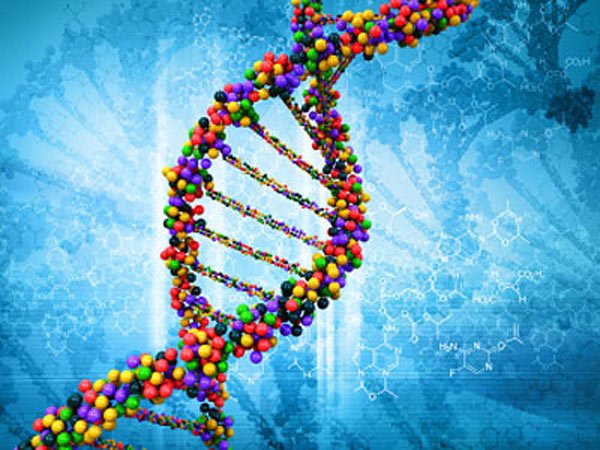
What is the name of the genetic material that is inside the nucleus?
a)
ER
b)
ATP
c)
YOLO
d)
DNA
19.
Directs all cell activities through the DNA located there.
a)
Lysosomes
b)
Nucleus
c)
ribosomes
d)
Mitochondria
20.

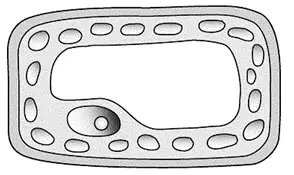
The diagram represents a cell of a green plant.
Solar energy is used to produce glucose (an energy-rich compound) in which structure?

a)
A
b)
B
c)
C
d)
D
21.
What type of cell is in this picture?
a)
plant cell
b)
animal cell
22.
What organelle is visible in this picture?
a)
nucleus
b)
cell wall
c)
chloroplast
d)
DNA
23.
What organelle is visible in this picture?
a)
nucleus
b)
chloroplast
c)
DNA
d)
endoplasmic reticulum
24.
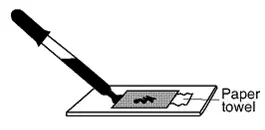
Why would a biologist use iodine, or other "stains," when viewing specimen under a microscope?
a)
to make the cell and the cell parts visible
b)
to make the cell look bigger
25.

A student makes a claim that the cell image shown represents a plant cell. What piece of evidence listed below would NOT support this claim?

a)

The cell contains cell wall and chloroplasts

b)

The cell image contains a rectangular shape

c)

The cell image has one large vacuole

d)

The cell image has a mass of 0.7 grams.