
 Worksheets
Chemistry Unit Review
Total questions: 80
Worksheet time: 2hrs 37mins
Name
Class
Date
1.
Acids are what range on the pH scale?
a)
0 - 14
b)
0 - 6
c)
7
d)
8 - 14
2.
Vinegar is an example of __________
a)
A base
b)
An acid
c)
A neutral substance
3.
Bases are what range on the pH scale?
a)
0 - 6
b)
7
c)
8 - 14
d)
0 - 14
4.
What color does acid turn litmus paper?
a)
It turns litmus paper purple.
b)
It turns red litmus paper blue.
c)
It turns blue litmus paper blue.
d)
It turns blue litmus paper red.
5.
What color does bases turn litmus paper?
a)
It turns litmus paper purple.
b)
It turns blue litmus paper red.
c)
It turns red litmus paper blue.
d)
It turns red litmus paper re
6.
Drain cleaner has a pH of 13. What is drain cleaner?
a)
An acid.
b)
A strong base.
c)
Neutral.
d)
A weak base.
7.
A pH scale is...
a)
A corrosive substance that says a substance is an acid.
b)
An indicator that tells if a substance is an acid or base.
c)
A blue litmus paper.
d)
A red litmus paper.
8.
What might happen if you mixed a strong acid with an equally strong base?
a)
You would see an explosive chemical reaction.
b)
The acid would destroy the base.
c)
The base would destroy the acid.
d)
You would wind up with a pH-neutral substance.
9.
Which of the following substances is basic?
a)
soda
b)
lemon juice
c)
soap
d)
vinegar
10.
On the pH scale, acids are ___ ___ 7, while bases are ___ ___ 7.
a)
greater than / less than
b)
less than / greater than
11.

Buffer is defined as
a)
ability to resist an acid
b)
ability to resist a base
c)
ability to prevent any pH changes
d)
ability to resist pH change whether an acid or base is added
12.
Which particle has a positive charge?
a)
electron
b)
orbital
c)
proton
d)
neutron
13.
Choose the particle that has no charge.
a)
nucleus
b)
neutron
c)
proton
d)
electron
14.
This causes the mass of the nucleus to increase.
a)
adding an electron
b)
adding a neutron
c)
more orbitals
d)
adding negatively charged particles
15.
An electron has a _____ charge.
a)
negative
b)
positive
c)
neutral
16.
What are the maximum number of electrons that go on the first 3 energy levels?
a)
2,4,16
b)
2,8,8
c)
4,8,12
d)
3,4,6
17.
What is it called when an atom has more electrons than protons?
a)
isotope
b)
radioactive isotope
c)
ions (cations)
d)
ions (anions)
18.
The particles of the atom you can find by knowing the atomic number.
a)
neutrons
b)
protons and electrons
c)
protons and neutrons
d)
atomic mass
19.
The subatomic particle that determines the identity of an element.
a)
neutron
b)
proton
c)
electron
d)
outer shell
20.
What charge does the nucleus have and why?
a)
positive - the neutrons do not have a charge
b)
positive - the neutrons and protons are positively charged particles
c)
neutral - the neutral charge dominates the positive charge
d)
neutral - electrons cancel out the positive charge of the atom
21.
What is the mass number and name of an element with 8 protons and 8 neutrons?
a)
16 - Carbon
b)
16 - Oxygen
c)
24 - Oxygen
d)
8 - Neon
22.
An element with a mass number of 10 and an atomic number of 6 has how many protons?
a)
5
b)
8
c)
6
d)
10
23.
An element with a mass number of 11 and an atomic number of 5 has how many neutrons?
a)
11
b)
5
c)
6
d)
16
24.
An atom has 10 protons, 15 neutrons and 10 electrons what is its mass number.
a)
20
b)
10
c)
5
d)
25
25.
Matter that cannot be broken down into a simpler substance – building blocks of life.
a)
neutron
b)
atom
c)
electron
d)
quarks
26.
An atom has 13 protons, 15 neutrons and 11 electrons what it's charge?
a)
+1
b)
+2
c)
-1
d)
-2
27.

Which letter represents a proton?
a)
A
b)
B
c)
C
d)
D
28.
Which letter represents a neutron?
a)
A
b)
B
c)
C
d)
D
29.
Which letter represents an electron?
a)
A
b)
B
c)
C
d)
D
30.
Which letter represents the nucleus?
a)
A
b)
B
c)
D
d)
E
31.

What is the atomic mass of the atom pictured?
a)
9
b)
10
c)
18
d)
19
32.
What is the atomic number of the atom pictured?
a)
9
b)
10
c)
18
d)
19
33.

How many electrons are in the atom pictured?
a)
1
b)
2
c)
3
d)
0
34.
What is an isotope?
a)
altering the number of protons
b)
altering the number of electrons
c)
altering the number of neutrons
35.
Proteins are made of monomers called ___________
a)
Nucleotides
b)
Monosaccharides
c)
Amino Acids
d)
Glycerol and fatty acids
36.
The element _______is found in all of the organic compounds.
a)
Iron
b)
Nitrogen
c)
Carbon
d)
Oxygen
37.
_________ are composed out of carbon (C), hydrogen (H), oxygen (O), nitrogen (N), and phosphorus (P)
a)
Carbohydrates
b)
Lipids
c)
Proteins
d)
Nucleic Acids
38.
DNA and RNA are examples of
a)
Carbohydrates
b)
Lipids
c)
Proteins
d)
Nucleic Acids
39.
Nucleotides are monomers of
a)
Carbohydrates
b)
Lipids
c)
Proteins
d)
Nucleic Acids
40.
Monosaccharides are monomers of
a)
Carbohydrates
b)
Lipids
c)
Proteins
d)
Nucleic Acids
41.
Waxes, oils and fats are examples of
a)
Carbohydrates
b)
Lipids
c)
Proteins
d)
Nucleic Acids
42.
Glycerol and fatty acids are the monomers of
a)
Carbohydrates
b)
Lipids
c)
Proteins
d)
Nucleic Acids
43.

Which macromolecule is shown?
a)
lipid
b)
protein
c)
nucleic acid
d)
carbohydrate
44.

Which macromolecule is shown?
a)
lipid
b)
protein
c)
nucleic acid
d)
carbohydrate
45.

Which macromolecule is shown?
a)
lipid
b)
protein
c)
nucleic acid
d)
carbohydrate
46.

Which macromolecule is shown?
a)
lipid
b)
protein
c)
nucleic acid
d)
carbohydrate
47.
What type of macromolecule are enzymes?
a)
Protein
b)
Carbohydrate
c)
Lipid
d)
Nucleic Acid
48.
Proteins are made of...
a)
C H O
b)
C H O N
c)
C H O N P
d)
C H O N S
49.

What type of fatty acid is this?
a)
Unsaturated
b)
Saturated
c)
Monounsaturated
50.
The bonds linking amino acids are called
a)
Peptide bonds
b)
Glycosidic bonds
c)
Ester bonds
51.

Attractions between the negative end of one water molecule and the positive end of a different water molecule are called
a)
Covalent bonds
b)
Ionic bonds
c)
Polar bonds
d)
Hydrogen bonds
52.
Which end of the water molecule has a slightly positive charge?
a)
the oxygen end
b)
the hydrogen end
c)
both ends are slightly positive
d)
neither end is positive
53.

What reaction is shown in the diagram and how do you know?
a)
Hydrolysis because water is removed
b)
Condemnation reaction because a larger molecule is being broken down into monomers
c)
Hydrolysis because a larger molecule is being made
d)
Condensation reaction because water is removed, forming a polymer
54.
Occurs when polysaccharides are digested to form monosaccharides
a)
Dehydration synthesis
b)
Hydrolysis
55.

Which formula represents an amino acid?
a)
a.
b)
b.
c)
c.
d)
d.
56.
What is the purpose of an enzyme?
a)
give permission for the reaction
b)
raise activation energy
c)
speed up reactions
d)
control how many reactions occur
57.
Enzymes are capable of increasing the rate of a chemical reaction within a living cell. Enzymes accomplish this through which of the following means?
a)
reducing the number of products
b)
reducing the activation energy
c)
increasing the temperature of the cell
d)
increasing the concentration of reactants
58.

What is structure A?
a)
Substrate
b)
Active site
c)
Enzyme
d)
Products
59.

What is structure C?
a)
Substrate
b)
Active site
c)
Enzyme
d)
Products
60.

What is structure E, F, G?
a)
Substrate
b)
Active site
c)
Enzyme
d)
Products
61.
How do enzymes speed up chemical reaction?
a)
Increasing activation energy
b)
Decreasing activation energy
c)
Increasing deactivation energy
d)
Decreasing deactivation energy
62.
Each enzyme only has 1 substrate that will fit its active site. What is this called?
a)
reusable
b)
catalyst
c)
specific
d)
fragile
63.
What is a substance called if it speeds up a chemical reaction?
a)
reusable
b)
catalyst
c)
specific
d)
fragile
64.
Once a new product leaves an enzyme, the enzyme is unchanged and ready for the next substrate. What is this called?
a)
reusable
b)
catalyst
c)
specific
d)
fragile
65.
What 3 letters do enzymes typically end in?
a)
-ose
b)
-ase
c)
-ese
d)
-tic
66.

The graph shows how enzymes affect reactions in cells. Which statement best summarizes the information shown in the graph?
a)
Enzymes increase the energy of the reactants.
b)
Enzymes decrease the energy level of the products.
c)
Enzyme decrease the activation energy of the reaction.
d)
Enzymes reverse the direction of the reaction.
67.
What is the name for the mechanism of enzyme activity?
a)
Lock and key
b)
jigsaw puzzle
c)
hammer and nail
d)
two hands pattern
68.
Water is polar because...
a)
The unequal sharing of electrons gives the water molecule a slight negative charge near its oxygen atom and a slight positive charge near its hydrogen atoms.
b)
The molecule has two poles, at which the it is colder than other regions of the molecule.
c)
The unequal sharing of electrons gives the water molecule a slight negative charge near its hydrogen atoms and a slight positive charge near its oxygen atom.
d)
The water molecule is neutral.
69.

The attraction that causes water and other liquids to form drops on thin films is called ________________. This is also water’s ability to be attraction to other water molecules.
a)
adhesion
b)
capillary action
c)
cohesion
d)
surface tension
70.
Why can water have no net charge but have slight charges in different parts of the molecule?
a)
The oxygen end is slightly negative and the hydrogen end is slightly positive
b)
The hydrogen end is slightly negative and the oxygen end is slightly positive
c)
The hydrogen and oxygen ends change in polarity
d)
Because it is hydrophobic
71.
Large bodies of water do not quickly fluctuate in temperature. Why?
a)
Water is a solvent.
b)
Water can absorb a great amount of energy/heat
c)
Water acts as a buffer.
d)
Water is non-polar.
72.
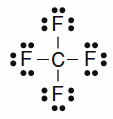
The molecule shown in the diagram can best be classified as a
a)
covalent molecule
b)
ionic molecule
73.
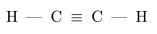
In the diagram shown, what is the total number of electrons shared in the bond between the two carbon atoms?
a)
2
b)
3
c)
4
d)
6
74.
Which substance contains bonds that involve a transfer of electrons from one atom to another?
a)
CO2
b)
NH3
c)
KBr
d)
Cl2
75.
How are covalent bonds explained?
a)
When one atom takes the other atom's electron
b)
When the atom shares an electron with an another atom
c)
When the two nucleus merge
d)
When the neutrons leave the nucleus
76.
How are ionic bonds formed?
a)
When atoms share an electron
b)
When opposite charged atoms attract
c)
When one atom takes a proton
d)
When one atom takes a neutron
77.
Why do ionic bonds form?
a)
so the number of protons equals the number of electrons
b)
to fill the outermost energy level
c)
so an atom can become unstable
78.
Atoms form ions in order to become this
a)
isotopes
b)
stable
c)
metals
d)
nonmetals
79.
What is a cation?
a)
positive ion
b)
Neutral atom
c)
Two additional protons
d)
negative ion
80.
What is an anion?
a)
positive ion
b)
negative ion
c)
neutral atom
d)
2 neutrons taken away
100 %

