
 Worksheets
Microscope
Total questions: 21
Worksheet time: 26mins
Name
Class
Date
1.
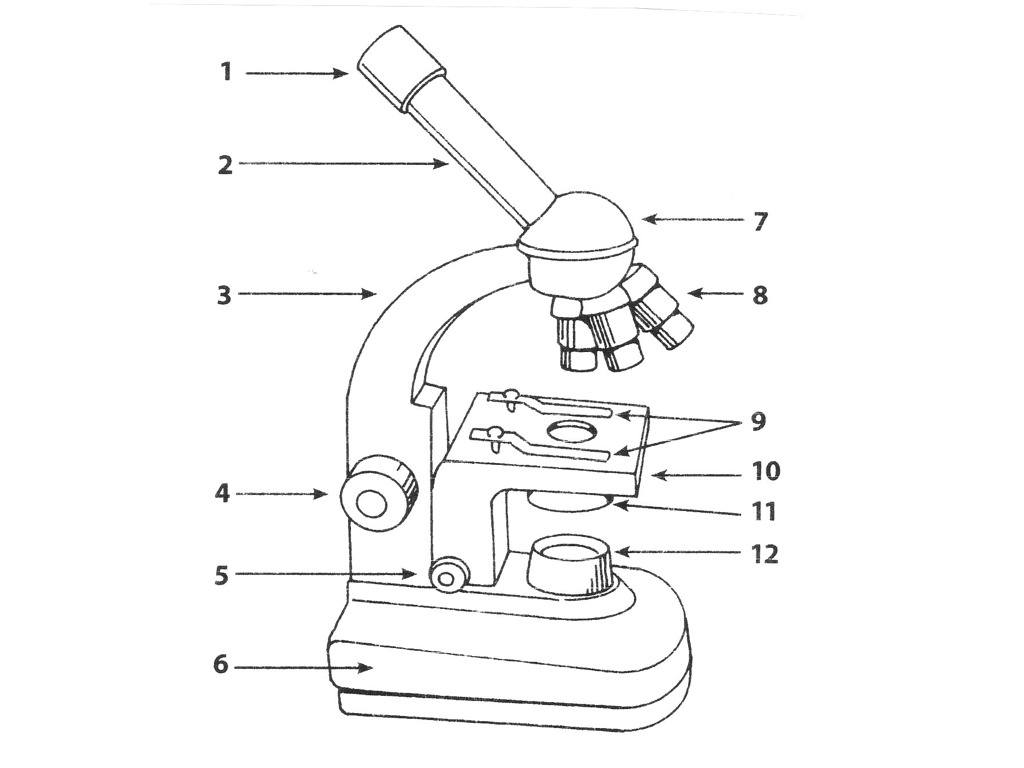
A microscope is an instrument that.
a)
makes faraway objects look closer.
b)
makes small objects appear larger.
c)
decreases the size of small objects.
d)
increases the size of small objects.
2.

If your teacher asks you to move a microscope to table, how do you carry it?
a)
by the body tube and the eyepiece
b)
with one hand
c)
one hand on the arm and the other under the base
d)
with one hand on the base and the other on the eyepiece.
3.

What does the word "microscopic" mean?
a)
Something that can't be seen with an eye alone
b)
A type of microscope
c)
Matter
d)
Mass that takes up space
4.
You should always carry the microscope by the
a)
arm and base
b)
arm and body tube
c)
arm only
d)
the objectives
5.
Find the total magnification:
Eyepiece = 10X
Objective lens = 55X
Eyepiece = 10X
Objective lens = 55X
a)
10x
b)
55x
c)
65x
d)
550x
6.
When looking at a specimen on your slide, you should always start with the
a)
low objective lens
b)
medium objective lens
c)
high objective lens
d)
super extra high power lens
7.
What power do you start with when using a microscope?
a)
High power
b)
Medium power
c)
Low power
d)
Extra high power
8.
The higher the magnification the ____ detail you see in the specimen
a)
more
b)
less
c)
the same
9.

What part is labeled with "J"?
a)
Stage Clips
b)
Stage
c)
Diaphragm
d)
Light Source
10.

What part is labeled with the letter "M"?
a)
Light Source
b)
Diaphragm
c)
Ocular Lens
d)
Arm
11.
What will be the total magnification if ocular lens is 10X and objective lens is 4X?
a)
4X
b)
40X
c)
10X
d)
100X
12.
What will be the total magnification if the ocular lens is 10X and the objective lens is 40X?
a)
40X
b)
10X
c)
100X
d)
400X
13.
You can find total magnification by which of the following methods?
a)
ocular PLUS objective
b)
ocular TIMES objective
c)
ocular MINUS objective
d)
ocular DIVIDED BY objective
14.
Magnifies the image (usually 10x) and you look into the scope here.
a)
Eyepiece/ Ocular
b)
arm
c)
low power objective
d)
fine adjustment
15.
Secures the slide in position for holding and viewing
a)
stage
b)
light source
c)
stage clips
d)
coarse adjustment knob
16.
Supports the microscope
a)
arm
b)
diaphragm
c)
base
d)
light source
17.
Supports and holds the slide
a)
eyepiece/ ocular
b)
arm
c)
base
d)
stage
18.
Controls the amount of light allowed to pass through the specimen
a)
diaphragm
b)
light source
c)
stage clips
d)
fine adjustment
19.
Provides light for viewing
a)
eyepiece/ ocular
b)
low power objective
c)
high power objective
d)
light source
20.
When looking at a specimen on your slide, you should always start with the
a)
low objective lens
b)
medium objective lens
c)
high objective lens
d)
super extra high power lens
21.
The higher the magnification, the ________ you see of the specimen.
a)
more
b)
less
c)
higher
d)
lower
100 %

