
NEW
Font size
S
M
L
XL
 Worksheets
Virus Quiz
Total questions: 22
Worksheet time: 22mins
Name
Class
Date
1.
Needs host cell to reproduce.
a)
Virus
b)
Bacteria
c)
Fungus
d)
Protozoan
2.
What happens in the lytic cyle?
a)
Virus goes in and leaves the host cell
b)
Virus quickly kills the host cell
c)
Virus sleeps inside of the host cell
d)
Virus stay dormant for a long time
3.
What happens in the lysogenic cycle?
a)
Virus goes in and leaves the host cell
b)
Virus quickly kills the host cell
c)
Virus inject the nucleic acid into the host cell, and the nucleic acid integrates into the host cell DNA, and stay dormant for a long time
d)
Bacteria injects DNA into a host cell
4.
The lytic cycle takes the longest out of the two viral reproductive cycles.
a)
True
b)
False
5.
What is the lytic and lysogenic cycle have in common?
a)
The host cell dies
b)
The virus dies
c)
The virus inserts its genetic information into the host cell
d)
copies of the virus are immediately released from the host
6.

What process is this?
a)
phagocytosis
b)
lytic cycle
c)
lysogenic cycle
d)
formation of antibodies
7.
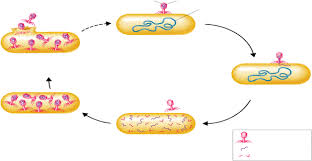
What is shown here?
a)
Lysogenic Cycle
b)
Lytic Cycle
c)
Binary Fission
d)
Conjugation
8.
This infectious viral disease has many symptoms, from chills, fever, and aching muscles to coughing and sneezing to nausea and vomiting. The symptoms show up within 2-7 days after the cell is infected. This is an example of?
a)
Lytic Cycle
b)
Lysogenic Cycle
c)
Meiosis
9.
Symptoms of HIV do not show up immediately because the virus can
a)
stay dormant for years
b)
mutate quickly
c)
stay outside the cell for a long time
10.
What is the difference between the lytic and lysogenic virus reproductive cycles?
a)
lysogenic is longer
b)
they are the same
c)
Lytic is longer
d)
Both are different each time
11.
A retrovirus is different from other viruses because retroviruses have __________ at their core.
a)
RNA and Reverse Transcriptase Enzymes
b)
RNA and Transcriptase Enzymes
c)
DNA and Reverse Transcriptase Enzymes
d)
DNA and Transcriptase Enzymes
12.
What is one way that a lysogenic infection differs from a lytic infection?
a)
A lysogenic virus does not act on bacteria as a lytic virus does.
b)
A lysogenic virus can remain in the host DNA for a longer period without becoming active.
c)
A lysogenic virus contains RNA instead of DNA.
d)
A lysogenic virus directs the production of new viruses right away.
13.
A _____________________ infection involves the phage combining its DNA with the host cells DNA. Often hiding for years.
a)
lysogenic
b)
lytic
c)
vaccine
d)
vinerial
14.
HIV is an example of which type of virus?
a)
Naked virus
b)
Bacterial
c)
Lytic
d)
Retrovirus
15.
What is the 1st step of virus infection?
a)
Entry
b)
Attachment
c)
Replication
d)
Assembly
16.

The lysing of a cell occurs in which phase?
a)
1
b)
2
c)
4
d)
5
17.
What happens before virus assembly during the lytic cycle?
a)
Attachment
b)
Entry
c)
Replication
d)
Lysis
18.
Influenza infects a cell and causes it to lyse immediately. Which type of virus is influenza?
a)
Lytic
b)
Lysogenic
c)
Bacterial
d)
None of the above
19.
HIV is an example of which type of virus?
a)
Lysogenic
b)
Bacterial
c)
Lytic
d)
None of the above
20.
Eukaryotes protect their genetic material inside a nucleus. What is the structure called that viruses protect their genetic material with?
a)
Capsid
b)
Nucleolus
c)
Glycoprotein
d)
McAfee
21.
All viruses contain-
a)
nucleic acids
b)
ribosomes
c)
mitochondria
d)
cytoplasm
22.
What is the capsid made from?
a)
proteins
b)
lipids
c)
carbohydrates
d)
nucleic acids
Reset

