wayground logo

Free Printable Worksheets

NEW

Font size

S
M
L
XL
Worksheets

Unit 2 Review: WAVES

Total questions: 40

Worksheet time: 44mins

Name
Class
Date
1.
How high or low a sound is perceived; depends on the frequency of the wave.
a)
pitch
b)
frequency
c)
sound
d)
medium
2.
Bending of waves around an object (such as through a doorway) is termed
a)
interference
b)
diffraction
c)
pitch
d)
volume
3.
The number of wavelengths that pass a point each second
a)
frequency
b)
wavelength
c)
pitch
d)
amplitude
4.
Material (matter) through which a wave travels
a)
medium
b)
Doppler Effect
c)
sound
d)
pitch
5.

The Doppler effect is the change in ______________ of a wave in relation to an observer who is moving relative to the wave source.

a)

amplitude

b)

loudness

c)

wave speed

d)

frequency

6.
A wave in which the vibration is in the same direction as that in which the wave is traveling; sound waves
a)
longitudinal wave
b)
ocean wave
c)
transverse wave
d)
mechanical wave
7.
The part of a longitudinal wave where the particles of the medium are close together.
a)
rarefaction
b)
compression
c)
crest
d)
trough
8.
The number of wavelengths that pass a point each second
a)
crest
b)
amplitude
c)
frequency
d)
pitch
9.
A ______ is a disturbance that transfers energy without transferring the matter with it.
a)
wave
b)
trough
c)
pitch
d)
sound
10.
A reflected sound wave
a)
frequency
b)
pitch
c)
echo
d)
rarefaction
11.

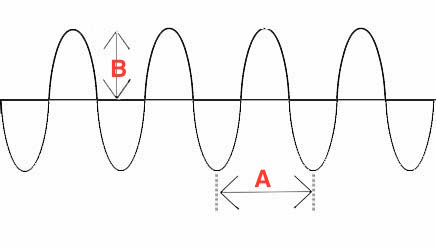
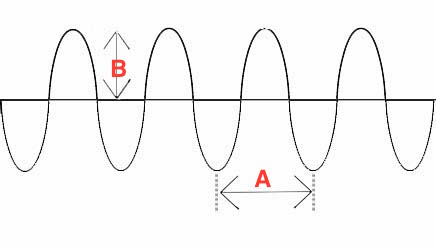
What property of this wave is represented by the letter "A"

a)

amplitude

b)

crest

c)

trough

d)

wavelength

12.
What property of the wave is represented by the letter "B"?
a)
amplitude
b)
crest
c)
trough
d)
wavelength
13.
The lowest point on a wave is the:
a)
Amplitude
b)
Crest
c)
Trough
d)
Wavelength
14.
The type of waves that require medium to pass:
a)
Mechanical Waves
b)
Electromagnetic Waves
15.
Which vocabulary term is used to identify the distance between points C & G?
a)
Amplitude
b)
Crest
c)
Frequency
d)
Wavelength
16.
When the frequency of a wave increases, what happens to the wavelength?
a)
The wavelength is not directly affected by the frequency of a wave.
b)
The wavelength increases.
c)
The wavelength decreases.
d)
More specific information is needed to form a conclusion about the wavelength.
17.
A mechanical wave cannot travel through...
a)
a vacuum(empty space).
b)
water.
c)
air. 
d)
glass.
18.
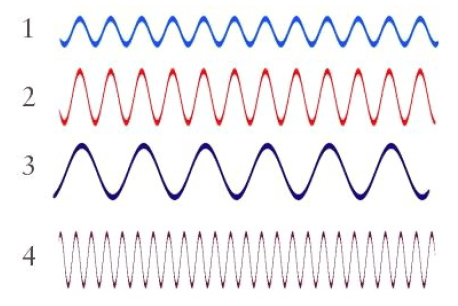
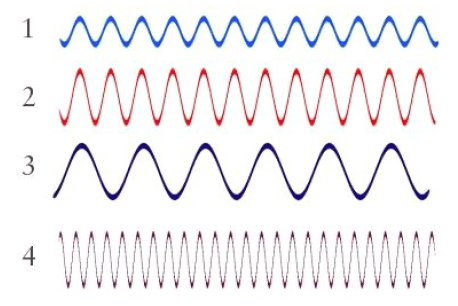
Which wave in the diagram has the greatest frequency?
a)
1
b)
2
c)
3
d)
4
19.
Which wave in the diagram has the greatest wavelength?
a)
1
b)
2
c)
3
d)
4
20.

Which of the following does sound travel the fastest?

a)

solid

b)

liquid

c)

gas

d)

plasma

21.

Electromagnetic waves include the following except

a)

radio waves

b)

X-rays

c)

sound wave

d)

microwaves

22.
which material does sound travel the fastest?
a)
a solid, such as a piece of glass
b)
a liquid, such as milk
c)
a gas, such as CO2
23.
When a wave strikes and object and bounces off. (example echo)
a)
medium
b)
refraction
c)
reflection
d)
interference
24.
When a wave bends as it passes through at an angle from one medium to another. 
a)
medium
b)
refraction
c)
reflection
d)
interference
25.
Which wavelength bends the easiest (because it is the shortest)?
a)
red
b)
yellow
c)
blue
d)
violet
26.
Light waves have long wavelengths
a)
True
b)
False
27.
What is reflection in simple terms?
a)
Soaks up light
b)
Passes through
c)
light bounces off
28.
What does refract mean?
a)
To shrink
b)
To bend
c)
To widen
d)
To enlarge
29.
Which type of electromagnetic radiation has the shortest wavelength?
a)
Radio Waves
b)
Visible Light
c)
Microwaves
d)
Gamma Rays
30.
Which type of visible light has the highest energy?
a)
Red
b)
Yellow
c)
Green
d)
Violet
31.
Which of the following types of radiation has the shortest wavelength and the highest frequency?
a)
Radio Waves
b)
Infrared
c)
Visible
d)
X-Rays
32.
Which of the following types of radiation has the shortest wavelength and the highest frequency?
a)
Radio Waves
b)
Infrared
c)
Visible
d)
X-Rays
33.
Another example of _____________  is the separation of white light into its individual colors by a glass prism.
a)
reflection
b)
rarefaction
c)
refraction
d)
diffraction
34.
This wave property determines the loudness of the sound or brightness of the light. 
a)
wavelength
b)
frequency
c)
resting position
d)
amplitude
35.
Which wave will be loud and have a low pitch?
a)
wave 1
b)
wave 2
c)
wave 3
d)
wave 4
36.

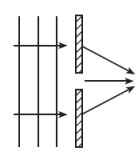
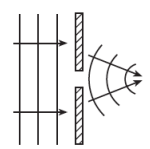
Which diagram best represents the shape and direction of a series of wave fronts after they have passed through a small opening in a barrier?
a)
b)
c)
d)
37.

Which wave phenomenon makes it possible for a player to hear sound from a referee's whistle in an open field even when standing behind the referee?

a)

diffraction

b)

Doppler effect

c)

reflection

d)

refraction

38.
According to the Law of reflection, a light ray striking a mirror
a)
continues moving through the mirror in the same direction
b)
moves into the mirror at a slightly different angle
c)
bounces off the mirror toward the direction it came from
d)
bounces off the mirror at the same angle it hits.
39.
The number of waves that passes through a point in one second is called ________.
a)
speed
b)
frequency
c)
wavelength
d)
amplitude
40.
Which is an example of electromagnetic wave?
a)
light
b)
x-rays
c)
radio
d)
All are examples of electromagnetic waves.