
 Worksheets
Early American Colonies
Total questions: 73
Worksheet time: 1hrs 13mins
Name
Class
Date
1.
Which of the following choices was not a reason that England started a colony in Jamestown?
a)
Increase wealth and power
b)
Find raw materials
c)
Trade with other countries
d)
To get a new King
2.
Which of the following is not a reason that the settlers chose the site for the Jamestown settlement?
a)
It had swamps
b)
Fresh supply of water
c)
Deep harbor to dock ships
d)
Easy to defend against attack
3.
As a result of French and Indian War, which of these groups gained territory in North America?
a)
Spain
b)
Britain
c)
France
d)
Canada
4.
In what year was Jamestown settled?
a)
1492
b)
1607
c)
1776
d)
2007
5.
Which of the following was not a hardship the settlers faced?
a)
Not enough safe drinking water
b)
Not enough survival skills
c)
The indians were nice to them.
d)
A harsh winter with little food
6.
Who said, "If you don't work, then you don't eat!"?
a)
Chief Powhatan
b)
Christopher Newport
c)
Lord De La Warr
d)
Captain John Smith
7.
What was the name of the indian girl who told the indians they should get along with settlers and help them survive?
a)
Belle
b)
Ariel
c)
Pocahontas
d)
Rapunzel
8.
What is one thing the Powhatan Indians traded to the settlers?
a)
Corn, beans, and squash
b)
money
c)
guns
d)
armor
9.
The most profitable agricultural product in the Virginia colony was
a)
lumber
b)
peanuts
c)
corn
d)
tobacco
10.

Why were Africans brought to Jamestown in 1619?
a)
To work on Sugar Plantations
b)
To seek Religious freedom
c)
To slave on tobacco plantations
d)
To fight against hostile Indians
11.
Why did the settlers select the name "Jamestown"?
a)
To honor their King James
b)
To honor a baby born on the ship
c)
To honor Saint James
d)
To honor the ship's captain
12.
Why did many of the men at Jamestown not want to work?
a)
They didn't know how.
b)
They forced the women to work.
c)
They wanted to hire American Indians to do the work.
d)
They were rich and used to having servants do all of their work in England.
13.
How did John Rolfe help Jamestown generate income for the Virginia Company?
a)
He introduced high-quality tobacco crops in the colonies
b)
He traded heavily with the natives
c)
He sold slaves for high profits
d)
Marrying Pocahontas
14.
A group of ordinary citizens that takes up weapons to fight for a cause
a)
National Guard
b)
Platoon
c)
Infantry
d)
Militia
15.
Britain wanted the Ohio River Valley for these reasons
a)
They wanted resources and Gold
b)
They wanted land and natural resources
c)
They wanted the Great Lakes region
d)
The British King was greedy
16.
The Proclamation of 1763 made this restriction.
a)
No one could hunt or fish without permission from the King
b)
No one could move west of the Appalachian Mountains
c)
Landowners could finally move west.
d)
Only wealthy people could move west
17.
Which group helped the French during the French-Indian War?
a)
The Native Americans in the Ohio Valley
b)
Royal Canadian Mounted Police
c)
Lewis & Clark
d)
The French Fur Trappers
18.
The religious movement that encouraged people to return to their faith was called?
a)
The Magnificent Magnification
b)
The Great Depression
c)
The Bourne Significance
d)
The Great Awakening
19.
As a result of the French & Indian War, which of the following gained territory in North America?
a)
Spain
b)
France
c)
Canada
d)
Britain
20.
Which of these is a result of the French & Indian War?
a)
The British had a large war debt.
b)
The colonists were given their independence.
c)
The British government stayed out of colonial politics.
d)
The colonists were free to move West of the Appalachians.
21.
Which group formed the Sons of Liberty?
a)
Patriots
b)
Loyalists
c)
British soldiers
d)
American Indians
22.
What did the colonists resent most about the Stamp Act?
a)
They didn't believe in taxation.
b)
They had no representatives to vote on the tax.
c)
People living in Great Britain didn't have to pay taxes.
d)
People in Great Britain were taxed only on their property.
23.
When the colonists protested the Stamp Act, how did Parliament respond?
a)
Repealed the Stamp Act
b)
Increased the tax on paper
c)
Refused to sell stamps to the colonists
d)
Arrested those who complained about the Stamp Act
24.

Which of these belongs in place of the question mark in the image?
a)
Proclamation of 1763
b)
French & Indian War
c)
Boycott of British goods
d)
Expansion of the British Empire
25.
The event known as the Boston Massacre was called this in order to
a)
create anti-British feelings
b)
create trouble for the American colonists
c)
warn about a disease in the city
d)
describe the truth about what happened
26.

Why did John Adams defend British soldiers after the Boston Massacre?
a)
He was against the colonists.
b)
He believed that every person had a right to a fair trial.
c)
He believed the British soldiers were not guilty of murder.
d)
He was a Loyalist that wanted to strengthen British rule.
27.

How did many of the Loyalists view the Patriots?
a)
brave soldiers
b)
foreign invaders
c)
ungrateful rebels
d)
friendly neighbors
28.

Which of the following should replace the ? in the diagram?
a)
the Stamp Act
b)
the Intolerable Acts
c)
the Boston Massacre
d)
the Proclamation of 1763
29.
How did Great Britain increase control over the colonies?
a)
It took away colonists' land.
b)
It required that colonists pay taxes.
c)
It demanded that colonists join the army.
d)
It forced colonists to work for the government.
30.

What was a goal of the First Continental Congress?
a)
to declare war on Great Britain
b)
to find a solution to the conflicts with Great Britain
c)
to create taxes that would be acceptable to the Americans
d)
to bring representatives from Great Britain and America together
31.
How did the colonists view themselves in 1774?
a)
as united Americans
b)
as dependent on the King of England
c)
as citizens of their individual colonies
d)
as united under the British government
32.
The colonists considered this an act of tyranny.
a)
the Boston Tea Party
b)
the Proclamation of 1763
c)
the French & Indian War
d)
the First Continental Congress
33.
What became obvious after the colonists fought the British at Lexington and Concord?
a)
The British feared the militia.
b)
The British were eager to start a war with the Colonies.
c)
The colonial militia was no match for the well-trained British troops.
d)
The colonists were willing to fight for the right to govern themselves.
34.
Who won the battles in the end?
a)
The English soldiers
b)
No one won
c)
The minutemen
35.
Why did the soldiers march to Concord?
a)
They marched to Concord to burn houses
b)
They didn't march to Concord
c)
They marched to Concord to destroy weapons
36.
Lexington and Concord were the first battles in what war?
a)
Revolutionary War
b)
World War I
c)
War of 1812
37.
Who jumped on the horse to warn the colonist that the British were coming?
a)
Paul Revere
b)
King George III
c)
John Adams
38.
What are militia?
a)
People who are ready to fight in minutes
b)
Everyday people training for battle
c)
Soldiers coming from England
39.
Where did the colonist hide their weapons?
a)
Boston
b)
Lexington
c)
Concord
40.
The battle of Lexington was the result of…
a)
Boston Tea Party
b)
Boston Massacre
c)
General Gage ordering troops to get colonial weapons
41.
The "shot heard 'round the world" was which battle?
a)
Battle of Bunker Hill
b)
Battle of Lexington and Concord
c)
Battle of Trenton
42.
The _____________ were colonists that did not want to separate from Britain.
a)
militia
b)
Loyalists
c)
Patriots
d)
minutemen
43.
The __________ were colonists that supported independence from Britain.
a)
militia
b)
Loyalists
c)
Patriots
d)
minutemen
44.
Why did General Thomas Gage send troops to Lexington and Concord?
a)
to seize weapons and arrest leaders
b)
to meet with the local governors
c)
to buy weapons and pay Paul Revere
d)
to arrest George Washington
45.

What as the name of the political body that represented Americans and challenged British control?
a)
Coercive Acts
b)
Continental Congress
c)
Sons of Liberty
d)
Suffolk Resolves
46.

What was the immediate effect due to the passing of the Stamp Act in 1765?
a)
Colonists sought military support from France.
b)
Colonists organized boycotts of British goods.
c)
Colonists signed the Declaration of Independence.
d)
Colonists dumped tea into the Boston Harbor
47.

The Sugar Act, Quartering Act, and the Stamp Act all contributed to the start of the Revolutionary War by....
a)
Restricting trade with American Indians
b)
Imposing regulations on colonial agriculture
c)
Angered colonists who believed that civil liberties had been violated
d)
Punishing colonists for resisting the authority of Parliament
48.

British colonists objected to the Proclamation of 1763 because they--
a)
Feared it would provoke attacks from American Indians
b)
Did not want to share control of the fur trade with France
c)
Resented the limits it imposed on westward expansion
d)
Wanted to be able to trade freely with foreign nations
49.
Arguably the first "battle" of the Revolutionary War occurred when the Massachusetts Minutemen fired on British troops at -
a)
Boston
b)
Philidelphia
c)
Saratoga
d)
Lexington and Concord
50.

After colonist threw rocks, sticks and snowballs at British forces, this event happened leading to tense relations between the British military and colonists.
a)
firing on Lexington and Concord
b)
Boston Tea Party
c)
Boston Massacre
d)
Battle at Bunker Hill
51.
What was the colonial response to the Tea Act?
a)
Boston Massacre
b)
The battle at Lexington
c)
The Quartering Act
d)
The Boston Tea Party
52.
What was Britain’s response to the Boston Tea Party?
a)
The Intolerable Acts
b)
The Stamp Act
c)
The Townshend Act
d)
Sugar Acts
53.
The 1st Continental Congress was a response for which Act?
a)
Intolerable
b)
Stamp
c)
Townshend
d)
Quartering
54.
The Quartering Act stated that…
a)
British soldiers could stay in private colonial homes
b)
Colonists could stay in British forts
c)
King George could stay in any colonial home
d)
Colonist had to pay a quarter tax for a pound of tea
55.
The _________________ Act is defined as a tax on paper
a)
Tea
b)
Food
c)
Stamp
d)
Intolerable
56.
The colonists did what to protest British goods?
a)
Send goods back
b)
boycott
c)
pickett
d)
yell at British soldiers
57.

A loyalist supported the cause of liberty from England.
a)
True
b)
False
58.

Samuel Adams, John Adams, Paul Revere and John Hancock all were_______ who supported the rebel cause.
a)
Patriots
b)
Loyalists
c)
Neutrals
d)
Republicans
59.

What is the name of the southern most colony?
a)
South Carolina
b)
North Carolina
c)
Georgia
d)
Maryland
60.
What is Parliament?
a)
a formal agreement among groups or individuals
b)
representatives
c)
a plan for spending money
d)
the lawmaking branch of the British goernment
61.

Who won the French and Indian War?
a)
British
b)
French
c)
Germans
d)
Russians
62.
What led to the French and Indian War?
a)
Conflict over control of the Ohio Valley
b)
French raids on English towns
c)
Native Americans were attacked by the French
d)
Conflict over control of Florida
63.

Define boycott.
a)
An organized campaign to refuse to buy certain products
b)
import tax
c)
Citizen soldiers who could be ready to fight at a minute's notice
d)
to surrender
64.
Taxation without Representation meant...
a)
Colonists weren't given free speech
b)
Parliament did not have delegates from the colonies
c)
Colonists didn't have money to pay taxes
d)
The colonists votes didn't count for enough
65.

What was the French and Indian War fought over?
a)
Land east of the Appalachian Mts
b)
Land west of the Appalachian Mts
c)
Economic freedom from England
d)
Political freedom from England
66.
After the war is over, Indians still lived in the Ohio River Valley which now belongs to England, to avoid conflict with the Indians what does the King order with the Proclamation of 1763?
a)
colonists are free to go west of the Appalachian Mts.
b)
Colonists are free to trade with the Indians of the Ohio River Valley
c)
colonists are forbidden to move west past the Appalachian Mts
d)
colonists are free to do whatever they want
67.
Colonists are not just angry about the taxes, the are angry they don't have a say in the passage of the taxes. What becomes their rallying cry?
a)
"Read my lips, No new taxes"
b)
"No taxation without Representation"
c)
"Taxes, we won't pay your stupid taxes"
d)
"Tax only the rich"
68.
After the French and Indian War, Britain __________ the colonists to pay of the war debt.
a)
taxed
b)
attacked
c)
enslaved
d)
jailed
69.
What was the 1st armed conflict or battle of the American Revolution?
a)
Lexington and Concord
b)
Saratoga
c)
Yorktown
d)
Seven Pines
70.
Which of the following is TRUE about the 1st Continental Congress?
a)
They declared war on Britain
b)
All the colonies except of Georgia went
c)
They decided to surrender to Britain
d)
They passed additional taxes on the colonists
71.
The ________ Branch of government makes the laws.
a)
Judicial
b)
Executive
c)
Legislative
d)
Bicameral
72.
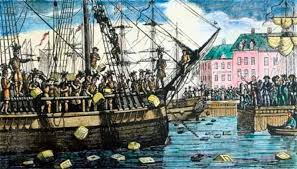
Samuel Adams and Paul Revere led members of the Sons of Liberty in this protest against taxes.
a)
First Continental Congress
b)
Boston Massacre
c)
Boston Tea Party
d)
Stamp Act Congress
73.
Patriots were known as Wigs. Loyalists were known as ___________________.
a)
Tories
b)
Americans
c)
Republicans
d)
Brown Beauty
100 %

