
Font size
S
M
L
XL
 Worksheets
Section Test Two
Total questions: 100
Worksheet time: 2hrs 50mins
Name
Class
Date
1.
This system is used to elect the president of the United States
a)
The Electoral College
b)
The Popular Vote
c)
The Paper Ballot
d)
The Winner Take All System
2.
What are the three requirements in the Constitution to be President?
a)
Must be 35, a US Citizen, and a resident for 14 years
b)
Must be 35, a natural born citizen, and a resident of 14 years
c)
Must be 35 and no older than 75, a US citizen, and a resident
d)
Must be 30, a natural born citizen, and a resident for 9 years
3.
The President may serve how many terms and how long are they?
a)
4 terms for 6 years each
b)
2 terms of 8 years each
c)
1 term for 4 years
d)
2 terms of 4 years each
4.
The unofficial qualifications for president include all EXCEPT
a)
To be married
b)
To have some experience in government
c)
To be educated
d)
To be rich
5.
As Chief Legislator the president may do all of the following except
a)
Address Congress to promote his agenda
b)
Propose legislation to be taken up by Congress
c)
Sign executive orders
d)
Make laws by himself
6.

The President has all of the following options when presented with legislation EXCEPT.
a)
Veto It
b)
Sign It
c)
Leave it unsigned on his desk for 10 days
d)
Ignore it
7.

President Carter acted as a Chief Diplomat when he brought the following two nations together to sign a peace accord.
a)
France and Germany
b)
Israel and Iran
c)
Iraq and Kuwait
d)
Egypt and Israel
8.
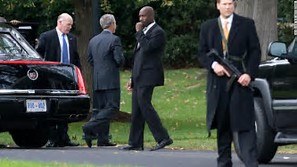
The organization that is charged with protecting the president is called
a)
US Marshals
b)
The Avengers
c)
MI6
d)
The Secret Service
9.

President Reagan acted as the Chief Communicator when he did the following.
a)
Invaded Grenada
b)
Negotiated an arms limitation treaty
c)
Addressed the nation after the Challenger disaster
d)
Pulled the Marines out of Lebanon
10.

When President Truman desegregated the military, he did so acting in what role?
a)
Commander in Chief
b)
Chief Citizen
c)
Chief Legislator
d)
Chief Negotiator
11.

President Kennedy faced a foreign policy crisis early in his presidency. What was this event called?
a)
The Iran-Contra Affair
b)
The Iran Hostage Crisis
c)
The Cuban Missile Crisis
d)
The Olympic Boycott
12.
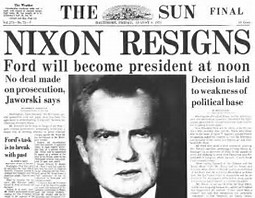
The following scandal led to President Nixon's resignation as president.
a)
The Bay of Pigs
b)
The Iran-Contra Affair
c)
The XYZ Affair
d)
Watergate
13.
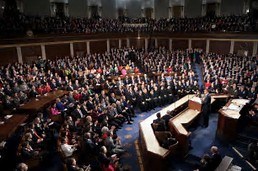
How does the president put forth his legislative agenda for the nation?
a)
Through executive orders
b)
In the State of the Union Address
c)
In his orders to Congress
d)
Through his military authority
14.

The first televised debate was between which two candidates?
a)
Truman and Dewey
b)
Carter and Reagan
c)
Kennedy and Eisenhower
d)
Nixon and Kennedy
15.
The branch of government responsible for executing or carrying out the law.
a)
Legislative
b)
Executive
c)
Judicial
16.

How does foreign policy pertain to the President of the United States
a)
As chief diplomat of the United States the president directs foreign ambassadors, negotiates treaties and trade agreements with leaders of other nations
b)
The president decides when and where military force can be used and if war is declared
c)
The president issues the necessary funding regarding foreign affairs
d)
The president negotiates and ratifies all treaties with other nations
17.

Article 2 Sec. 3 of the U.S. Constitution requires the President to do what every January
a)
Submit an annual budget
b)
Give a State of the Union Address to the American people
c)
Meet with his/her cabinet members to plan policy for the upcoming year
d)
Speak before the United Nations General Assembly
18.

Presidential Succession. If the president were to die while in office, who are the next two officials in line to succeed him in office
a)
The Vice President and the Secretary of State
b)
The Vice President and the Senate Majority Leader
c)
The Vice President and the Speaker of the House
d)
The Vice President and the President Pro Tempore
19.

Why is the ability to use the media vital to the president
a)
The president can appeal directly to the people and persuade them to agree with him or her
b)
The president can manipulate and maneuver around Congress to pass legislation
c)
Presidents are careful when using the media because it may work against them
d)
Most presidents shy away from the media only using it when it furthers their agenda
20.
How are the electoral college votes for each state determined?
a)
The individual parties decide how many votes each state has.
b)
The number of representatives each state has in the House plus each state's two senators determine the number of votes a state has.
c)
The Congress decides how many votes a state has.
d)
This is determined by the Federal Election Commission.
21.
How many times in the last 17 years has the winner of the popular vote lost the electoral college vote?
a)
Twice
b)
Four times
c)
Three times.
d)
Never
22.

Ronald Reagan acted as both chief diplomat and chief communicator when he did the following
a)
Informed the nation of the invasion of Grenada
b)
Consoled the nation after the Shuttle Challenger explosion
c)
Addressed the nation after the Iran-Contra scandal
d)
Called on Russia to "tear down this wall" when speaking before the Berlin Wall.
23.
The principle intermediary between the president and the public is
a)
congress.
b)
The Vice President.
c)
The Press Secretary.
d)
the Media.
24.
What is the line in Kennedy's inaugural address he is famous for?
a)
Ask not what your country can do for you, ask what you can do for your country
b)
I walk slowly, but I never walk backward
c)
The only man who makes no mistake is the man who does nothing
d)
I would rather belong to a poor nation that was free than to a rich nation that had ceased to be in love with liberty
25.
What failed invasion of Cuba embarrassed JFK & led to his distrust of the CIA?
a)
Bay of Pigs
b)
D-Day
c)
Operation Havana
d)
Cuban Offensive
26.
On what day do many states hold their primary elections?
a)
Right after the Iowa caucuses
b)
March 1
c)
Super Tuesday
d)
The week before the national convention
27.
Who is the only President to have served more than two terms?
a)
Teddy Roosevelt
b)
Franklin Delano Roosevelt
c)
Ronald Reagan
d)
George Washington
28.
The only President to resign his office was
a)
Jimmy Carter
b)
Andrew Johnson
c)
Richard Nixon
d)
Millard Fillmore
29.
The following are all examples of Interest Groups EXCEPT
a)
The National Rifle Association (NRA)
b)
The American Association of Retired Persons (AARP)
c)
The National Highway, Traffic, and Safety Administration (NHTSA)
d)
The American Medical Association (AMA)
30.

The legislative branch is made up of what two governing bodies?
a)
The president and the supreme court
b)
The House of Representatives and the Senate
c)
Committees and caucuses
d)
The Congress and the Executive
31.
How many members of the House of Representatives are there?
a)
535
b)
100
c)
435
d)
465
32.

The practice of redrawing a congressional district boundary to benefit one party is called...
a)
Gerrymandering
b)
Boundary Fixing
c)
Party Redistricting
d)
District Drawing
33.

A person or group who attempts to influence how a member of Congress votes on a piece of legislation is called a...
a)
Influence Peddler
b)
Lobbyist
c)
Groupie
d)
Gift-Giver
34.

The part of the Constitution that describes the legislative branch is _________________-
a)
Preamble
b)
Article I
c)
Article II
d)
Amendments
35.

The chair of a committee has all of the following powers EXCEPT
a)
The ability to subpoena evidence and witnesses
b)
The ability to decide what legislation the committee will discuss and vote on
c)
The ability to launch investigations into issues related to the committee
d)
The ability to approve legislation without the committee
36.

How many seats in the House of Representatives must one party hold to have a majority?
a)
250
b)
190
c)
218
d)
435
37.

What are the three types of Congressional committees?
a)
Permanent, temporary, and issue driven.
b)
Standing, issue driven, and joint.
c)
Democratic, Republican, and Independent.
d)
Standing, Select, and Joint.
38.
BEFORE to the 17th Amendment was passed, how were Senators elected?
a)
They were elected by popular vote.
b)
They were appointed by state governors.
c)
They were elected by state legislators.
d)
They were elected by the House of Representatives.
39.
This rule in the House of Representatives requires a bill have "the majority of the majority" before it can brought to the floor for a vote.
a)
The Pelosi Rule
b)
The Trump Policy
c)
The Hastert Rule
d)
The McConnell Policy
40.
Who decides what bills are brought before the House of Representatives for a full vote?
a)
The Majority Leader
b)
The committee chair
c)
The majority of the majority party.
d)
The Speaker of the House
41.
What must happen to a bill before it can be voted on by the whole House of Representatives or Senate?
a)
It must be first scored by the CBO
b)
It must pass through a committee with a majority of votes
c)
It must be signed by the President
d)
It must be screened by the Supreme Court
42.
The Speaker of the House and the Senate Majority Leader both have the following powers EXCEPT
a)
The ability to appoint committee chairs
b)
The ability to choose what legislation is brought before the House or the Senate
c)
The ability to "kill" any legislation they don't approve of.
d)
They are both the 3rd in line for the presidency
43.
How many standing committees are in the House of Representatives?
a)
16
b)
20
c)
18
d)
10
44.
Bills that involve taxing and spending must begin from what branch of congress?
a)
The House of Representatives
b)
The Senate
45.
When NOT in session, members of congress have the opportunity to do all of the following EXCEPT?
a)
Meet their constituents in town hall meetings
b)
Meet in committee to discuss bills
c)
Meet with donors and lobbyists
d)
Raise money for re-election.
46.
Which of the following MUST start in the House of Representatives?
a)
Impeachment Proceedings
b)
Presidential Nominations
c)
Treaty Approvals
d)
Declarations of War
47.

What powers are exclusive to the Senate?
a)
Spending the government's money.
b)
Impeachment proceedings, presidential nominations, and approving tariffs.
c)
Approving presidential nominations, declaring war, and approving treaties.
d)
Investigating government agencies, approving presidential nominations, and declaring war.
48.

Who creates the boundaries of US Congressional districts?
a)
State Representatives
b)
State Legislature using Census info.
c)
State Governors
d)
The President
49.
How many electoral college votes must a candidate have to win the presidency?
a)
100
b)
538
c)
270
d)
261
50.
How many electoral college votes are there?
a)
400
b)
435
c)
535
d)
538
51.

This woman was the first woman appointed to the supreme court.
a)
Sonia Sotomayor
b)
Sandra Day O'Connor
c)
Hillary Clinton
d)
Eleanor Roosevelt
52.
What is the first level of the federal court system?
a)
District Court
b)
Circuit Court
c)
Supreme Court
d)
Trial Court
53.
The Federal Court System is made up of all of the following levels EXCEPT
a)
District
b)
Circuit
c)
Probate
d)
Supreme
54.
This legal concept was established in the case of Marbury v Madison and forms the foundation of the court's authority.
a)
Judicial Review
b)
Judicial Restraint
c)
Judcial Activism
d)
Judicial Legislation
55.
This law enforcement agency is the only one that is under the Judicial Branch and is the oldest law enforcement agency in the country.
a)
The FBI
b)
The Secret Service
c)
The US Marshals Service
d)
The State Police
56.
What are the Constitutional requirements to be a Supreme Court Justice?
a)
To have a law degree and to be appointed by the President.
b)
To be nominated by the President and approved by the Senate.
c)
To have prior experience as a judge, to be nominated by the President, and approved by the Senate.
d)
To win a national election for the office of Justice.
57.
All of the following are roles of the US Marshal Service EXCEPT
a)
Witness Security
b)
Judicial Security
c)
Fugative Operations
d)
Border Security
58.
The reluctance to interpret the law and to hesitate to overturn existing legal precedent unless it is obviously unconstitutional is called what?
a)
Judicial Restraint
b)
Judicial Activism
c)
Constitutional Interpretation
d)
The Status Quo
59.
Of the three levels of Federal Courts, which one utilizes a jury?
a)
District
b)
Circuit
c)
Supreme
d)
All of them
60.
In the Brown v Board of Education case, what was the practice that the court had established in Plessy v Fergusson, but that was now being viewed as possibly unconstitutional?
a)
The Monroe Docrine
b)
Separate But Equal
c)
Equal Protection of the law
d)
The Doctrine of Dred Scott
61.
The practice of interpreting the Constitution in light of the norms and values of present day society is often referred to as
a)
Judicial Restraint
b)
Constitutional Interpretation
c)
Originalism
d)
Jurist Prudence
62.
On the Supreme Court, who assigns the writing of the majority decision?
a)
The ranking justice.
b)
The Chief Justice
c)
Whichever justice wants to write the decision
d)
They take turns.
63.
Who was the Chief Justice who wrote the Brown v Board of Education decision?
a)
John Marshall
b)
Earl Warren
c)
Thurgood Marshall
d)
John Roberts
64.
In the Brown v Board of Education case, what organization provided the legal counsel to argue the case in favor of desegregation?
a)
The NRA
b)
The State of South Carolina
c)
The NAACP
d)
The AARP
65.
A court not ruling on a case involving abortion or wire tapping phones because neither is specifically mentioned in the Constitution is an example of what practice?
a)
Jurist Prudence
b)
Originialism
c)
Constitutional Interpretation
d)
Separate But Equal
66.
Why was the case of Bush v Gore considered an example of Judicial Activism by critics?
a)
Because the case had not been challenged in a lower court first.
b)
Because there were not four judges who wanted to take the case.
c)
Because the Supreme Court had never before ruled on how a state could run its election process.
d)
Because there was no law that was being challenged.
67.
All of these were lasting impacts of the Loving v Virginia case EXCEPT
a)
Interracial marriage became legal throughout the United States.
b)
The case became a precedent for other cases involving marriage.
c)
It established that states could pick and choose what individual liberties they would recognize.
d)
It allowed each state to decide what marriages it would recognize.
68.
This deputy US Marshal would be the first African American marshal, serve 32 years, bring in more than 3,000 felons, and be considered the most feared lawman of the late 19th Century. (He also would be the inspiration for the character of The Lone Ranger)
a)
James McQuade
b)
Bass Reeves
c)
Mariam Rogers
d)
Wyatt Earp
69.
This lawyer would head up the NAACP Legal Defense Fund, argue the Brown v Board of Education case before the Supreme Court, and eventually become the first African American justice on the Supreme Court.
a)
William O. Douglas
b)
Earl Warren
c)
Thurgood Marshall
d)
Clearance Thomas
70.
Why do federal judges enjoy lifetime tenure?
a)
To ensure the system of checks and balances
b)
To strengthen their jurisdiction over state courts
c)
To limit the power of the legislative and executive branches
d)
To maintain their independence from political and popular pressures
71.
Role of the judicial branch
a)
make laws
b)
interpret laws
c)
enforce laws
d)
impeach a president
72.
Role of the executive branch
a)
make laws
b)
interpret laws
c)
enforce laws
d)
veto laws
73.
Role of the legislative branch
a)
Make laws
b)
Interpret laws
c)
Enforce laws
d)
Nominate Supreme Court justices
74.

In _____ v. _____ the Supreme Court ruled that slaves were property, not citizens, and had no rights under the Constitution. Also, that slavery couldn't be banned anywhere in the U.S.
a)
Korematsu v. U.S.
b)
Tinker v. Des Moines
c)
Dred Scott v. Sandford
d)
Miranda v. Arizona
75.

The ___ is the highest law in the United States.
a)
Declaration of Independence
b)
Articles of Confederation
c)
Monroe Doctrine
d)
Constitution
76.

1896- established “separate but equal” by which segregation became legal as long as the facilities for each race w
a)
Regents of the University of California v. Bakke
b)
McCulloch v. Maryland
c)
Plessy v. Ferguson
d)
Brown v. Board of Education
77.
The Supreme Court ruled that your 5th amendment right of self-incrimination and 6th amendment right to a lawyer must be read to you at the time of arrest.
a)
Miranda v. Arizona
b)
Engel v. Vitale
c)
Hazelwood v. Kuhlmeier
d)
Gideon v. Wainwright
78.
During WWII, the Supreme Court ruled that relocation of Japanese-American citizens to internment camps was constitutional. Over 40 years later, it was officially admitted that this ruling was in violation of the concept of limited government.
a)
Korematsu v. US
b)
University of California v. Bakke
c)
Roe v. Wade
d)
Gideon v. Wainwright
79.
In 1973, the court legalized abortion by saying that states could not make laws that would ban abortion citing a woman’s right to privacy.
a)
Gibbons v. Ogden
b)
Mapp v. Ohio
c)
Roe v. Wade
d)
Marbury v. Madison
80.
One opposes abortion, high taxes and immigration reform. This person would lean mostly to the...
a)
Left
b)
Right
c)
Independent
81.

More voters tend to go the polls to vote in what type of election?
a)
Off-year
b)
Mid-term
c)
Presidential
d)
Local
82.
People who fall into this category support funding of social programs, higher taxes in order to provide government services, and government involvement in regulating the economy.
a)
Liberal
b)
Moderate
c)
Conservative
83.

People who fall into this category support low taxes, limited government involvement in regulating the economy and funding for a strong national defense.
a)
Liberal
b)
Moderate
c)
Conservative
84.

The two major political parties in the United States today are
a)
Democrats and Republicans
b)
Republicans and Independents
c)
Democrats and Independents
d)
Green party and Libertarian Party
85.
Primary election in which only persons registered in the party holding the primary may vote
a)
Direct Primary
b)
Open Primary
c)
Closed Primary
d)
Mixed Primary
86.
A political party's statement of its goals and policies for the next four years. It is the best formal statement of a party's beliefs.
a)
Party Platform
b)
Republic
c)
Public Morality
d)
Popular Sovereignty
87.
Primary election in which any registered voter may vote
a)
Closed Primary
b)
Open Primary
c)
Mixed Primary
d)
Direct Primary
88.
Which branch of government do the supreme court justices work under?
a)
Executive
b)
Legislative
c)
Judicial
d)
All branches
89.
Which branches of government does the president work under?
a)
Legislative
b)
Judicial
c)
All branches
d)
Executive
90.
According to the Constitution, how many judges are to be on the Supreme Court?
a)
It leaves that to the court to decide.
b)
It doesn't say.
c)
The president decides.
d)
Nine
91.
This decision resolved the election of 2000
a)
US vs. Nixon
b)
McCulloch vs. Maryland
c)
Bush vs. Gore
d)
Citizens United vs FEC
92.
One of the most influential Supreme Court Justices; he helped establish the idea of Judicial Review which made the Supreme Court the powerful institution it is today.
a)
John Marshall
b)
John Smith
c)
John Q. Adams
d)
John Rolfe
93.
This Supreme court decision serves as a reminder that rule of law applies to the President of the United States.
a)
United States v. Nixon
b)
Miranda v Arizona
c)
Bush v. Gore
d)
Washington D. C. v Heller
94.
Using a prior court decision as the foundation for a current court decision is called what?
a)
Anticedent
b)
Judicial Scafolding
c)
Legal Stacking
d)
Legal Precedent
95.
When are the presidential nominees for the two major parties *formally* chosen?
a)
When the electoral college meets in December
b)
At the national party conventions
c)
After the New Hampshire primary
d)
After Super Tuesday
96.
This Supreme court decision serves as a reminder that rule of law applies to the President of the United States.
a)
United States v. Nixon
b)
Miranda v Arizona
c)
Bush v. Gore
d)
Washington D. C. v Heller
97.
Most states give all of their electoral college votes to the candidate that wins the popular vote in that state. This practice is called what?
a)
The Spoils System
b)
The Winner Take All System
c)
The Proportional System
d)
The All In System
98.
How many electoral college votes does Georgia Have?
a)
23
b)
55
c)
10
d)
16
99.
The bigger the ___________________ of a state the more electoral votes a state receives.
a)
trees
b)
land
c)
population
d)
ceiling fans
100.
A common criticism of the Electoral College is that it
a)
Gives too much power to big states
b)
Does not reflect the idea of "one person - one vote"
c)
Gives too much power to small states
Reset

