wayground logo

Free Printable Worksheets

Font size

S
M
L
XL
Worksheets

American Imperialism & WWI

Total questions: 95

Worksheet time: 1hrs 7mins

Name
Class
Date
1.

This foreign policy idea promotes staying out of world affairs.

a)

Imperialism

b)

Isolationism

c)

Globalism

d)

Communism

2.

This type of foreign policy encourages stronger nations to extend their influence over weaker ones.

a)

Imperialism

b)

Isolationism

c)

Globalism

d)

Communism

3.

Identify reasons for American Imperialism (multiple answers)

a)

Economic Interests

b)

Military Interests

c)

Cultural Superiority

d)

Self Interests

4.

Why did America annex Hawaii in 1898?

a)

Beautiful beaches

b)

Sugar Cane plantations

c)

It's location in the Pacific Ocean

d)

Tourism benifits

5.

Which American Secretary of State promoted an 'open door ' policy with China?

a)

John Kennedy

b)

John Lennon

c)

John Wayne

d)

John Hay

6.

Why was the purchase of Alaska criticized at the time?

a)

It was too expensive.

b)

It was too far away.

c)

It was seen as worthless.

d)

It was seen as too cold.

7.

Why was the queen of Hawaii overthrown in 1893?

a)

She was not liked by her subjects

b)

She tried to limit the influence of foreigners

c)

She tried to make the monarch too powerful

d)

She tried to give better treatment to native Hawaiians

8.

Theodore Roosevelt commanded a cavalry unit in Cuba known as the

a)

Rough Rollers

b)

Rough Riders

c)

Rough Company

d)

Rough Racers

9.

These types of exaggerated news stories helped push the U.S. into war with Spain.

a)

Red Journalism

b)

Orange Journalism

c)

Yellow Journalism

d)

Green Journalism

10.

The Platt Amendment

a)

gave the U.S. the right to intervene in Puerto Rico's business at any time it wanted.

b)

gave the U.S. the right to intervene in the Philippine Island's business any time it wanted.

c)

gave the U.S. the right to intervene in Hawaii's business any time it wanted.

d)

gave the U.S. the right to intervene in Cuba's business any time it wanted.

11.

This American organization was opposed to the U.S. becoming an empire.

a)

Anti-nationalist league

b)

Anti-immigration league

c)

Anti-imperialist league

d)

Anti-internationalist league

12.

America first attempted to buy land to build the Panama Canal from what country ?

a)

Cuba

b)

Columbia

c)

Croatia

d)

Cambodia

13.

How did America end up getting the land it needed to build the Panama Canal?

a)

We supported a revolution in Columbia.

b)

We supported a revolution in Cuba

c)

We supported a revolution in Croatia

d)

We supported a revolution in Cambodia

14.
Which of the following defines the Roosevelt Corollary?
a)
Europe was not allowed to imperialize the Americas
b)
America was the police force for the Western Hemisphere
15.
Which country was imperializing Cuba before the US took it over?
a)
France
b)
Spain
c)
Colombia
d)
Mexico
16.
Which of the following defines the Monroe Doctrine?
a)
Europe was not allowed to imperialize the Americas
b)
America was the Police force for the Western Hemisphere
17.
Which of the following men would not be considered an interventionist?
a)
Teddy Roosevelt
b)
Alfred T Mahan
c)
Mark Twain
d)
Albert Beveridge
18.
What book did Alfred T Mahan write?
a)
The Jungle
b)
How the Other Half Lives
c)
The Influence of Naval Power Upon History
d)
Adventures of Tom Sawyer
19.
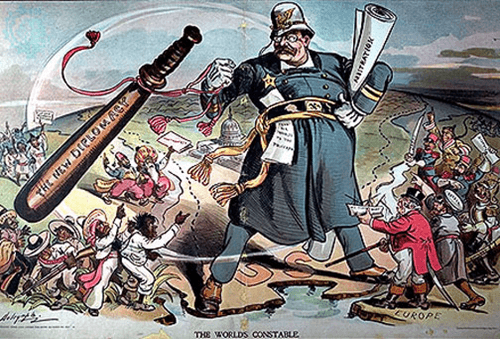
Which aspect of Imperialism does this picture represent?
a)
Roosevelt Corollary
b)
Monroe Doctrine
c)
Influence of Naval Power Upon History
d)
Spanish American War
20.
Which of the following is not true about Hawaii and its experience with Imperialism?
a)
Hawaii had the resource of sugar
b)
Hawaii's queen was Queen Lili
c)
Missionaries were first sent to Hawaii
d)
Hawaii wanted to become apart of America
21.

Which of the following defines Yellow Journalism?

a)

Writing about bad stuff to cause change

b)

Exaggerating events to sell newspapers

c)

Investigative journalism

d)

Reporting only the truth

22.
Which of the following describes the Teller Amendment?
a)
Promised that America would give Cuba its inedpendence
b)
Promised the US would give Hawaii its independence
c)
Promised the US would give the Philippines its independence
d)
Gave America control over Guantanamo Bay
23.
Which of the following is not true about the Platt Amendment?
a)
Cuba was given its independence
b)
Cuba could not make treaties with other nations
c)
America gets Guantanamo Bay
d)
America gets Puerto Rico
24.
Emilio Aguinaldo fought for independence in which country that America imperilized?
a)
Hawaii
b)
Philippines
c)
Cuba
d)
Puerto Rico
25.
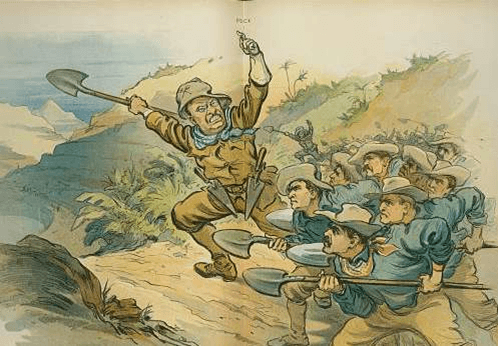
The following political cartoon refers to the construction of what by Teddy Roosevelt?
a)
Naval Base at Guantanamo Bay
b)
Suez Canal
c)
Panama Canal
d)
Washington Monument
26.

Which is NOT an argument for American expansion?

a)

spread democracy & peace

b)

acquire land to compete against European nations

c)

racial & religious superiority

d)

gain more citizens around the world

27.

What was the US mainly concerned about during imperialism?

a)

finding new markets for trade

b)

acquiring raw materials

c)

world conquest

d)

declaring war

28.

US annexed the following territory due to its strategic location and sugar plantations

a)

Hawaii

b)

Japan

c)

Philippines

d)

Alaska

29.

Strategy for how a nation deals with other nations

a)

foreign policy

b)

imperialism

c)

extractive economy

d)

domestic policy

30.

Argued that a powerful navy was key to national greatness

a)

Alfred T. Mahan

b)

Carl Schurz

c)

Josiah Strong

d)

Mr. Salguero

31.

A reason why US acquired islands in the Pacific Ocean

a)

for coaling or fuel stations

b)

for tourism

c)

to trade weapons

d)

for oil

32.

Why did plantation owners in Hawaii fear a loss of profit?

a)

a new tariff imposed taxes on sugar

b)

protesters burned their plantations

c)

not enough workers to produce sugar

d)

not enough customers to buy sugar

33.
Why did United States business interests favor overseas expansion in the late 1800's? 
a)
to establish a commonwealth of colonies 
b)
to establish military bases around the world
c)
to acquire new markets and sources of raw materials 
d)
to spread democratic ideals to other areas of the world
34.
Areas where the imperial power protected local rulers who had to accept advice from imp. power.
a)
Dollar Diplomacy
b)
protectorate
c)
sphere of influence
d)
Yellow Journalsim
35.
Reporters who published sensationalized stories about Spanish atrocities were called 
a)
Muckrakers
b)
Mugwumps
c)
Yellow Journalists
d)
Conquistadors
36.
The United States government supported the overthrow of a government in this country: 
a)
Cuba
b)
Puerto Rico
c)
Hawaii
d)
Congo
37.
Why did Americans in Hawaii want to be annexed by the United States?  
a)
Queen Liluokalani was persecuting American sugar growers. 
b)
Annexation had trade advantages for the American sugar growers in Hawaii. 
c)
Laws forced Americans to return land to the Hawaiian government. 
d)
 All are true.
38.
In the late 1800's, Cuba produced 1/3 of the worlds ___________
a)
Sugar
b)
Banananas
c)
Coal
d)
Lumber
39.
 What was the United States warship called that exploded killing over 200 American sailors?
a)
USS Michigan
b)
USS Maine
c)
USS Missouri
d)
USS Maritime 
40.
Alfred T. Mahan argued:
a)
to become an empire, the US needed to acquire naval bases and strengthen its naval power
b)
the burden of the white man is to support and uplift non-whites
c)
imperialism was not democratic and engaging in it would be hypocritical
d)
the nation's economic needs could be satisfied from within as the US should avoid risking itself in foreign entanglements
41.
 What ensured that Cuba would remain tied to the United States?
a)
Roosevelt Corollary
b)
Foraker Act
c)
Anglo-Saxonism
d)
Platt Amendment
42.
What idea or belief states that Americans have a God-given right to expand west?
a)
Manifest Destiny
b)
Imperialism
c)
Isolationism
d)
Democracy
43.
According to the Roosevelt Corollary, what was the role of the US in the Western Hemisphere? 
a)
Ok for Europeans to imperialize
b)
international police force
c)
allow imperialism in the Americas
d)
allow European nations to take over
44.
What island did Alfred Thayer Mahan think would be important in fortifying their new Imperial status?
a)
Cuba
b)
Guam
c)
Puerto Rico
d)
Hawaii
45.
What is the type of sensational reporting where writers exaggerated or even invented stories?
a)
muckraking
b)
yellow journalism
c)
journalism
d)
paparazzi
46.
What was Roosevelt's policy called?
a)
Dollar Diplomacy
b)
Big Stick Diplomacy
c)
Sphere of Influence
d)
Pan-Americanism
47.
Why did the US encourage a Panamanian Revolution against Colombia? 
a)
to allow nationalism
b)
to build the Panama Canal
c)
to spread imperialism
d)
to enforce the Roosevelt Corollary and establish a naval base
48.
How did many Americans react to the Zimmermann Telegram?
a)
They became concerned about Russian expansion
b)
They wanted to avoid membership in the League of Nations.
c)
They wanted to fire Zimmermann
d)
They were outraged over a possible German-Mexican alliance.
49.
One of the major reasons the United States went to war was over Germany's submarine warfare. The other was friendship with---
a)
France
b)
Great Britain
c)
Italy
d)
Russia
50.
Which war tactic of World War I caused soldiers to endure terrible living conditions?
a)
Armored tanks
b)
U-boats
c)
Dogfights from the air
d)
Trench warfare
51.
What is the correct chronological order of these events?
a)
2, 1, 4, 3
b)
3, 4, 1, 2
c)
1, 2, 3, 4
d)
4, 3, 2, 1
52.
Who were the Allied Powers during World War I?
a)
Russia, German Empire, France, Spain
b)
United States, France, Russia, Serbia, Britain
c)
Ottoman Empire, Bulgaria, Germany, Italy
d)
Spain, Italy, France, German Empire
53.
Which of the following was NOT a Central Power during World War I?
a)
German Empire
b)
Ottoman empire
c)
Belgium
d)
Bulgaria
54.
Who was the commander of the American Expeditionary Forces on the Western Front during World War I ?
a)
General Sherman
b)
General MacArthur
c)
General Eisenhower
d)
General Pershing
55.
Which country never joined the League of Nations?
a)
Great Britain
b)
 Germany
c)
France
d)

United States

56.
Woodrow Wilson's purpose in proposing a League of Nations was to --
a)
Prepare for World War II
b)
have countries settle dieputes in nonviolent ways
c)
provide Europe with money to rebuild after the war
d)
create a world army
57.
 Which nation’s legislative body refused to ratify the Treaty of Versailles?
a)
United States
b)
Great Britian
c)
France
d)
Germany
58.
This was a German offer of an alliance with Mexico.
a)
Sedition Act
b)
Zimmerman Note
c)
Sussex Pledge
d)
Fourteen Point
59.
What is the policy of building up armed forces in aggressive preparedness for war?
a)
Militarism
b)
Nationalism 
c)
Imperialism
d)
Alliances
60.
What is a devotion to the interests and culture of one's nation?
a)
Imperialism
b)
Alliance
c)
Nationalism
d)
Militarism
61.
What was the land between two enemy lines called?
a)
No Man's Land
b)
His brother's land
c)
Auntie Anne's Land
d)
Pen Cattle
62.
What caused the U.S. and German relations to deteriorate in 1915?
a)
German invasion of Belgium
b)
German blockade
c)
Sinking of the Lusitania
d)
German embargo on U.S. goods
63.
Which group of countries allied themselves to form the Triple Entente (Allies) in the years before World War I?
a)
Britain, France, and Austria-Hungary
b)
Germany, Austria-Hungary, and the Ottoman Empire
c)
Russia, Germany, and Italy
d)
Britain, France, and Russia
64.
Which event sparked World War I?
a)
the German-French dispute over Alsace-Lorraine
b)
Russia’s quest for a warm water port
c)
assassination of the heir to the Austro-Hungarian throne
d)
sinking of the Lusitania
65.
Who was Vladimir Lenin?
a)
Communist leader of Russia
b)
Socialist arrested in the US
c)
Democratic presidential candidate
d)
Head of the Committee of Public Information
66.
What was one of the three reasons United States joined the war?
a)
Germany bombed America
b)
Britain declared war on the U.S. 
c)
Germany used unrestricted submarine warfare
d)
France invaded Germany
67.
Which of the following was not a main cause of WWI?
a)
Militarism
b)
Imperialism 
c)
Alliances
d)
Progressivism
68.
What British ship got sunk in 1915?
a)
Lusitania 
b)
USS Maine
c)
Disney Cruise Ship
d)
Titanic
69.
This navy blockaded the water to prevent supplies from getting to Germany
a)
USA
b)
British
c)
Germany
d)
Austria-Hungary 
70.

Whose assassination caused the beginning point of WWI?

a)

A Serbian

b)

A German

c)

An Austria-Hungarian

d)

An American

71.

Countries choosing sides is referred to as

a)

Nationalism

b)

Imperialism

c)

Militarism

d)

Alliances

72.

The United States entered WWI soon after what event

a)

German submarines sank the Lusitania

b)

German propaganda began attacking President Wilson

c)

Americans learned about trench warfare

d)

When Germany sided with Austria-Hungary

73.

Which country was not part of the Central Powers?

a)

Germany

b)

Great Britain

c)

Austria-Hungary

d)

Bulgaria

74.

Which country was not part of the Allies?

a)

Great Britain

b)

United States

c)

Serbia

d)

Austria-Hungary

75.

Which one is NOT new technology that was used in the war?

a)

poison gas

b)

machine gun

c)

bayonet

d)

tanks

76.

What was propaganda used for during WWI?

a)

Get Americans to support the war

b)

Convince Germans to fight back

c)

Convince Americans to not support the war

d)

Convince Americans to speak their mind

77.

What was the Treaty of Versailles?

a)

Document that gave more power to Germany

b)

Peace agreement to end the war

c)

Agreement to give back some of the Native American's land

d)

agreement to punish Serbia for starting the war

78.

The League of Nations was created for what reason?

a)

prevent future conflict

b)

to set up alliances

c)

to build up the armies of nations

d)

to divide up the land after the war

79.

The United States wanted to stay neutral during World War I. What does the word neutral mean?

a)

An agreement between nations to defend one another

b)

A country that does not join alliances

c)

Information or ideas that are spread to help or harm a person, group or cause.

80.

What was one cause of World War I?

a)

Germany sank the Lusitania

b)

The Austria-Hungarian heir to the throne was assassinated

c)

Germany asked Mexico to join the Central Powers

81.

Select all the countries that made up the Allied Powers.

a)

Austria-Hungary

b)

Germany

c)

Great Britain

d)

Russia

e)

United States

82.

Select all the countries that made up the Central Powers.

a)

Austria-Hungary

b)

Germany

c)

Great Britain

d)

Ottoman Empire

e)

United States

83.

What TWO types of battling were commonly used during WWI?

a)

guerilla warfare

b)

trench warfare

c)

submarine warfare

84.
At the beginning of WWI, President Woodrow Wilson believed that the United States should...
a)
send troops to Europe
b)
support Germany
c)
support Great Britain
d)
remain neutral
85.
What treaty officially ended WWI?
a)
Brest-Litovsk
b)
Paris
c)
Versailles
d)
Trafalgar
86.
Which organization was created after WWI to deal with world problems, and prevent future wars?
a)
The League of Champions
b)
The United Nations
c)
The League of Nations
d)
The Justice League
87.
Which boat was sunk by the Germans?
a)
U.S. Maine
b)
Lusitania
c)
Titantic
d)
Princess
88.
This Allied leader brought his "Fourteen Point Peace Plan" to the treaty conference to end WWI.
a)
David Lloyd George
b)
Georges Clemenceau
c)
Woodrow Wilson
d)
Vittorio Orlando
89.

Allowed national government to draft men to serve in war.

a)

Treaty of Versailles

b)

Selective Service

c)

Draft Law of 1916

d)

Fourteen Points

90.

American fighting force in WWI led by John J. Pershing.

a)

American Expeditionary Force

b)

Rough Riders

c)

21st Cavalry

d)

101st Airborne

91.
What was the goal of Woodrow Wilson's 14 points?
a)
to achieve world peace
b)
to punish germany
c)
to start WW2
d)
to reward Russia
92.
What did Wilson believe about navigation of seas
a)
the US should dominate navigation
b)
there should be freedom of the seas
c)
the allies should have free access
d)
there should be a number of trade barriers
93.
What organization did Wilson want to establish?
a)
United Nations
b)
European Union
c)
League of Nations
d)
NAFTA
94.
What was the point of the League of Nations according to Wilson?
a)
to grant independence to nations
b)
to resolve international disagreements
c)
to sue Germany
d)
establish new governments
95.
What treaty officially ended the war?
a)
Treaty of Versailles
b)
Woodrow Wilson's 14 Points
c)
League of Nations
d)
Hague Accords