
 Worksheets
Modern World History (Trimester I Review)
Total questions: 100
Worksheet time: 1hrs 19mins
Name
Class
Date
1.
Theologians of the Reformation disagreed about how people could achieve________, or acceptance into heaven.
a)
indulgence
b)
predestination
c)
annulment
d)
salvation
2.
The money and goods given by the wife's family to the husband at the time of marriage is called a____________.
a)
settlement
b)
dowry
c)
tithe
d)
taille
3.
John Calvin emphasized___________, the belief that God determined in advance who would be saved and who would be damned.
a)
predisposition
b)
salvation
c)
predestination
d)
humanism
4.
An image painted on fresh, wet plaster is called a ____________.
a)
ceramic
b)
flying buttress
c)
fresco
d)
relic
5.
In Renaissance Italy, urban society developed a____________, or worldly viewpoint, which contrasted with a purely religious viewpoint.
a)
medieval
b)
secular
c)
Reformation
d)
capitalist
6.
Which of the following was a characteristic of the Renaissance?
a)
Rejection of the classical learning of ancient Greece and Rome
b)
Renewed emphasis on an all-powerful God
c)
Emergence of a more secular worldview
d)
Reawakening of feudalism
7.
Who helped to make Florence the cultural center of Europe during the Renaissance
a)
Francesco Sforza
b)
Lorenzo de' Medici
c)
Niccolo Machiavelli
d)
Girolamo Savonarola
8.
Who has been called the father of Italian Renaissance humanism?
a)
Petarch
b)
Leonardo da Vinci
c)
Dante
d)
Albrecht Durer
9.
What was the Divine Comedy?
a)
A collection of stories told by a group of pilgrims on a journey
b)
A defense of the theater
c)
An ancient Roman poem by Virgil
d)
A poem about a soul's journey to Heaven
10.
Which artist painted figures on the ceilings of the Sistine Chapel in Rome?
a)
Leonardo da Vinci
b)
Michelangelo
c)
Raphael
d)
Jan van Eyck
11.
What was the major goal of Christian humanism?
a)
To create a new form of Christian faith
b)
To preserve religious unity in the Holy Roman Empire
c)
To promote external forms of religion, such as pilgrimages and relics
d)
To reform the Catholic Church
12.
What agreement ended the religious warfare in Germany in 1555?
a)
Ninety-Five Theses
b)
Edict of Worms
c)
Peace of Augsburg
d)
Great Schism
13.
Why did King Henry VIII break with Rome and establish the Church of England?
a)
To marry Anne Bolyn
b)
To promote his religious views
c)
To force the Catholic Church to reform
d)
To separate church and state.
14.
Who founded the jesuits?
a)
John Calvin
b)
Ignatius of Loyola
c)
Marin Luther
d)
Pope Paul III
15.
How did fifteenth-century humanists differ from those in the fourteenth century?
a)
They preferred to live in solitude
b)
They believed in service to the state
c)
Most moved to the country
d)
They emphasized classical Latin
16.
Why were liberal studies at the core of a humanist curriculum?
a)
To create great scholars
b)
To promote advances in science
c)
To enable more people to read Latin
d)
To provide practical preparation for life
17.
In his Ninety-Five Theses, Martin luther wrote: "Christians are to be taught that he who gives to the poor or lends to the needy does a better work than buying pardons." To what is Luther objecting in this statement?
a)
The doctrine of predestination
b)
The lack of concern for the poor
c)
The sale of indulgences
d)
The spread of secular humanism
18.
__________, were the offspring of Africans and Europeans.
a)
Creoles
b)
Peninsulares
c)
Mestizos
d)
Mulattoes
19.
Spanish conquerors of the Americas were known as
a)
viceroys
b)
conquistadors
c)
peninsulares
d)
governor-generals
20.
The____________ is a trading route that connected Europe, Africa, and the Americas.
a)
triangular trade
b)
Bermuda Triangle
c)
Middle Passage
d)
circular trade
21.
The_____________ system allowed authorities to draft natives to work in silver mines.
a)
peninsulares
b)
feudal
c)
mita
d)
tithe
22.
__________, or large agricultural estates, were established in the 1500's in Brazil and on the Caribbean islands to grow sugarcane.
a)
Mestizos
b)
Colonies
c)
Peninsulares
d)
Plantations
23.
What were the chief motives for European expansion?
a)
Adventure, travel, and war
b)
Politics, taxes, and war
c)
Gold, Glory, and Gold
d)
Oil, gold, and coal
24.
Which country took the lead in European exploration along the West African coast?
a)
Portugal
b)
The Netherlands
c)
England
d)
France
25.
Who is remembered as the first explorer to circumnavigate the world?
a)
Bartholomeu Dias
b)
Christopher Colombus
c)
Ferdinand Magellan
d)
Vasco da Gama
26.
Which ruler granted encomienda to the Spanish settlers in the Americas?
a)
Louis XII
b)
Isabella
c)
Ferdinand
d)
Henry VI
27.
Which nation controlled most of the eastern seaboard of North America by the end of the 1600s?
a)
France
b)
Spain
c)
England
d)
The Netherlands
28.
What set of principles dominated economic thought in the seventeenth century?
a)
Mercantalism
b)
Capitalism
c)
Secularism
d)
Socialism
29.
In what year did the first Spanish ship carry enslaved Africans directly from Africa to the Americas?
a)
1560
b)
1492
c)
1518
d)
1430
30.
Which of the following is a true statement about colonial Latin American Society?
a)
It had no class system
b)
It was largely Protestant
c)
It had few peasents
d)
It was multiracial
31.
Who worked on the immense estates or worked as farmers on marginal lands in Latin America?
a)
Creoles
b)
Native Americans
c)
Conquistadors
d)
Peninsulares
32.
What caused the most deaths in the Aztec and Inca populations?
a)
Combat with the Europeans
b)
Human Sacrifice
c)
European diseases
d)
Combat with rival cities
33.
Why did some slave owners believe that buying a new enslaved person was cheaper than raising a child to working age?
a)
New enslaved people had immunity to diseases
b)
Providing food and shelter until the child was of working age cost more than a new enslaved person
c)
Slave traders gave slave owners discounts on new enslaved people
d)
A child took longer to train how to work
34.
What impact did European mercantalism have on colonies in the Americas?
a)
Latin American colonies became industrialized
b)
Latin American colonies exported manufactured goods
c)
Mercantalism promoted freedom for the indigenous peoples of the colonies
d)
The production of cash crops, such as sugar and tobacco, became important in many Latin American colonies.
35.
What was an effect of the Columbian Exchange?
a)
It transformed the diets in both hemispheres
b)
The Americas benefited the most
c)
Native Americans remained afraid of the new animals.
d)
Plants and animals were the only things exchanged.
36.
The Stuart rulers of England beleived in the ___________ right of kings.
a)
social
b)
divine
c)
supreme
d)
property
37.
John Locke called the rights to life, liberty, and property ____________ rights
a)
inalienable
b)
universal
c)
rational
d)
natural
38.
Phillip II of Spain sent a fleet of warships, or ____________, to invade England.
a)
armada
b)
brigade
c)
regiment
d)
battalion
39.
The term____________ refers to a type of republic.
a)
nation
b)
absolutism
c)
commonwealth
d)
monarchy
40.
Ivan IV crushed the power of the Russian nobility, or ______________.
a)
boyars
b)
burghers
c)
serfs
d)
czars
41.
Which monarch was called the "Most Catholic King"?
a)
Louis XIV
b)
Phillip II
c)
Elizabeth Tudor
d)
James I
42.
What was the name given to French Calvinists?
a)
Philosophes
b)
Methodists
c)
Puritans
d)
Huguenots
43.
Which act brought an end to the Holy Roman Empire as a political entity?
a)
the Edict of Nantes
b)
the Peace of Westphalia
c)
the Treaty of Versailles
d)
the Toleration Act
44.
What did the struggle between King Charles I and Parliament to govern England result in?
a)
the English Revolution
b)
the American Revolution
c)
the Thirty Years' War
d)
the Seven Years' War
45.
In 1689. what laid the foundation for a limited, or constitutional, monarchy in England?
a)
the Edict of Nantes
b)
the Toleration Act
c)
the Bill of Rights
d)
the Stamp Act
46.
In which system does a ruler hold total power?
a)
Absolutism
b)
Republicanism
c)
Militant Catholiicism
d)
Commonwealth
47.
Who was the most prominent Russian rulers in the Romanov dynasty?
a)
Frederick William the Great Elector
b)
Phillip II
c)
Ivan IV
d)
Peter the Great
48.
Which movement replaced the artistic Renaissance?
a)
Baroque
b)
Puritanism
c)
Mannerism
d)
Rococo
49.
Elizabethan playwrights such as William Shakespeare generally wrote their plays for what social group?
a)
Nobles
b)
All classes
c)
Merchants
d)
Lower classes
50.
Which of the following was an important development in sixteenth-century European culture?
a)
Mannerism replaced the baroque movement
b)
El Greco completed St. Peter's Basilica
c)
Miguel de Cervantes wrote Don Quixote
d)
Lope de Vega wrote Leviathan
51.
The was the sultan’s chief minister.
a)
grand vizier
b)
marshal
c)
shah
d)
pasha
52.
Another word for lawlessness and disorder is .
a)
rebellion
b)
orthodoxy
c)
revolt
d)
anarchy
53.
The private domain of a sultan was called the .
a)
sanctuary
b)
mosque
c)
harem
d)
zamindar
54.
Who were the janissaries?
a)
Pashas
b)
Bureaucrats
c)
Religious leaders
d)
An elite guard
55.
The Ottomans ended the Byzantine Empire by laying siege to which city?
a)
Constantinople
b)
Lepanto
c)
Mohács
d)
Topkapi
56.
The success of which type of empire was largely based on its mastery of firearms?
a)
Bourgeois
b)
Gunpowder
c)
Blackfriar
d)
Pastoral
57.
Under which ruler did the Ottoman Empire reach its high point?
a)
Selim I
b)
Selim II
c)
Mehmed II
d)
Süleyman I
58.
What did the S·afavids use as a unifying force?
a)
Shia faith
b)
Sunni faith
c)
Grand vizier
d)
Persians
59.
Sha h ‘Abba ̄ s moved the capital city of the Safavids from Tabrız to which city?
a)
Azerbaijan
b)
I ̇stanbul
c)
Es ̧fahaˉn
d)
Riza-i-Abbasi
60.
S·afavid society was a combination of Turkish and what kind of elements?
a)
Mogul
b)
Persian
c)
Ottoman
d)
French
61.
What was the “Black Hole of Calcutta”?
a)
An oil spill
b)
A great whirlpool
c)
Ornamental art
d)
An underground prison
62.
How was the Ottoman Empire characterized in the fi rst half of the seventeenth century?
a)
The empire was preoccupied with internal problems.
b)
The bureaucracy slowed down the government.
c)
The queen mother was waiting to assume power.
d)
The empire was preoccupied with the arts.
63.
Which of the following took place in the Safavid Empire after the death of Shah Abbas?
a)
Women no longer wore the veil.
b)
Women were forced from seclusion.
c)
The power of religious elements declined.
d)
Religious orthodoxy increased.
64.
Which of the following took place in the Safavid Empire after the death of Shah Abbas?
a)
Women no longer wore the veil.
b)
Women were forced from seclusion.
c)
The power of religious elements declined.
d)
Religious orthodoxy increased.
65.
The Ming Emperor wanted more tributaries so he gave his trusted adviser, ___________ the title "Admiral of the Western Seas" and told him to sail to "the countries beyond the horizon"
a)
Zheng He
b)
Marco Polo
c)
Ahmed
d)
Jamal al-Din
66.
Zheng He made ____________ expeditions between 1405 and 1433. he traveled to India, the Persian Gulf, and even sailed to the east coast of Africa. Thirty or more of the places he visited became tributaries.
a)
7
b)
9
c)
11
d)
13
67.
Who invaded China and eventually defeated the weakened Ming Empire?
a)
Zheng
b)
Yong Le
c)
Manchus
d)
Nanjing
68.
Chinese technologies like the ________ reached Europe, this helped the Europeans when they began exploring.
a)
wheelbarrow
b)
printing press
c)
compass
d)
stirrup
69.
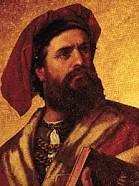
The European merchant named ___________ arrived in Kublai Kahns court and impressed him.
a)
King George
b)
Christopher Coloumbus
c)
Marco Polo
d)
Vasco de Gama
70.
What did the Ming rebuild with stone?
a)
Grand Canal
b)
Silk Road
c)
Great Wall
d)
a new capital city
71.
Great emperor of Qing Chinese history, tolerant of Christians, supported scholars.
a)
Hiroku Sakki
b)
Yonglo
c)
Kangxi
d)
Oda Nabunaga
72.
What was the name of China's last dynasty
a)
Qing
b)
Qin
c)
Ming
d)
Tang
73.

What country is highlighted on this map?
a)
China
b)
Korea
c)
India
d)
Japan
74.
Military leaders of Japan during its feudal era and the actual powers behind the emperor
a)
Bushido
b)
Daimyo
c)
Shogun
d)
Confucian
75.
Japanese warriors that lived by a strict code of ethics and duty
a)
Samurai
b)
Daimyo
c)
Shogun
d)
Confucian
76.
Japanese warlords and great land owners
a)
Bushido
b)
Daimyo
c)
Shogun
d)
Confucian
77.
The code of honor and morals developed by the Japanese samurai
a)
Bushido
b)
Daimyo
c)
Shogun
d)
Confucian
78.
Ritual suicide or disembowelment in Japan; commonly known in the west as hara-kiri; demonstrated courage and a means to restore family honor
a)
Bushido
b)
Seppuku
c)
Japanese Feudalism
d)
Samurai
79.
Why does Japanese cuisine mainly consist of seafood?
a)
There was no other food available in Asia
b)
They lived by the coast
c)
It was delicious
d)
SUSHI
80.

Why did Japan develop a different culture from other countries in Asia?
a)
because their islands were isolated from Asia
b)
because they were ruled by an emperor
c)
because Japan is a peninsula
d)
because it was ruled by shoguns
81.
The Tokugawa Shogunate was a type of:
a)
commercial partnership
b)
military government
c)
religious authority
d)
cultural institution
82.
Kabuki is a type of
a)
music
b)
theatre (drama)
c)
poetry
d)
religion
83.
Who completed the process of unifying Japan?
a)
Matsuo Basho
b)
Oda Nobunaga
c)
Toyugawa Ieyasu
d)
Tokugawa Hideyoshi
84.
Haiku is a type of ______.
a)
literature
b)
ritual suicide
c)
fortified castle
d)
riddle found in Buddhism
85.
How did the Tokugawa shoguns exert political control over the daimyo in 17th century Japan?
a)
They killed the daimyo’s draft animals.
b)
They kept the daimyo’s family in Edo as hostages.
c)
They exiled the daimyo to Korea.
d)
Nothing, the shoguns did not exert political control over the daimyo.
86.
A Japanese poem containing 17 syllables arranged in three lines of 5, 7, and 5 syllables.
a)
shogun
b)
haiku
c)
Prince Shotoku
d)
Golden Age
87.
A period of cultural advancement.
a)
shogun
b)
haiku
c)
Prince Shotoku
d)
Golden Age
88.
A person in the feudal society who received land and protection from a lord in return for loyalty.
a)
samurai
b)
Tokugawa Shogunate
c)
Lady Mirasaki Shikibu
d)
vassal
89.
A traditional religion of Japan that worships and respects nature and ancestors.
a)
regent
b)
bushido
c)
Heian Period
d)
Shinto
90.
A form of Buddhism focused on self-discipline.
a)
Tokugawa Ieyasu
b)
Zen
c)
daimyo
d)
feudalism
91.

A trained warrior of the Japanese aristocracy.
a)
samurai
b)
Tokugawa Shogunate
c)
Lady Mirasaki Shikibu
d)
vassal
92.
Dynasty founded by Shah Esma'il
a)
Ottoman
b)
Mogul
c)
Safavid
d)
Byzantine
93.
A sultan's chief minister
a)
Pasha
b)
Ulema
c)
Grand Vizier
d)
Zaminder
94.
Empires formed by outside conquerors who unified the regions they conquered
a)
Gunpowder Empires
b)
Colonization
c)
Exploration
d)
Ulema Empires
95.
Which religion was used to unify the Safavid empire?
a)
Sunni Islam
b)
Shia Islam
c)
Christianity
d)
Hinduism
96.
The Ottomans took control of which part of Europe?
a)
Rome
b)
Persia
c)
The Balkans
d)
India
97.

The holy book of Islam is called
a)
Qur'an
b)
Torra
c)
Talmud
d)
New Testament
98.

After his beloved wife passed away, Shah Jahan, the emperor of the Safavid Empire, built a memorial to her called the
a)
Safavid reflection pool
b)
Taj Mahal
c)
Sultans Palace
d)
Esfahan
99.

The Holy city of Islam that followers must face when praying
a)
Medina
b)
Mecca
c)
Jerusalem
d)
Bethlehem
100.
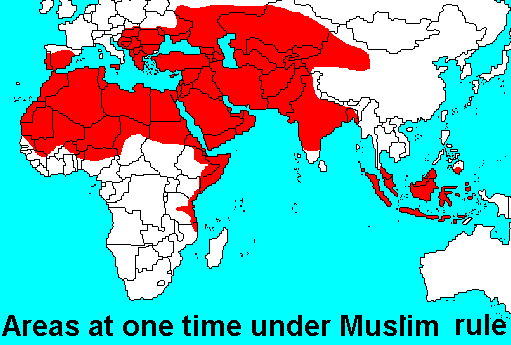
Muslim empires were characterized by all of the following EXCEPT:
a)
New military technology
b)
Strong armies
c)
Cultural diffusion
d)
Democratic governments
100 %

