
 Worksheets
Physics 9wk review
Total questions: 198
Worksheet time: 6hrs 26mins
Name
Class
Date
1.
The rate at which velocity changes is called acceleration.
a)
True
b)
False
2.
A train travels 6 meters in the first second of travel, 6 meters again during the second second of travel, 6 meters again during the third second. It's acceleration is __ m/s2?
a)
0
b)
6
c)
12
d)
18
3.
A car starts from rest and after 7 seconds it is moving at 42 m/s. What is the ’s average acceleration?
a)
0.17
b)
1.67
c)
6
d)
7
4.

The graph represents
a)
no motion
b)
constant velocity
c)
acceleration
d)
negative acceleration
5.

The graph represents
a)
no motion
b)
constant velocity
c)
increasing velocity
d)
decreasing velocity
6.

The graph respresents
a)
no motion
b)
constant velocity
c)
increasing velocity
d)
decreasing velocity
7.

What does this graph represent?
a)
decreasing velocity, away
b)
increasing velocity, towards
c)
increasing velocity, away
d)
increasing velocity, towards
8.

What does this graph represent?
a)
constant speed
b)
acceleration
c)
not moving
9.

Which runner had a head start?
a)
A
b)
B
c)
C
10.

At what time did runner A pass runner B?
a)
0 seconds
b)
1 second
c)
2 seconds
d)
3 seconds
11.

Calculate the acceleration for segment A.
a)
2 m/s2
b)
2 m/s
c)
-2 m/s2
d)
0 m/s2
12.

During which interval does the object have the greatest displacement?
a)
A to B
b)
B to C
c)
C to D
d)
D to E
13.

What is the displacement from B to C?
a)
10 m
b)
20 m
c)
40 m
14.

During which interval is the object speeding up?
a)
A to B
b)
B to C
c)
D to E
d)
E to F
15.

During which interval is the object slowing down?
a)
A to B
b)
D to E
c)
E to F
d)
G to H
16.

Which runner stopped for a rest?
a)
Albert
b)
Bob
c)
Charlie
17.

Which runner won the race?
a)
Albert
b)
Bob
c)
Charlie
18.
What are the units of acceleration?
a)
m/s
b)
m
c)
m/s^2
d)
s
19.
"A car is at rest and accelerates to 15 m/s. If the car reaches his speed in 5 s, find the acceleration of the car."
- What is the unknown?
- What is the unknown?
a)
Final velocity
b)
Acceleration
c)
Initial velocity
d)
Time
20.
What are the units of velocity?
a)
m
b)
m/s^2
c)
m/s
d)
s
21.
A car goes from 0 m/s to 50 m/s in 3.5 s. What is its average acceleration?
a)
7.14 m/s^2
b)
-7.14 m/s^2
c)
14.29 m/s^2
d)
-14.29 m/s^2
22.
If a bunny hops at 2 m/s, how long does it take him to go 5 m?
a)
2.5 s
b)
10 s
c)
.4 s
d)
2 s
23.
ΔV = ?
a)
V(i) - V(f)
b)
V(f) + V(i)
c)
V(f) - V(i)
d)
½ V(f) + V(i)
24.

What is speed?
a)
how far you go
b)
how much distance is covered over a period of time
c)
how fast you accelerate
d)
the change in the location of a object
25.

What is the formula to calculate speed?
a)
S = t/d
b)
S = d/t
c)
S = d x t
d)
S = t x d
26.

What is velocity?
a)
the quickness of an object
b)
the location of an object
c)
acceleration
d)
speed in a specific direction
27.

What is happening at D?
a)
Stationary
b)
Accelerating
c)
Fast steady speed; moving away from the starting position
d)
Slower steady speed; moving away from the starting position
28.

What is happening at E?
a)
Stationary
b)
Accelerating
c)
Fast steady speed; moving away from the starting position
d)
Steady speed; returning to start position
29.

Total distance divided by total time is
a)
average speed
b)
constant speed
c)
instantaneous speed
d)
acceleration
30.
Velocity is both ____ and _____.
a)
speed , direction
b)
direction, mass
c)
volume, density
d)
direction, magnitude
31.
Calculate the speed of a sprinter who ran 200 meters in 20 seconds.
a)
10m/s
b)
10km/s
c)
10m/hr
d)
10km/hr
32.
Find the velocity of a plane that traveled 3000 miles west in 5 hours.
a)
65 mph west
b)
6 mph west
c)
600 mph west
d)
6000 mph west
33.
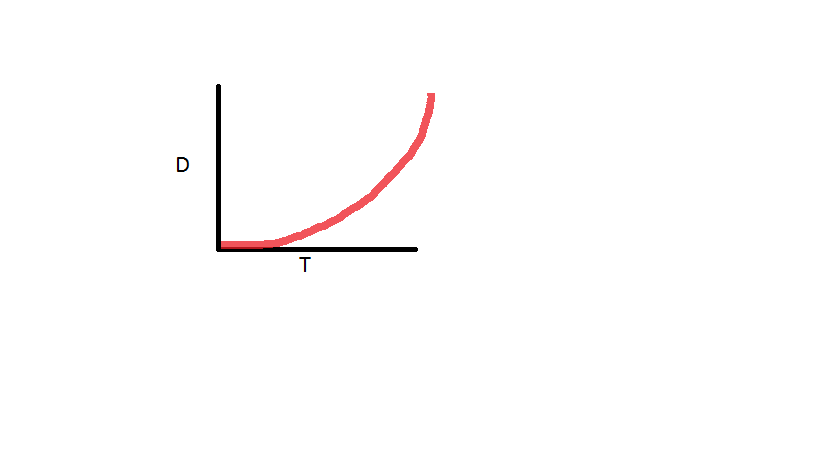
The graph below represents
a)
Speed
b)
Velocity
c)
Acceleration
d)
Deceleration
34.
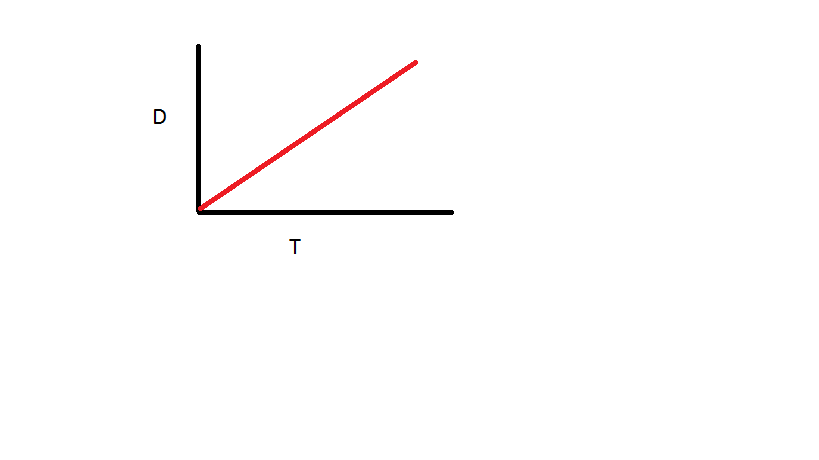
The graph represents
a)
Acceleration
b)
No motion
c)
Deceleration
d)
Constant Velocity
35.
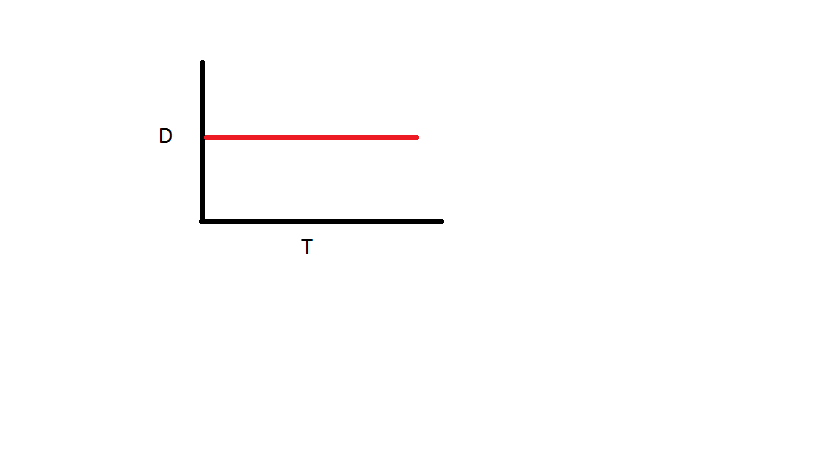
The graph represents
a)
No motion
b)
Constant velocity
c)
Acceleration
d)
Deceleration
36.
When a car goes around a corner at 20 mph, why do we say it accelerates?
a)
The car is accelerating because of the velocity is constant
b)
The car accelerates because it's going 20 mph
c)
Cars always accelerate when they are in motion
d)
The car is accelerating because it's changing direction
37.
Which of the following represents a velocity?
a)
40 m
b)
40 m north
c)
40 m/s
d)
40 m/s north
38.
If a cheetah runs 180 miles in 3 hours, what is its average speed?
a)
60 hours
b)
60 miles
c)
60 miles/hour
d)
60 miles/second/second
39.
Acceleration of an object happens when things ________
a)
slow down
b)
go faster
c)
change direction (turn)
d)
All of the above
40.
Suppose you are in a car that is going around a curve. The speedometer reads a constant 30 miles per hour. Which of the following is NOT true?
a)
You and the car are accelerating.
b)
Your acceleration is constantly changing.
c)
Your velocity is constant.
d)
Your speed is constant.
41.
A car accelerates at 2 m/s2. Assuming the car starts from rest, how much time does it need to accelerate to a speed of 16 m/s?
a)
4 s
b)
8 s
c)
16 s
d)
1/16 s
42.
How long will it take a running horse to travel 260 m and attain a speed of 12 m/s from rest?
a)
1200 seconds
b)
1.2 hours
c)
43 Hours
d)
43 minutes
43.
The SI unit for length or distance is
a)
foot (ft)
b)
inch (in)
c)
mile (mi)
d)
meter (m)
44.
The SI unit for time is
a)
second (s)
b)
minute (min)
c)
hour (hr)
d)
year (yr)
45.
In each of the following cases, determine which car has the greatest acceleration.
a)
starts from 0 m/s to 20 m/s in 4 seconds.
b)
speed up from 20m/s to 40m/s in 3 seconds
c)
slow down from 50m/s to stop in 2 seconds
d)
starts from 0 m/s to 20m/s in 5 seconds
46.
A car accelerates from a standstill to 70 m/s in 10 seconds. What is the acceleration?
a)
0.7m/s2
b)
7m/s2
c)
14m/s2
d)
none of the above
47.
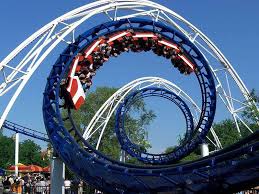
A roller coasters accelerates from an initial velocity of 6.0 m/s to a final velocity of 70 m/s over 4 seconds. What's the acceleration?
a)
24 m/s2
b)
18 m/s2
c)
16 m/s2
d)
16 m/s
48.
A dog runs with an initial speed of 7.5 m/s to a stop in 15 seconds. What is the dog's acceleration?
a)
-7.5 m/s
b)
-7.5 m/s2
c)
-0.5 m/s2
d)
7.5 mi//hr
49.
A car is traveling at 21.0 m/s. It slows to a stop at a constant rate over 5.00 s. How far does the car travel during those 5.00 seconds before it stops?
a)
4.20 m
b)
52.5 m
c)
105 m
d)
158 m
50.
An object can be moving for 10 seconds and still have zero displacement.
a)
True
b)
False
51.
You run from your house to a friend's house that is 3 km away. You then walk home. The distance you traveled is 6 km. What is your displacement?
a)
6 km
b)
0 km
52.
A _________ quantity is completely described by magnitude alone. A _________ quantity is
completely described by a magnitude with a direction.
completely described by a magnitude with a direction.
a)
vector, scalar
b)
scalar, vector
53.
A car slows down from +32 m/s to +8 m/s in 4 s. The acceleration is
a)
6 m/s/s opposite the motion
b)
2m/s/s in the direction of motion
c)
8 m/s/s opposite the motion
54.
An airplane accelerates down a runway at 3.20 m/s/s
for 8 s until it finally lifts off the ground.
Determine the velocity at take-off.
for 8 s until it finally lifts off the ground.
Determine the velocity at take-off.
a)
0.4 m/s
b)
25.6 m/s
c)
2.5 m/s
55.
An airplane accelerates down a runway at 3.20 m/s/s for 8 s until it finally lifts off the ground. The velocity of 25.6 m/s at liftoff is
a)
instantaneous
b)
average
56.
A cheetah travels 75 m in 3 s. What is her velocity over the interval?
a)
225 m/s
b)
25 m/s
c)
0.04 m/s
57.

How far has the red runner gone in 3 seconds?
a)
40 yards
b)
10 yards
c)
30 yards
d)
20 yards
58.
Which runner got a head start?
a)
red line runner
b)
blue line runner
59.
Which runner is faster?
a)
red line runner
b)
blue line runner
60.
If a car is traveling forward at 15 m/s, how fast will it be going in 1.2 seconds if the acceleration is -10 m/s/s?
a)
27 m/s
b)
3 m/s
c)
-27 m/s
d)
-3 m/s
61.
Jermaine runs exactly 2 laps around a 400 meter track. What is the displacement?
a)
800 meters
b)
400 meters
c)
0 meters
d)
200 meters
62.

Calculate the average speed (in meter/sec) if a cheetah runs 180 meters in 10 seconds.
a)
198 m/sec
b)
170 m/sec
c)
12 m/sec
d)
18 m/sec
63.

What does this graph represent?
a)
Constant Speed
b)
Acceleration
c)
Not moving
64.

At 60 seconds, how far had this object traveled?
a)
0 m
b)
10 m
c)
20 m
d)
40 m
65.

According to the graph how far does the person travel in the first 5 seconds?
a)
2 m
b)
10 m
c)
0 m
d)
5 m
66.

What is the person doing from 5 seconds to 10 seconds?
a)
Walking
b)
Running
c)
Standing Still
d)
Walking Fast
67.
The graph represents
a)
no motion
b)
constant velocity
c)
acceleration
d)
negative acceleration
68.
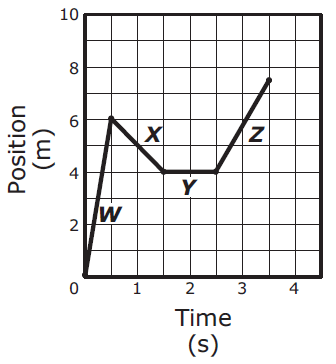
Motion sensors recorded the following data about a runner during a cross-country race. During which segment of the race did the runner have the greatest speed?
a)
W
b)
X
c)
Y
d)
Z
69.
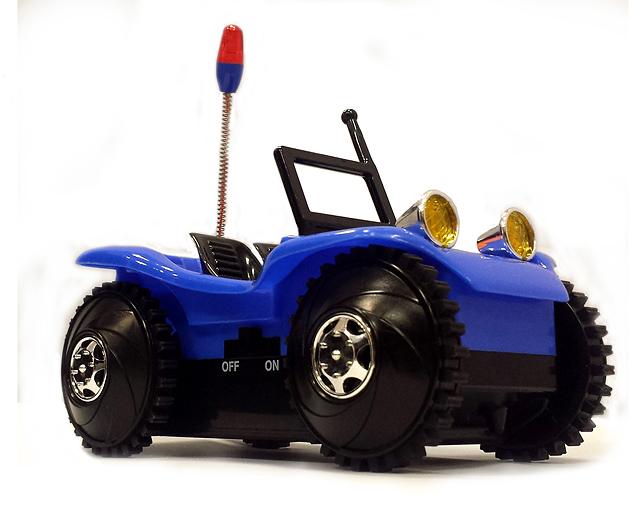
What would the v-t graph look like for an object travelling at a constant velocity?
a)
Curved line
b)
Straight line
c)
Horizontal line
70.
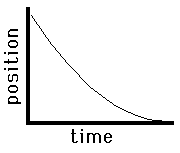
Describe the motion
a)
Slow to fast; Negative direction
b)
Fast to slow; Negative direction
c)
Fast to slow; Positive direction
d)
Slow to fast; Positive direction
71.
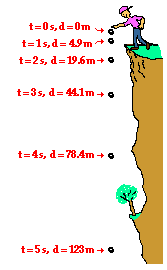
What happens to the velocity of a ball as it is dropped off a cliff?
a)
It decreases at a uniform rate
b)
It increases at a uniform rate
c)
It is constant
d)
It increases at a non-uniform rate
72.
The equation for finding average acceleration for straight-line motion is
a)
(Vi-Vf) x Time
b)
(Vf-Vi) / Time
c)
Vi+Vf+time
d)
Vi+Vf-time
73.
A car travels 90 meters due north in 15 seconds. Then the car turns around and travels 40 meters due south. What is the magnitude and direction of the car's resultant displacement?
a)
40 metres, South
b)
50 metres, South
c)
50 metres, North
d)
40 metres, North
74.

In practice A of the figure, What is the magnitude of the resultant displacement?
a)
5 km
b)
8 km
c)
11 km
d)
15 km
75.

In practice A of the figure, what is the direction of the resultant displacement?
a)
63 degrees, South of East
b)
63 degrees, North of West
c)
27 degrees, North of West
d)
27 degrees, South of West
76.

In practice B of the figure, which displacement is the horizontal component?
a)
30 km, East
b)
30 km, West
c)
40 km, North
d)
40 km, South
77.
Is this a scalar quantity or a vector quantity?
Wind blowing at 20 knots
Wind blowing at 20 knots
a)
Scalar
b)
Vector
78.
Is this a scalar quantity or a vector quantity?
A deer running 15 meters per second due west
A deer running 15 meters per second due west
a)
Scalar
b)
Vector
79.

If a boomerang is thrown 20 m in a straight line and returns exactly to the spot it was thrown what is its displacement?
a)
20m
b)
40m
c)
0m
d)
-20m
80.
If a car moves 12 km North, 19 km East, and 12 km South, what is its displacement?
a)
12 km
b)
19 km, East
c)
31 km
d)
43 km, East
81.
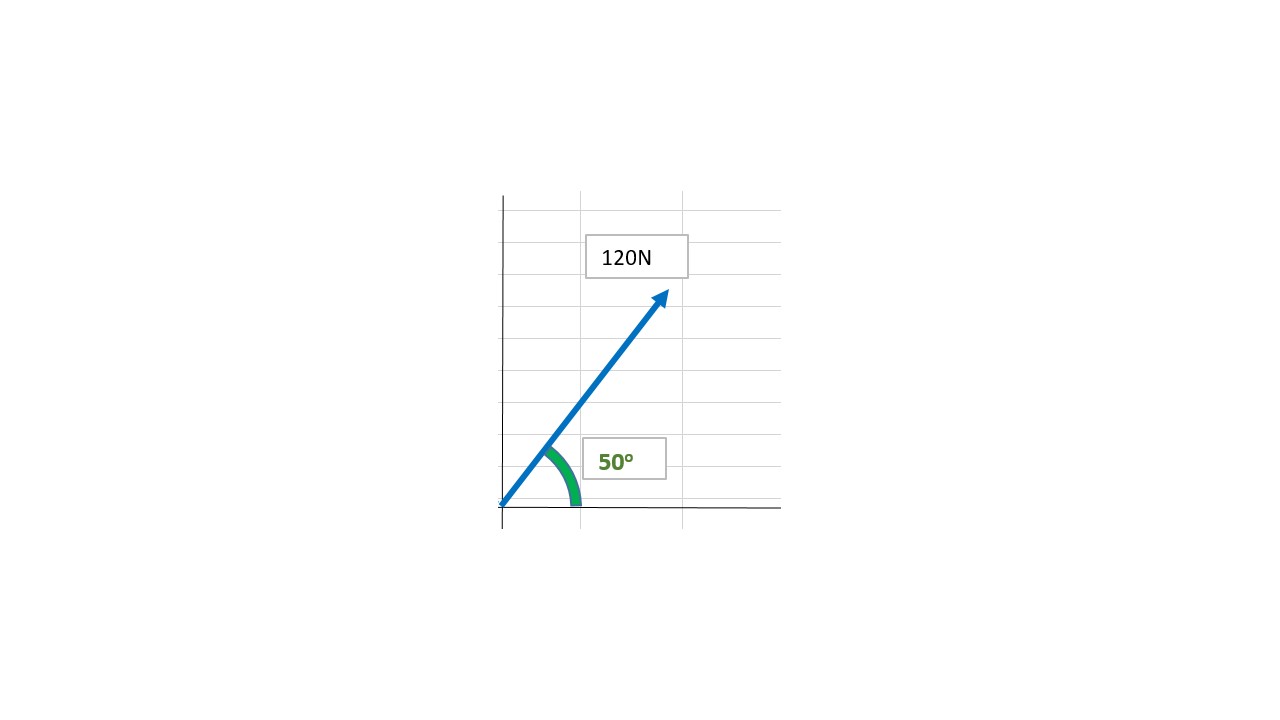
What is the x component of the vector given in the diagram?
a)
77N
b)
92N
c)
120N
d)
60N
82.
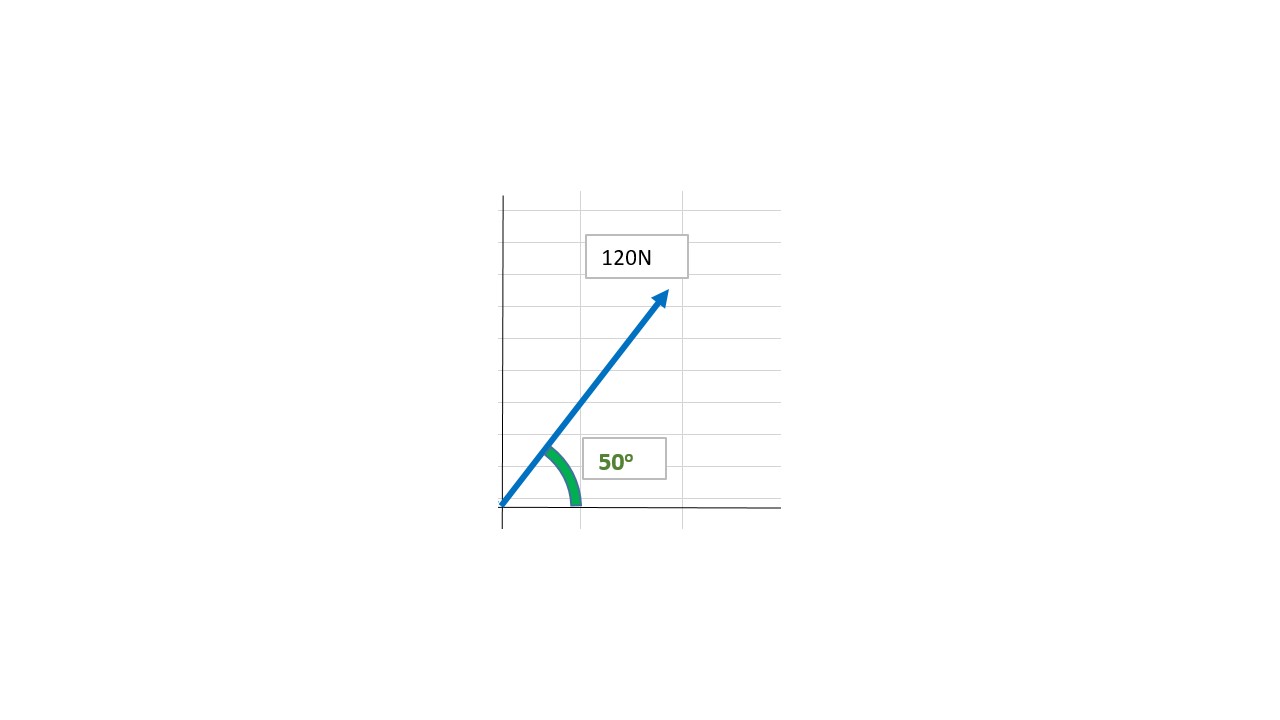
What is the y component of the vector given in the diagram?
a)
77N
b)
92N
c)
120N
d)
60N
83.
Which of the following quantities are vectors?
a)
speed, velocity, acceleration
b)
velocity, acceleration, force
c)
force, acceleration, mass
d)
length, mass, time
84.
The _______ of two or more vectors is the sum of the vectors.
a)
components
b)
scalar
c)
resultant
d)
magnitude
85.
What is the net force?
100 N 230 N
<------ --------->
100 N 230 N
<------ --------->
a)
30 N to the right
b)
230 N to the right
c)
130 N to the right
d)
This is a balanced force
86.
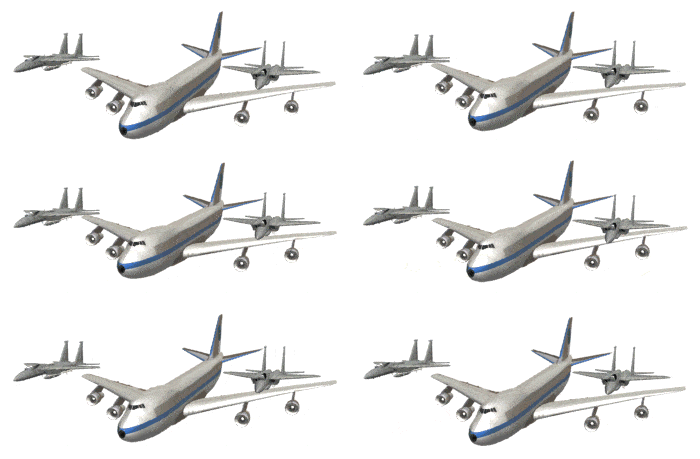
An airplane traveling north at 220 meters per second encounters a 50.0-meters-per-second crosswind from west to east. The resultant velocity of the airplane is ____
a)
170 m/s
b)
214 m/s
c)
226 m/s
d)
270 m/s
87.

Which side is adjacent to the 400 angle?
a)
AB
b)
AC
c)
BC
88.

Find the angle made by sides 14 and 7.
a)
600
b)
300
c)
450
d)
500
89.

Which are equivalent vectors?
a)
u and -u
b)
u and a
c)
u and v
d)
u and b
90.
2.0 milligrams is
a)
2.0 x 10⁻³ grams
b)
2.0 x 10⁻⁶ grams
c)
2.0 x 10⁻² grams
d)
2.0 x 10⁻⁹ grams
91.
The prefix that means a thousand times the base is
a)
milli
b)
centi
c)
kilo
d)
nano
92.
A motorboat, which has a speed of 6 meters per second in still water, is headed east as it crosses a river flowing south at 3 meters per second. What is the boat’s resultant velocity?
a)
18 m/s S
b)
45.0 m/s SE
c)
6.7 m/s SE
d)
8.3 m/s S
93.

A person begins a corn maze by walking 6.00m to the East and 10.0m to the North. How far away is the person from the starting position?
a)
10.4 m
b)
11.7 m
c)
16.0 m
d)
16.8 m
94.

Choose the best answer.
Distance will equal displacement if...
Distance will equal displacement if...
a)
Object moves through its starting position.
b)
Object moves back and forth repeatedly.
c)
Object moves in straight line in one direction.
d)
Object moves up and down repeatedly.
95.

Calculate distance.
Maria walked 30 m west, turned, walked 25 m north.
Maria walked 30 m west, turned, walked 25 m north.
a)
55 m
b)
5 m
c)
39 m
d)
75 m
96.

Calculate displacement.
Maria walked 30 m west, turned, walked 25 m north.
Maria walked 30 m west, turned, walked 25 m north.
a)
55 m NW
b)
5 m W
c)
39 m NW
d)
75 m N
97.

The graph shows the motion of person walking.
At what time(s) did the person move in the forward direction?
At what time(s) did the person move in the forward direction?
a)
At 0-4 seconds
b)
At 4-8 seconds
c)
At 8-12 seconds
d)
At 16-24 seconds
98.
The graph shows the motion of person walking.
What is the person's distance at 4 seconds?
What is the person's distance at 4 seconds?
a)
4 meters
b)
8 meters
c)
16 meters
d)
12 meters
99.
The graph shows the motion of person walking.
What is the person's distance at 24 seconds?
What is the person's distance at 24 seconds?
a)
4 meters
b)
8 meters
c)
16 meters
d)
12 meters
100.
The graph shows the motion of person walking.
What is the person's displacement at 24 seconds?
What is the person's displacement at 24 seconds?
a)
+4 meters
b)
+8 meters
c)
+16 meters
d)
0 meters
101.
How do you write
8.317 x 10⁶
in standard form?
8.317 x 10⁶
in standard form?
a)
8, 371, 000
b)
83, 170, 000
c)
837, 100
d)
8, 317, 000
102.
Express the following in standard notation:
8.025 x 10⁻⁸
a)
.00000008025
b)
.000000008025
c)
802,500,000,000
d)
80,250,000,000
103.
How would you write -5.6 x 10⁻³ in standard form?
a)
0.0056
b)
-5,600
c)
0.00056
d)
-0.0056
104.
When writing a number in scientific notation, the first number must be greater than 1, but less than 10.
a)
False
b)
True
105.
Which of the following is correct scientific notation?
a)
20.35 x 10⁴
b)
.2035 x 104
c)
2035 4
d)
2.035 x10⁴
106.
How would you write 0.0005 in scientific notation?
a)
50 x 105
b)
5 x 10⁻⁴
c)
5 x 10⁻³
d)
.5 x 103
107.
How would you write 564,000,000 in scientific notation?
a)
5.64 x 10⁻⁷
b)
5.64 x 10⁶
c)
5.64 x 10⁸
d)
56.4 x 10⁷
108.
Write 274,400 in scientific notation.
a)
2.74400 x 10⁵
b)
2.744 x 10⁵
c)
2.7 x 10⁵
d)
2.744000 x 10⁶
109.
Solve:
(9 x 10⁻⁶) / (3 x 10⁻³)
(9 x 10⁻⁶) / (3 x 10⁻³)
a)
27 x 10-9
b)
3 x 10⁻³
c)
3 x 10⁻⁹
d)
27 x 10-3
110.
Which is the smallest?
1.3 x 10²⁰
2.9 x 10²¹
9.5 x 1032
8.4 x 10¹⁹
1.3 x 10²⁰
2.9 x 10²¹
9.5 x 1032
8.4 x 10¹⁹
a)
1.3 x 10²⁰
b)
2.9 x 10²¹
c)
9.5 x 1032
d)
8.4 x 10¹⁹
111.
Express the following in scientific notation:
0.0000002203
0.0000002203
a)
.02203 x 107
b)
22.03 x 10⁻⁶
c)
2.203 x 10⁻⁷
d)
22.03 x 10⁶
112.
convert 650 m to km
a)
6.5
b)
0.65
c)
65
d)
0.065
113.
If you are driving at a rate of 65 miles per hour, about how many feet per second are you driving?
a)
About 100 feet per second
b)
About 5280 feet per second
c)
About 95 feet per second
d)
About 5720 feet per second
114.

A cricket can travel approximately 8 feet per minute. How many feet could a cricket travel in 75 minutes?
a)
83 feet
b)
9.375 feet
c)
180 feet
d)
600 feet
115.
John took 90 minutes to bicycle to his grandmother's house, a total of six kilometers. What was his speed (pay attention to units)?
a)
540 km/hr
b)
.066 km/hr
c)
4 km/hr
d)
9 km/hr
116.
If a car is traveling forward at 15 m/s, how fast will it be going in 1.2 seconds if the acceleration is -10 m/s/s?
a)
27 m/s
b)
3 m/s
c)
-27 m/s
d)
-3 m/s
117.

What is the speed of an object that travels 60 meters in 4 seconds?
a)
240 m/s
b)
15 m/s
c)
0.067 m/s
d)
15 mph
118.

Describe the graph.
a)
The object remains stationary from 1-6 seconds
b)
The object is at rest for 1 second and then begins moving away from the reference point for 5 seconds
c)
The object began moving back toward the reference point at 3 seconds
d)
The object stopped moving from 3 seconds until 4.5 seconds and then began moving back toward the reference point
119.
Who has more speed: runner A who travels 600 meters in 60 seconds or runner B who travels 60 meters in 5 seconds?
a)
Runner A
b)
Runner B
120.
A biker rides for 50 km in 2 hours. She then takes a 20 min break for water and stretching. Then she rides for another 2 hours going 100 km. What is the bikers average speed?
a)
75 km/ hr
b)
37.5 km/ hr
c)
75 m/hr
d)
37.5 m/ hr
121.
How is velocity different from speed?
a)
They are not different!
b)
Speed is the distance an object travels per unit of time and includes a direction
c)
Velocity is the distance an object travels per unit of time and includes a direction
d)
They are the same.
122.

Read this instrument to the nearest tenth
a)
613.37 g
b)
163.7 g
c)
163.5 g
d)
163 g
123.

Mr. Rudman drives his race car for 4 hrs at 150 miles/hr. How far will he travel?
a)
600 km
b)
60 miles
c)
6 miles
d)
600 miles
124.

In which of the following graphs (click the image) are both runners moving at the same speed (note that graph c is the bottom right graph, and graph d is the bottom left graph)?
a)
Graph A
b)
Graph B
c)
Graph C
d)
Graph D
125.

Which of the graphs shows that one of runners started 10 yards further ahead of the other (note that graph c is the bottom right and graph d is the bottom left)?
a)
Graph A
b)
Graph B
c)
Graph C
d)
Graph D
126.

What is happening in this graph from point A to B?
a)
The object is accelerating.
b)
The object is not moving.
c)
The object is decelerating.
d)
The object is moving at a constant speed.
127.

What is happening in the graph from point O to A?
a)
The object is moving SLOWLY
b)
The object is moving FAST
c)
The object is NOT moving
d)
The object is accelerating
128.

What is happening in this graph from point B to C?
a)
The object is going down a hill.
b)
The object is returning to its starting location.
c)
The object is slowing down.
d)
The object is staying still.
129.

What is happening from point D to E?
a)
The object is moving SLOWLY
b)
The object is moving FAST
c)
The object is decelerating
d)
The object is NOT moving
130.

What is happening in this graph from point B to C?
a)
The object is going down a hill.
b)
The object is returning to its starting location.
c)
The object is slowing down.
d)
The object is staying still.
131.

What is the speed of this object at 3 seconds?
a)
5 m/s
b)
45 m/s
c)
5 s/m
d)
45 s/m
132.

How fast is the object traveling between points B and C?
a)
1 km/hr
b)
0 km/hr
c)
There is no way to tell from this graph
d)
0.9 km/hr
133.
How fast is the object traveling between points B and C?
a)
1 km/hr
b)
0 km/hr
c)
There is no way to tell from this graph
d)
0.9 km/hr
134.

Every morning, Tom walks along a straight road from his home to the bus stop. Below, is a graph representing Tom’s trip to school.
- What is the average speed of Tom’s journey throughout the first segment, which is between 0 seconds, and 50 seconds?
- What is the average speed of Tom’s journey throughout the first segment, which is between 0 seconds, and 50 seconds?
a)
3 m/s
b)
5 m/s
c)
2 m/s
d)
2 miles per second
135.

Every morning, Tom walks along a straight road from his home to the bus stop. Below, is a graph representing Tom’s trip to school.
- What is the distance covered through the second segment, which is between 50 seconds, and 70 seconds?
- What is the distance covered through the second segment, which is between 50 seconds, and 70 seconds?
a)
40 meters
b)
60 meters
c)
80 meters
d)
20 meters
136.

. Every morning, Tom walks along a straight road from his home to the bus stop. Below, is a graph representing Tom’s trip to school.
- What is the average speed of Tom’s Journey throughout the second segment, which is between 50 seconds and 70 seconds?
- What is the average speed of Tom’s Journey throughout the second segment, which is between 50 seconds and 70 seconds?
a)
5 m/s
b)
4 m/s
c)
3 m/s
d)
2 m/s
137.

According to the graph how far does the person travel in the first 5 seconds?
a)
2 m
b)
10 m
c)
0 m
d)
5 m
138.

What is the person doing from 5 seconds to 10 seconds?
a)
Walking
b)
Running
c)
Standing Still
d)
Walking Fast
139.

How far is the person from the starting point after 3 seconds?
a)
0 m
b)
2 m
c)
3 m
d)
6 m
140.

LT4: The graph shows Ashley riding her bike to Maria's house.
What was occurring from point B to point C?
What was occurring from point B to point C?
a)
She was increasing her speed.
b)
She stopped for 4 minutes
c)
She was decreasing in speed
141.

Isabella runs 2 miles down the road from her house in 15 minutes and then walks 2 miles home over 1 hour. What is her total displacement?
a)
0
b)
4 miles
c)
15 minutes in one hour
d)
2 miles
142.

The line C-D shows...
a)
Constant acceleration
b)
Constant speed
c)
deceleration
d)
sationary
143.

The speed of the vehicle between points A-B is...
a)
12m/s
b)
8m/s
c)
10m/s
d)
16m/s
144.

which line shows a negative acceleration ?
a)
A
b)
B and C
c)
D
d)
A, B, and
A, B, and D
A, B, and D
145.

which line represents the constant acceleration?
a)
A
b)
B and D
c)
C
d)
A, B, and D
146.

What is the objects average speed from 0-20 seconds?
a)
0.5m/s
b)
10m/s
c)
2m/s
d)
10m
147.
Calculate the acceleration for segment A.
a)
2 m/s2
b)
20 m/s2
c)
-2 m/s2
d)
0 m/s2
148.
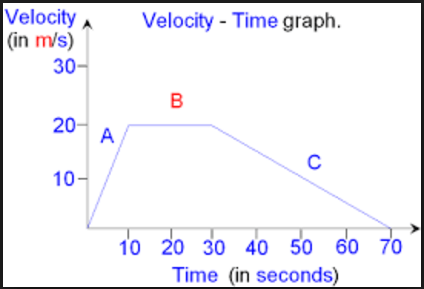
This is a velocity-time graph. What is the object doing in segment C?
a)
Positive acceleration
b)
Negative acceleration
c)
Constant Velocity
d)
Not moving
149.

How many times does this object STOP moving?
a)
None
b)
Once
c)
Twice
d)
Three times
150.
This variable in an experiment is the one being deliberately changed by the scientist.
a)
dependent variable
b)
independent variable
c)
data
d)
control group
151.
There are two types of data. Which type of data involves numbers that are obtained by counting or measuring?
a)
quantitative
b)
qualitative
152.
A series of steps used by scientists to solve a problem or answer a question.
a)
scientific method
b)
recipe
c)
data collection
d)
metric system
153.
In a controlled experiment, how many independent variables can be worked with at a time?
a)
one
b)
none
c)
two or more
d)
how ever many makes sense.
154.
An experiment is performed on plants to see how different liquids affect plant growth. Each plant in the experiment is given a different liquid; water, apple juice, or milk. Each plant has the same amount of soil, sunlight, and listens to the same music. In this investigation, what is the dependent variable?
a)
Type of plant
b)
Water, apple juice, milk
c)
Plant growth
d)
Color of the plant's leaves
155.
When experimenting with the growth of a plant, a scientist uses three (of the same type of) plants, two different fertilizers, equal light, and equal water. What type of variable is the fertilizer?
a)
Dependent
b)
Independent
c)
Control
d)
Compound
156.
When experimenting with the growth of a plant, a scientist uses three (of the same type of) plants, two different fertilizers, equal light, and equal water. What type of variable is the fertilizer?
a)
Dependent
b)
Independent
c)
Control
d)
Compound
157.
Mr. S. sets up an experiment to see how the mass of a ball affects the distance it rolls off a ramp. Identify the dependent variable.
a)
height of the ramp
b)
distance traveled by the ball
c)
mass of the ball
d)
weight of the ball
158.
Mr. S. sets up an experiment to see how the mass of a ball affects the distance it rolls off a ramp. Identify the independent variable.
a)
distance traveled by the ball
b)
height of the ramp
c)
mass of the ball
d)
weight of the ball
159.

What is being changed in this experiment?
a)
ramp height
b)
the speed that the ball rolls
c)
type of ball
160.
Observations made during an experiment are considered:
a)
data
b)
problems
c)
conclusions
d)
questions
161.

What is a hypothesis?
a)
an educated guess stating what you believe will be the result of your experiement
b)
a random guess
c)
a statement of the outcome of your experiment
d)
step by step directions for your experiment
162.
Why do we want to test one variable at a time?
a)
Because it is hard to setup a data table with more
b)
To know what is causing the changes. This helps us understand cause and effect.
c)
It is what has always been done
163.
What skill is a scientist using when she listens to the sounds that an elephant makes?
a)
drawing conclusions
b)
making observations
c)
interpreting data
d)
making a hypothesis
164.
A scientist hypothesizes the the temperature at which an alligator's egg is incubated will determine whether the alligator will be male or female. The independent variable is
a)
the male alligators
b)
the incubator
c)
the gender of the alligator
d)
the temperature
165.

In this graph, what is the independent variable?
a)
Population
b)
Day
c)
Species 5
166.

In this graph, what is the dependent variable?
a)
Walla Walla Island
b)
Time
c)
Number of Deer
167.
How close a measurement is to the true value is called..
a)
Accuracy
b)
Precision
c)
Significant
d)
Estimate
168.
When a measurement is repeatable and consistent it is said to have...
a)
High precision
b)
Low precision
c)
High accuracy
d)
Low accuracy
169.

This bullseye demonstrates...
a)
High Accuracy & High Precision
b)
High Accuracy & Low Precision
c)
Low Accuracy & High Precision
d)
Low Accuracy & Low Precision
170.
When a measurement is repeatable and consistent it is said to have...
a)
High precision
b)
Low precision
c)
High accuracy
d)
Low accuracy
171.
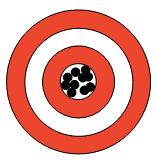
?
a)
High Accuracy & High Precision
b)
High Accuracy & Low Precision
c)
Low Accuracy & High Precision
d)
Low Accuracy & Low Precision
172.

a)
0.81%
b)
0.47%
c)
99.8%
d)
0.18%
173.

a)
Direct
b)
Inverse
c)
Extrapolated
d)
Interpolated
174.
There are __?__ significant digits in the number 0.00076
a)
2
b)
4
c)
5
d)
6
175.
There are __?__ significant digits in the number 90,000.00
a)
1
b)
2
c)
5
d)
7
176.
How many significant figures does the following number have: 0.002040
a)
6
b)
4
c)
3
d)
2
177.
A set of data are not close to each other, but the average of the data is very close to the actual value. This set of data can be described as...
a)
accurate
b)
precise
c)
both precise and accurate
178.
Solve & Round to Correct Sig Figs.
4.5 + 4.32 =
4.5 + 4.32 =
a)
8.8
b)
8.7
c)
8
d)
8.0
179.
Which of the following is the answer for the problem with the correct number of significant digits?
0.0025 x 1.41 = 0.003525
0.0025 x 1.41 = 0.003525
a)
0.00
b)
0.004
c)
0.00353
d)
0.0035
180.
What is 0.0568 rounded to 1 significant figure?
a)
0.0
b)
0.06
c)
0.6
d)
0.057
181.
A car is traveling at 21.0 m/s. It slows to a stop at a constant rate over 5.00 s. How far does the car travel during those 5.00 seconds before it stops?
a)
4.20 m
b)
52.5 m
c)
105 m
d)
158 m
182.
An object with an initial velocity of 3.50 m/s moves east along a straight and level path. The object then undergoes a constant acceleration of 1.80 m/s2 east for a period of 5.00 s. How far does the object move while it is accelerating?
a)
6.30 m
b)
17.5 m
c)
27.2 m
d)
40.0 m
183.
An airplane lands on a runway with a velocity of 150 m/s. How far will it travel until it stops if its rate of deceleration is constant at -3 m/s2?
a)
525 m
b)
3750 m
c)
6235 m
d)
9813 m
184.

A car accelerates uniformly from rest to a speed of 6.6 m/s i 6.5 s. Find the distance the car travels during this time
a)
.51 m
b)
3.3 m
c)
39 m
d)
21 m
185.

An aircraft has a liftoff speed of 33m/s. What min constant acceleration does this require if the aircraft is to be airborne after a takeoff run of 240 m?
a)
-2.3 m/s^2
b)
4.5 m/s^2
c)
2.3 m/s^2
d)
-4.5 m/s^2
186.

A car with an initial speed of 6.5 m/s accelerates uniformly (constant rate of change) of .92 m/s^2 for 3.6 s. Find the displacement of the car during this time
a)
29 m
b)
35 m
c)
27m
d)
45 m
187.
The Richmond County sheriff is trying to determine the speed of a car that slid off a 5 m bridge on a rainy night and landed in a ditch. The tire tracks show that the car landed 12.0 m horizontally from the bridge. How fast was the car going when it left the road?
a)
11.9 m/s
b)
65.7 m/s
c)
43.2 m/s
d)
9. 53 m/s
188.
Ray runs 30 feet north, 30 feet west, and then 30 feet south. What is the displacement?
a)
30 feet west
b)
90 feet
c)
30 feet south
d)
0 feet
189.

A car travels 14 meters in 7 seconds. How fast was the car going?
a)
v = 0.5 m/s
b)
v = 14.7 m/s
c)
v = 21 m/s
d)
v = 2 m/s
190.
How long would it take a car, starting from rest and accelerating uniformly in a straight line at 5 m/s^2, to cover a distance of 200m
a)
9.0s
b)
10.5s
c)
12.0s
d)
15.5s
191.
A boat travels 12.0 m while it reduces its velocity from 9.5 m/s to 5.5 m/s. What is the magnitude of the boat’s acceleration while it travels the 12.0 m?
a)
1.3 m/s2
b)
2.5 m/s2
c)
3.0 m/s2
d)
7.5 m/s2
192.
A car is traveling at 21.0 m/s. It slows to a stop at a constant rate over 5.00 s. How far does the car travel during those 5.00 seconds before it stops?
a)
4.20 m
b)
52.5 m
c)
105 m
d)
158 m
193.
A bus is moving forward at 20 m/s. A student on the bus throws a tennis ball horizontally at 15 m/s toward the front of the bus. From the perspective of an observer on the sidewalk outside the bus, the tennis ball appears to move at —
a)
5 m/s
b)
15 m/s
c)
20 m/s
d)
35 m/s
194.
An object with an initial velocity of 3.50 m/s moves east along a straight and level path. The object then undergoes a constant acceleration of 1.80 m/s2 east for a period of 5.00 s. How far does the object move while it is accelerating?
a)
6.30 m
b)
17.5 m
c)
27.2 m
d)
40.0 m
195.

A car starts at the origin, travels 4 m east, and then 7 m west. What is the cars displacement?
a)
Δx = 3 m
b)
Δx = -3 m
c)
Δx = 12 m
d)
Δx = -12 m
196.

Describe the motion
a)
Slow to fast; Negative direction
b)
Fast to slow; Negative direction
c)
Fast to slow; Positive direction
d)
Slow to fast; Positive direction
197.

The picture of the position vs. time graph shows an object that is...
a)
accelerating/speeding up
b)
moving at a constant speed
c)
not moving
d)
accelerating/slowing down.
198.

Which graph represents zero acceleration (constant velocity)?
a)
A
b)
B
c)
C
d)
D
100 %

