
 Worksheets
CW Sept 25 Density
Total questions: 197
Worksheet time: 3hrs 45mins
Name
Class
Date
1.
Jack has a rock. The rock has a mass of 14g and a volume of 2cm3. What is the density of the rock?
a)
7 mL
b)
7 g/cm3
c)
28 g/cm3
d)
1/7 g/cm3
2.
Which units of measurement are used for volume?
a)
grams
b)
centimeters
c)
grams/milliliter
d)
milliliter
3.

What is the volume of Object X?
a)
10.0 cm3
b)
15.0 cm3
c)
20.0 cm3
d)
25.0 cm3
4.
True or False: The density of a specific type of material never changes.
a)
True
b)
False
5.

I have two objects with the same volume but different masses. Which object will be more dense?
a)
The object with less weight.
b)
The object with more weight.
c)
The object with more mass.
d)
The object with less mass.
6.
What is the formula for density?
a)
density = mass x volume
b)
density = mass / volume
c)
density = mass + volume
d)
density = mass - volume
7.
Frank has an eraser. It has a mass of 4g, and a volume of 2cm3. What is its density?
a)
8 g/cm3
b)
2 g/cm3
c)
1/2 g/cm3
d)
24 g/cm3
8.
Frank has a paper clip. It has a mass of 9g and a volume of 3cm3. What is its density?
a)
3 g/cm3
b)
1/3 g/cm3
c)
27 g/cm3
d)
39 g/cm3
9.
An object with which of the following densities will float on water?
a)
0.7 g/cm3
b)
1.2 g/cm3
c)
3.5 g/cm3
d)
11.4 g/cm3
10.
A block has a mass of 54g and a volume of 20cm3. What is the density of the block?
a)
74 g/cm3
b)
1080 g/cm3
c)
34 g/cm3
d)
2.7 g/cm3
11.
A can of Coke will sink in a bowl of water. A can of Diet Coke will float in a bowl of water. What does this tell you about the density of the Diet Coke?
a)
it is bigger than 1
b)
it is smaller than 1
c)
it is equal to 1
d)
it is equal to -1
12.
Why do ice cubes float in a glass of water?
a)
the ice cubes are more dense than the water
b)
the water is more dense than the ice cubes
c)
the water is more dense than the glass
d)
the ice is more dense than the glass
13.
Veal finds a gold colored rock in a river. It has a mass of 9.65 grams and a volume of 0.5 cm3. What is the density of the rock?
a)
10.15 g/cm3
b)
19.3 g/cm3
c)
9.15 g/cm3
d)
4.825 g/cm3
14.
Which property of matter is determined by dividing its mass by its volume?
a)
elasticity
b)
buoyancy
c)
density
d)
viscosity
15.
The following liquids are poured together in a beaker: alcohol (density=0.79), corn syrup (density=1.38), water (density=1.0), and cooking oil (density=0.93). Which of these liquids will sink to the bottom of the beaker?
a)
alcohol
b)
corn syrup
c)
water
d)
cooking oil
16.
Will an object with a density of 1.01 g/cm3 float or sink?
a)
float
b)
sink
17.
Mercury is a metal that is liquid at room temperature and has a density of 13.5 g/cm3. Which of these metals would sink below the mercury if dropped into a container of mercury?
a)
gold (density=19.3 g/cm3)
b)
lead (density=11.4 g/cm3)
c)
iron (density=7.9g/cm3)
d)
aluminum (density=2.7g/cm3)
18.
A brick sinks in water while a wooden block of the same size floats. This is because the brick has a
a)
lower volume than the wooden block
b)
lower density than the wooden block
c)
higher volume than the wooden block
d)
higher density than the wooden block
19.
What is the density of a liquid that has a mass of 27g and a volume of 30ml?
a)
0.9 g/ml
b)
3 g/ml
c)
57 g/ml
d)
810 g/ml
20.
Will an object with a density of 0.999 sink or float in water?
a)
sink
b)
float
21.
A scientist has four different liquids and pours them all into a bottle. The silver liquid sinks to the bottom, the red liquid settles on top of the silver one, and the pink liquid stays at the surface. Which liquid has the smallest density?
a)
the pink liquid
b)
the silver liquid
c)
the red liquid
d)
the water
22.
What is the density of a substance that has a mass of 30g and a volume of 6 liters?
a)
24 g/l
b)
5 g/l
c)
36 g/l
d)
180 g/l
23.
Why do some substances float on water?
a)
they are warmer than water
b)
they are cooler than water
c)
they are more dense than water
d)
they are less dense than water
24.
A piece of copper has a mass of 89g and a volume of 10 cm3. What would be the density of the copper?
a)
0.89 g/cm3
b)
89 g/cm3
c)
8.9 g/cm3
d)
890 g/cm3
25.
Helium balloons rise on earth because
a)
helium is less dense than air
b)
helium is more dense than air
c)
helium is cooler than air
d)
helium is warmer than air
26.
Jack has a rock. The rock has a mass of 14g and a volume of 2cm3. What is the density of the rock?
a)
7 mL
b)
7 g/cm3
c)
28 g/cm3
d)
1/7 g/cm3
27.
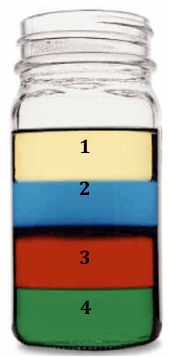
Put the liquids in order from most dense to least dense?
a)
4, 3, 2, 1
b)
1, 2, 3, 4
c)
3, 4, 2, 1,
d)
4, 3, 1, 2
28.
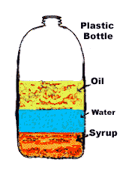
Which liquid is the least dense?
a)
oil
b)
water
c)
syrup
d)
plastic bottle
29.

Which box has a higher density?
a)
Box A
b)
Box B
c)
cannot be determined
d)
they are the same
31.
In general what is the most dense form of matter?
a)
solid
b)
liquid
c)
gas
d)
plasmas
31.
In general what is the most dense form of matter?
a)
solid
b)
liquid
c)
gas
d)
plasmas
32.
What is the formula for density?
a)
density = mass x volume
b)
density = mass / volume
c)
density = mass + volume
d)
density = mass - volume
33.
Frank has an eraser. It has a mass of 4g, and a volume of 2cm3. What is its density?
a)
8 g/cm3
b)
2 g/cm3
c)
1/2 g/cm3
d)
24 g/cm3
34.
Jack has a rock. The rock has a mass of 14g and a volume of 2cm3. What is the density of the rock?
a)
7 mL
b)
7 g/cm3
c)
28 g/cm3
d)
1/7 g/cm3
35.
What is the volume of 150 grams of lead if it has a density of 11.3 g/cm3?
a)
13.3 g
b)
13.3 cm3
c)
.075 g
d)
1695 cm3
36.
An empty beaker has a mass of 60 grams. When mercury is added to the beaker, it has a mass of 200 grams. What is the mass of the mercury?
a)
140 grams
b)
200 grams
c)
140 mL
d)
260 g
37.
Density is...
a)
the amount of mass in an object
b)
the amount of space an object takes up
c)
the amount of mass in a given space
d)
the weight of an object
38.
What is the formula for density?
a)
density = mass x volume
b)
density = mass / volume
c)
density = mass + volume
d)
density = mass - volume
39.
What units can be used to express density?
a)
g/mL
b)
grams
c)
millimeters
d)
milliliters
40.
If the density of a bar of gold is 19.3 g/cm3and you cut it into 4 pieces, what is the density of each piece of gold?
a)
4.825 g/cm3
b)
9.65 g/cm3
c)
19.3 g/cm3
d)
38.6 g/cm3
41.
Frank has a paper clip. It has a mass of 9g and a
volume of 3cm3. What is its density?
a)
3 g/cm3
b)
1/3 g/cm3
c)
27 g/cm3
d)
39 g/cm3
42.
Frank has an eraser. It has a mass of 4g, and a
volume of 2cm3. What is its density?
a)
8 g/cm3
b)
2 g/cm3
c)
1/2 g/cm3
d)
24 g/cm3
43.
Jack
has a rock. The rock has a mass of 14g and a volume of 2cm3. What is
the density of the rock?
a)
7 mL
b)
7 g/cm3
c)
28 g/cm3
d)
1/7 g/cm3
44.
Jill has a gel pen. The gel pen has a mass of 8g and a
volume of 2cm3. What is the density of the rock?
a)
4 g/cm3
b)
16 g/cm3
c)
.25 g/cm3
d)
64 g/cm3
45.

Which liquid has the highest density?
a)
corn syrup
b)
lamp oil
c)
rubbing alcohol
d)
honey
46.

What do we know about the density of lamp oil, rubbing alcohol, and vegetable oil?
a)
The density is greater than 1.0 g/mL
b)
The density is less than 1.0 g/mL
c)
The density is equal to 1.0 g/mL
d)
The density can not be determined
47.

Why do the liquids form different layers?
a)
They have different densities.
b)
They have different masses.
c)
They have different volumes.
d)
They are different temperatures.
48.
Define the Term Density.
a)
Mass/Volume
b)
Volume/Mass
c)
The amount of matter in an object
d)
The amount of space an object occupies.
49.
What is matter?
a)
The amount of matter in an object.
b)
Anything that has mass and occupies space.
c)
The amount of space an object occupies.
d)
mass/volume
50.

What is this place?
a)
Science Laboratory
b)
Computer Room
c)
Covered Playground
d)
Swimming pool
51.

What is the name of this apparatus?
a)
breaker
b)
bigger
c)
beaker
d)
baker
52.

Name this apparatus.
a)
Insulating mat
b)
wire gauze
c)
tile
d)
white board
53.

What is this which can protect your eyes in the laboratory?
a)
Sun glasses
b)
Safety goggles
c)
Safety google
d)
Sun mirror
54.

What is this equipment?
a)
Fire extinguisher
b)
First aid box
c)
Mail box
d)
Fume cupboard
55.

What equipment is used by the lady to put out the fire?
a)
Fire blanket
b)
Sand bucket
c)
Fire extinguisher
d)
Fire fighter
56.

Name the equipment
a)
graduated cylinder
b)
test tube
c)
thermometer
d)
beaker
57.

Name the equipment
a)
beaker
b)
long tube
c)
graduated cylinder
d)
thermometer
58.

Name the equipment
a)
thermometer
b)
test tube rack
c)
beaker
d)
dropper pipette
59.

Name the equipment
a)
thermometer
b)
dropper pipette
c)
burette
d)
stirring rod
60.

Name the equipment
a)
burette
b)
dropper pipette
c)
stirring rod
d)
iron stand
61.

Name the equipment
a)
iron tower
b)
iron ring
c)
iron stand
d)
iron base
62.

Name the equipment
a)
iron ring
b)
iron stand
c)
iron base
d)
iron tower
63.

Name the equipment
a)
test tube
b)
test tube container
c)
test tube stand
d)
test tube rack
64.

Name the equipment
a)
test tube pin
b)
test tube metal
c)
test tube coil
d)
test tube clamp
65.

Name the equipment
a)
lamp
b)
lamp receptacle
c)
clip
d)
alligator clip
66.

Name the equipment
a)
alligator clamps
b)
alligators
c)
alligator clips
d)
alligator crocs
67.

Name the equipment
a)
battery holder
b)
battery receptacle
c)
battery box
d)
battery house
68.

Name the equipment
a)
thermometer
b)
lab. thermometer
c)
thermostat
d)
temperature
69.

Name the equipment
a)
balance
b)
equal scale
c)
balance beam
d)
equal arm balance
70.

Name the equipment
a)
goggles
b)
googles
c)
safety googles
d)
safety goggles
71.

Name the equipment
a)
thermometer
b)
spring scale
c)
scale
d)
hook scale
72.

Name the equipment. Choose the best answer
a)
electric burner
b)
electric stove
c)
electric cooker
d)
electric cube
73.
v =
a)
m/d
b)
d/m
c)
m*d
d)
m*v
74.
mass =
a)
d*v
b)
m/v
c)
v/m
75.
A box has a mass of 10kg and density of 2 g/cc. What is it's volume?
a)
2 liters
b)
20 liters
c)
0.2 liters
d)
5 liters
76.
A kierren has a volume of 10 liters. It is filled with sand that has a density of 1.5g/cc. What is the bottle's mass?
a)
10 kilos
b)
7.5 kilos
c)
15 kilos
d)
0.15 kilos
77.

The amount of "stuff" or particles in an object is called its _____________.
a)
Mass
b)
Volume
c)
Density
d)
Weight
78.

The amount of particles or "stuff" in a given amount of space is called __________.
a)
Mass
b)
Volume
c)
Density
d)
Weight
79.

The amount of space that an object takes up is called its ___________.
a)
Mass
b)
Volume
c)
Density
d)
Weight
80.
_________ is a substance that is a good conductor of heat and electricity.
a)
metal
b)
malleable
c)
insulator
d)
salt
81.
A(n) ___________ is something that can help prevent movement of heat, energy, and even sound. Examples include wood, plastic, glass, and ceramics.
a)
insulator
b)
conductor
c)
metal
d)
acid
82.
When substance change into new substance, or when matter undergoes chemical changes, this is called a(n) ________________
a)
chemical reaction
b)
conductivity
c)
acidity
d)
precipitate
83.
Any metal that can be rolled or pounded into flat sheets is usually called ___________
a)
malleable
b)
metal
c)
insulator
d)
ductile
84.
Metals have good electrical ____________ which means that the let electricity flow through them easily.
a)
conductivity
b)
acidity
c)
reactability
d)
reaction
85.
Metal that is capable of being drawn out into wire or thread is said to be __________
a)
Ductile
b)
base
c)
precipitate
d)
product
86.
Which of these grouping of elements could have the characteristic of brittle?
a)
Metal
b)
Nonmetal
87.
Which of the following is a good conductor of heat?
a)
Metal
b)
Nonmetal
c)
Metalloid
88.
Which of these is a property of metals?
a)
It's malleable
b)
It can't conduct electricity
c)
They are used in food
d)
It's very brittle
89.
Which of the following properties refers to the ability of metals to be drawn into wires?
a)
A. malleability
b)
B. compressibility
c)
C. ductility
d)
D. luster
90.
Which of the following property of metal can reflect light
a)
A. malleability
b)
B. compressibility
c)
C. ductility
d)
D. luster
91.
Metals appear to the _______ of the dark ziz-zag line on the periodic table.
a)
A. right
b)
B. middle
c)
C. left
92.
Nonmetals occur to the ________of the dark zig-zag on the periodic table.
a)
A. right
b)
B. middle
c)
C. left
93.
ability for a solid to be hammered without shattering
a)
Density
b)
Conductivity
c)
Malleability
d)
Viscosity
94.
ability to allow heat to flow
a)
Viscosity
b)
Conductivity
c)
Density
d)
Melting/Boiling Point
95.
What is mass
a)
how much something weighs
b)
mass is how much matter is in something
c)
matter
d)
stuff
96.
_____ - describes the ability of a substance to reflect light.
a)
Ductility
b)
Luster
c)
Malleability
d)
Conductivity
97.
_____ - how well it allows electricity to move through.
a)
Ductility
b)
Luster
c)
Malleability
d)
Conductivity
98.
____ - is the ability of a substance to be hammered or rolled into sheets
a)
Ductility
b)
Luster
c)
Malleability
d)
Conductivity
99.
_____ - is the ability of a substance to be pulled into thin wires.
a)
Ductility
b)
Solubility
c)
Malleability
d)
Conductivity
100.
Something that can be observed or measured without changing the substance -
a)
Mass
b)
Volume
c)
Physical Property
d)
Shape
101.
If you use a flash light you are testing -
a)
Luster
b)
Solubility
c)
Magnetisim
d)
Ductility
102.
If a substance does not reflect light it can be described as -
a)
shiny
b)
dull
c)
magnetic
d)
soluble
103.
Which physical property will change if you visit the moon?
a)
mass
b)
volume
c)
density
d)
weight
104.
What tool can be used to measure mass?
a)
microscope
b)
Mr Thayer
c)
hand lens
d)
balance
105.
Which of the following is typically a good conductor of heat?
a)
Metal
b)
Nonmetal
c)
Metalloid
106.
Silicon is a semiconductor and has properties of both metals and nonmetals. What type of element is Silicon?
a)
Metal
b)
Nonmetal
c)
Metalloid
d)
Pretty
107.
Which elements are found on the right side of The Periodic Table?
a)
Metals
b)
Nonmetals
c)
Metalloids
d)
Water
108.
All of these properties describe metals except...
a)
malleable
b)
conductors
c)
brittle
d)
shiny
109.

Which element is a metalloid?
a)
Titanium
b)
Selenium
c)
Potassium
d)
Polonium
110.
Which of the following is a property of a non-metal?
a)
Conducts electricity and heats well
b)
Can be hammered into thin sheets
c)
Is brittle and breaks easily
d)
Has a shiny, metallic luster
111.
Which of the following correctly lists the three main groups of elements from greatest conductivity to least conductivity?
a)
Nonmetals -metalloids-metals
b)
metals-nonmetals-metalloids
c)
metalloids-metals-nonmetals
d)
metals-metalloids-nonmetals
112.
The word “luster” refers to which property of matter?
a)
The ability to conduct electrical or thermal energy
b)
Capable of being drawn out into thin wires
c)
The way a surface appears when it reflects light
d)
Suitable for being shaped by beating or rolling
113.

Elements in this area can best be described as -
a)
Malleable
b)
Brittle
c)
Dull
d)
Insulators
114.

Elements in this area can best be described as -
a)
Semi-conductors
b)
Insulators
c)
Ductile
d)
Siny
115.

Which table below correctly lists the properties of metals and nonmetals? *
a)
A
b)
B
c)
C
d)
D
116.
What physical properties are used to classify elements as metals, non-metals, or metalloids?
a)
Color, smell, physical state
b)
Reactivity, streak, hardness
c)
Ability to burn, mass, density
d)
Luster, conductivity, malleability
117.
Which of these is a property of metals?<
a)
It's malleable
b)
It can't conduct electricity
c)
They are used in food
d)
It's very brittle
118.
Iron is a good conductor, malleable and magnetic. What type of element is Iron?
a)
Metal
b)
Nonmetal
c)
Metalloid
119.
Metalloids have physical properties of metlas and non metals
a)
True
b)
False
c)
Sometimes
120.
If a material can easily be drawn into the shape of a wire, it is
a)
Ductile
b)
Magnetic
c)
Malleable
d)
Reactive
121.

Ice melting is an example of a
a)
physical change
b)
chemical change
c)
physical property
d)
chemical property
122.

Ability to rust is this type of property:
a)
Physical property
b)
Chemical property
123.
Which is an example of a physical property?
a)
ability to react with acid
b)
color
c)
flammability
d)
ability to react with oxygen
124.
Physical properties are
a)
properties that can be observed without changing the identity of the substance
b)
properties that describe how a substance changes into a completely different substance
c)
properties that we can only observe with our eyes
d)
properties that we need special tools to observe
125.
Which of the following is a chemical property?
a)
how something tastes
b)
ability to explode
c)
ability to float in water
d)
size of an object
126.
Which of the following is a chemical property of water?
a)
Reacts with pure sodium
b)
Boils at 100 oC
c)
Is liquid at room temperature
d)
Has a density of 1 gm/mL
127.
Which is an example of a chemical change?
a)
melting ice to make water
b)
baking cake batter to make a cake
c)
putting cheese on bread to make a cheese sandwich
d)
cutting an orange into slices for a snack
128.
Hammering wood together to build a playhouse
a)
Chemical change
b)
Physical change
129.
Milk turns sour. This is what kind of change?
a)
Chemical change
b)
Physical change
c)
Physical Property
d)
Chemical Property
130.

Green bananas turning yellow on their own as they ripen.
a)
Chemical Change
b)
Physical Change
131.

a copper penny turning greenish after a few years.
a)
Chemical Change
b)
Physical Change
132.

Baking a cake by mixing flour, sugar, chocolate powder, eggs, and milk, and then heating them in the oven.
a)
Chemical Change
b)
Physical Change
133.
A high specific heat means...
a)
It heats up quickly with energy added
b)
It requires more energy to change temperature
134.
What has particularly high specific heat?
a)
Water
b)
Gases
c)
Metals
d)
Poptarts
136.
For a skillet, used for cooking, do you want a high or low specific heat
a)
High, so that it will need more energy to heat up
b)
Low, so that it will change temperature quickly
136.
For a skillet, used for cooking, do you want a high or low specific heat
a)
High, so that it will need more energy to heat up
b)
Low, so that it will change temperature quickly
137.

This is an example of an insulator. Insulator should:
a)
have high specific heat
b)
have low specific heat
c)
have higher temperature
d)
have low temperature
138.
What is a indicator of chemical change:
a)
fire
b)
a solid becomes a gas
c)
boiling
d)
cooling
139.
Absolute zero is...
a)
0º C
b)
0º F
c)
0º K
d)
0º O
140.

What is the temperature on this thermometer in Celsius degrees?
a)
32° Fahrenheit
b)
0° Celsius
c)
0° Fahrenheit
d)
40° Fahrenheit
141.
Water boils at...
a)
273º K
b)
73º K
c)
173º K
d)
373º K
142.

a)
2
b)
8
c)
3
d)
13
143.

a)
2
b)
3
c)
5
144.

a)
2
b)
6
c)
10
d)
16
145.

a)
2
b)
5
c)
10
d)
15
146.

a)
12
b)
7
c)
8
d)
14
147.

a)
1
b)
2
c)
3
d)
4
148.

a)
7
b)
8
c)
9
d)
10
149.

a)
1
b)
2
c)
3
d)
4
150.

a)
6
b)
7
c)
8
d)
9
151.

a)
2
b)
3
c)
4
d)
5
152.

a)
1
b)
2
c)
3
d)
4
153.

a)
4
b)
5
c)
6
d)
7
154.

a)
4
b)
6
c)
8
d)
10
155.

a)
2
b)
6
c)
8
d)
12
156.

a)
3
b)
13
c)
4
d)
14
157.

a)
16
b)
32
c)
6
d)
4
158.

a)
15
b)
16
c)
5
d)
6
159.

a)
10
b)
2
c)
8
d)
18
160.

a)
19
b)
20
c)
1
d)
4
161.

a)
17
b)
18
c)
7
d)
3
162.

a)
38
b)
2
c)
5
d)
40
163.

a)
14
b)
4
c)
3
d)
28
164.

a)
35
b)
4
c)
7
d)
17
165.

a)
7
b)
5
c)
2
d)
15
166.

a)
4
b)
6
c)
16
d)
34
167.

a)
1
b)
5
c)
37
d)
48
168.

a)
4
b)
8
c)
18
d)
36
169.

How many valence electrons are represented here?
a)
7
b)
5
c)
2
d)
8
170.
Valence electrons are:
a)
Electrons farthest away from the nucleus
b)
Electrons closest to the nucleus
c)
Electrons that just come and go - they don't stay with the atom
d)
Electrons in the second shell
171.

Sodium has an atomic number of 11, how many protons does this atom have?
a)
22
b)
11
c)
12
d)
2
172.

Where is the proton located?
a)
In the very dense nucleus
b)
Floating around in the negative electron cloud
c)
the loose nucleus
d)
the positive electron cloud
173.
What number on the element key tells you how many protons an element has?
a)
Atomic Mass
b)
Element name
c)
Atomic number
d)
Element Symbol
174.
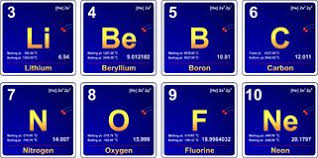
Elements can have the same number of protons?
a)
True
b)
False
175.

What is the atomic mass of Neon?
a)
10
b)
20.18
c)
10.18
d)
30.18
176.

How many protons are in Beryllium?
a)
4
b)
9
c)
5
d)
2
177.

How many neutrons are in a Gold atom?
a)
79
b)
196
c)
118
d)
275
178.

How many electrons does an Iodine atom have?
a)
53
b)
126
c)
73
d)
179
179.

How many electrons does an atom of Krypton have?
a)
36
b)
83.80
c)
47.80
d)
119.80
180.
Which two particles make up the nucleus of an atom?
a)
Protons and Electrons
b)
Protons and Neutrons
c)
Molecules and Compounds
d)
Neutrons and Electrons
181.
What is the role of an electron in an atom?
a)
Electrons live inside the nucleus and carry a neutral charge.
b)
Electrons circle the nucleus and have a positive charge.
c)
Electrons circle the nucleus and have a negative charge.
d)
Electrons live inside the nucleus and have a negative charge.
182.
In an atom, what is the number of protons equal to?
a)
The number of electrons.
b)
The number of neutrons.
c)
The number of molecules.
d)
The number of nuclei.
183.
Which of the following determines the type of element that an atom makes?
a)
The size of the nucleus.
b)
The number of protons.
c)
How much the atom weighs.
d)
The number of neutrons.
184.
An electron is a _____ charged particle.
a)
Positively
b)
Negatively
185.
The number of neutrons equals...
a)
atomic number - mass number
b)
Protons - neutrons
c)
Electrons - protons
d)
mass number - atomic number
186.
How many protons are in Boron (B) ?
a)
3
b)
5
c)
10
d)
11
187.
How many electrons are in Manganese (Mn) ?
a)
12
b)
25
c)
55
d)
30
188.
How many neutrons are in Phosphorus (P) ?
a)
15
b)
31
c)
16
d)
14
189.
How many protons are in Zirconium (Zr) ?
a)
40
b)
91
c)
30
d)
65
190.
How many electrons are in Bromine (Br) ?
a)
35
b)
80
c)
5
d)
11
191.
Which element has 31 protons ?
a)
Gallium
b)
Germanium
c)
Gadolinium
d)
Polonium
192.
Which element has 56 electrons ?
a)
Barium
b)
Boron
c)
Beryllium
d)
Bromine
193.
The subatomic particle with a neutral charge is:
a)
protons
b)
electrons
c)
neutrons
d)
cloud
194.
If an atom has 24 protons and 24 electrons, what is the atomic number of this element?
a)
24
b)
48
c)
0
d)
42
195.
What is the atomic number for Helium?
a)
2
b)
4
c)
6
196.
How many neutrons does B (Boron) contain?
a)
5
b)
11
c)
6
d)
10.811
197.
How many neutrons does Be (Beryllium) contain?
a)
4
b)
5
c)
9.012182
100 %

