wayground logo

Free Printable Worksheets

Font size

S
M
L
XL
Worksheets

Structure and Properties of Matter Test Review

Total questions: 54

Worksheet time: 32mins

Name
Class
Date
1.
In a ___________change, a substance changes into a different substance.
a)
Physical
b)
Chemical
2.
Physical or Chemical Property? If copper comes in contact with water, it will turn green.
a)
Physical
b)
Chemical
c)
Neither
3.
Water and Kool-Aid are mixed together. Hot water, coffee and sugar are mixed together. Which substance is the solvent in both?
a)
Water
b)
Coffee
c)
Kool-aid
d)
Sugar
4.
What is a substance that is dissolved in another substance? 
a)
solution
b)
solute
c)
solvent
d)
compound
5.
Which of the following is a method of separating solutions?
a)
hand seperation
b)
filtering
c)
screening
d)
evaporation 
6.
Which of these is NOT a sign that a chemical change has occurred? 
a)
Change in shape.
b)
An unexpected color change
c)
A temperature change
d)
The formation of a precipitate
7.

You know you a chemical reaction has occurred if

a)

there is a precipitate (new solid)

b)

there is a color change.

c)

there is a temperature change.

d)

All of these answers are evidence.

e)

there are bubbles forming.

8.
What indicates a chemical reaction occurred?
a)
Heat or Light is released
heat or light is produced
b)
gas (bubbles) produced
c)
color change
d)
all of the above
9.
Making a mixture results in ___________________ only.
a)
chemical reactions
b)
separate parts
c)
physical changes
d)
two subtances
10.

The air around us is a mixture of gases.

a)

True

b)

False

11.
Lemonade is a special mixture called a 
a)
substance
b)
solution
c)
plasma
d)
ingredient
12.

A solution is a mixture of one or more substances that _________ evenly into another substance.

a)

dissolved

b)

evaporated

c)

carried

d)

split

13.
Coffee is a 
a)
solution
b)
mixture
14.
Imagine you have a 500 g bar of chocolate that you chop to make chocolate chip cookies. After  chopping the bar into small pieces you put all the pieces on a scale. The scale measures
a)
Less than 500 g
b)
More than 500g
c)
500 g
d)
It is impossible to know
15.
What type of change occurs when a match is lit?
a)
physical change
b)
chemical change
16.
What type of change occurs when a jar breaks into pieces?
a)
physical change
b)
chemical change
17.
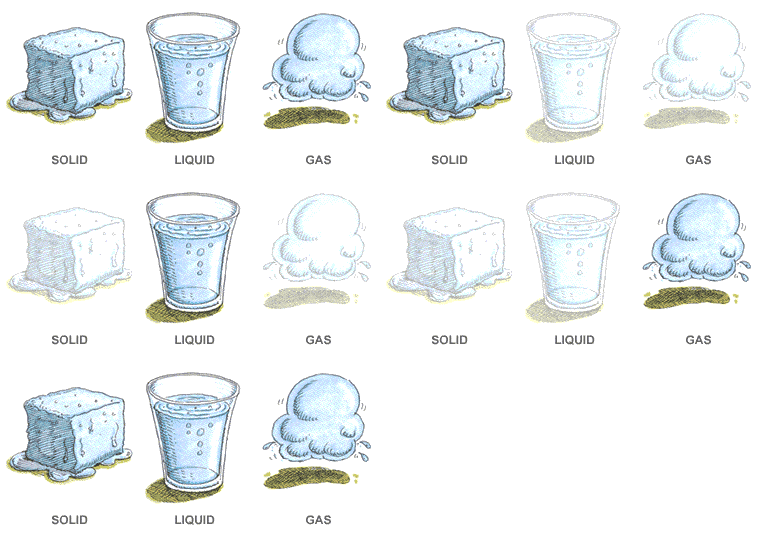
In which of these do particles move slowest?
a)
matter
b)
gas
c)
liquid
d)
solid
18.
When a substance can dissolve in another substance, it is said to be..
a)
soluble
b)
insoluble
c)
miscible
d)
solution
19.

Can sand dissolve in water?

a)

YES

b)

NO

20.
The amount of space an object takes up is its _____________.
a)
volume
b)
weight
c)
density
d)
mass
21.
The ability of a substance to dissolve is its
a)
solubility
b)
chemical change
c)
volume
d)
shape
22.
Which of these is NOT a physical property?
a)
Color
b)
Temperature
c)
Size
d)
Flammability
23.
Which one of these is NOT a property of this object?
a)
Yellow
b)
Pill Shaped
c)
Rounded
d)
Big
24.

Which one of these is NOT a descriptive property of this object?

a)

Soft

b)

White and Grey

c)

Large

d)

60 x 48 inches

25.
A special kind of mixture in which the solid material dissolves into a liquid and CANNOT be separated from the water through filtering.
a)
mixture
b)
solution
c)
chemical reaction
d)
solubility
26.
Which of these is NOT an example of a property?
a)
color
b)
shape
c)
size
d)
how cool it is
27.
Solid that dissolves into the liquid (a material or substance that dissolves/ ie: salt).
a)
solute
b)
solvent
c)
solution
d)
solid
28.
Liquid part of the solution (the material that solid dissolves into/ ie: the water).
a)
solute
b)
solvent
c)
indent
d)
matter
29.
What takes up space and has a mass?
a)
matter
b)
volume
c)
solute
d)
solvent
30.
The process when a liquid turns into a gas and disperses into the air leaving any solid material behind (causes the liquid to dry up).
a)
precipitate
b)
evaporation
c)
condensation
31.
A solid material that forms during a chemical reaction.
a)
precipitate
b)
bubbles
c)
solute
d)
solution
32.
A process in which one material spreads out evenly into another material, so the first material seems to disappear (but is actually still there). 
a)
dissolve
b)
melt
c)
vanish
d)
volume
33.

A solution where as much solid material as possible has dissolved into a liquid, and any EXTRA solid material sits or collects on the bottom.

a)

soluble solution

b)

chemical reaction

c)

saturated solution

34.
The process in which two or more materials combine to make one or more new substances that have different properties than the original materials.
a)
solution
b)
saturated solution
c)
chemical reaction
d)
mixture
35.
Which of these is not a mixture? 
a)
oil and water
b)
sand and soda
c)
diet soda
d)
all are mixtures
36.
When materials combine to form a mixture, they
a)
keep their original properties.
b)
react to form a new substance with new properties.
c)
combine in a specific ratio.
d)
always change their physical state.
37.

Imagine you have a 500 g bar of chocolate that you melt into a liquid. After melting it, you put the liquid on a scale. The scale measures

a)

Less than 500 g

b)

More than 500g

c)

500 g

d)

It is impossible to know

38.

In which of these do particles move fastest?

a)

matter

b)

gas

c)

liquid

d)

solid

39.

Does air have matter?

a)

Yes

b)

No

40.

There is a cup of salt and water. Some salt has fallen to the bottom. Is it a chemical reaction or just a mixture/solution?

a)

It is a chemical reaction because salt is at the bottom.

b)

It is just a mixture/solution because you can evaporate the water out.

c)

It is just a mixture/solution because it is a saturated solution. That's why there is salt at the bottom.

d)

It is a chemical reaction because salt and water makes a chemical reaction.

41.

You find a material's ______________ by saturating a solution, filtering out the excess, and finding out how much material has actually dissolved into the solution.

a)

solubility

b)

flexibility

c)

color

d)

malleability

e)

flammability

42.

There is a pitcher full of water, chemical A and chemical B. There is a lot of bubbling. Is this a chemical reaction or just a mixture/solution?

a)

Carbon dioxide is being released so it is a chemical reaction.

b)

Oxygen is being released so it is a chemical reaction.

43.

There is a cup with Chemical A and B. When I add water, there is no fizzing, but some powder fell to the bottom. I tested the powder and found it was Chemical B. What happened?

a)

A precipitate formed so it is a chemical reaction.

b)

The solution was saturated so it could not dissolve anymore Chemicals.

44.

You can filter a solution to separate the solute and the solvent.

a)

True

b)

False

45.

You can filter salt out of saltwater.

a)

True

b)

False

46.

There is a cup with Chemical A and B. When I add water, there is no fizzing, no material at the bottom, but it got really cold. What happened?

a)

It was not a chemical reaction because only one of the signs was present.

b)

It was a chemical reaction because it was cold.

c)

It was not a chemical reaction because there needs to be a precipitate.

47.

There is a cup with Chemical A and B. When I add water, some crystals fell to the bottom. I tested the crystals and they were not Chemical A or B. What happened?

a)

It was a chemical reaction because a precipitate was formed.

b)

It is not a chemical reaction because it was just a saturated solution.

48.

These are all words that can be confused when used as properties EXCEPT...

a)

long

b)

tall

c)

tiny

d)

hard

e)

pretty

49.

These are all words that can be confused when used as properties EXCEPT...

a)

short

b)

transparent

c)

colorful

d)

fat

e)

huge

50.

Transparent means

a)

see through

b)

kind of see through

c)

not see through

51.

Opaque means

a)

see through

b)

kind of see through

c)

not see through

52.

These are all words that cannot be confused when used to describe something...

a)

opaque

b)

giant

c)

metallic

d)

solid

e)

flexible

53.

If I mix 5 g of sugar and 50 g of water, the sugar dissolves into the water and looks like it disappeared. I can prove it is still there by...

a)

Weighing it

b)

Filtering it

c)

Observing it

d)

Smelling it

54.

The weight of an object DOES change if...

a)

you freeze it

b)

you melt it

c)

you reshape it

d)

you cut it into pieces

e)

you add more to it