wayground logo

Free Printable Worksheets

NEW

Font size

S
M
L
XL
Worksheets

VUS.8

Total questions: 37

Worksheet time: 21mins

Name
Class
Date
1.
I helped form the NAACP to provide equality for African Americans.
a)
W.E.B. DuBois
b)
Booker T. Washington
c)
Ida B. Wells
d)
Samuel Gompers
2.
I amassed my fortune from the steel industry. Later as a philanthropist, I provide funds for libraries, education and scientific research.
a)
Henry Ford
b)
Thomas Edison
c)
Andrew Carnegie
d)
Theodore Roosevelt
3.
The Homestead Act of 1862 provided this to settlers who moved west. 
a)
Money
b)
Water
c)
Land
d)
golf
4.
Immigrants followed the process of assimilation into an America _______. Public schools served as an essential role in this process. 
a)
Square Deal
b)
Melting Pot
c)
Manifest Destiny
d)
Great Migration
5.
This invention made farming profitable by increasing the efficiency of production.
a)
Railroads
b)
Mechanical Reaper
c)
Canals
d)
Lightbulb
6.
What did I invent/improve?
a)
Light bulb
b)
Steel Process
c)
Telephone
d)
Assembly-line manufacturing
7.
This event was the movement of African American from the South, Northward in search of a better life
a)
Great Migration
b)
Manifest Destiny
c)
Reconstruction
d)
Homestead Act
8.
The Transcontinental Railroad was mainly built with the help of which minority group?
a)
Hispanics
b)
African Americans
c)
Native American
d)
Chinese
9.

I helped the Progressive Movement reach their goals through my "New Freedom" programs that had banking and business reforms.

a)
Samuel Gombers
b)
Eugene Debs
c)
John Sherman
d)
Woodrow Wilson
10.
In State governments, all the following are used except:
a)
Referendum
b)
Initiative
c)
Recall
d)
Urbanization
11.
This invention made travel much quicker and was refined in North Carolina by the Wright Brothers.
a)
Airplane
b)
Automobile
c)
Plow
d)
Locomotive
12.
This court case ruled segregation was legal as long as both parties have equal services. 
a)
 McCulloch v. Maryland,
b)
Marbury v. Madison
c)
Plessy v. Ferguson
d)
Gibbons v. Ogden 
13.
In what industry did this man make his fortune?
a)
Steel
b)
Oil
c)
Railroads
d)
Finance
14.
The years immediately before and after the Civil War were the era of the American cowboy, marked by long cattle drives for hundreds of miles over unfenced open land in the West, the only way to get _______.
a)
cattle to market
b)
freedom from Spanish
c)
away from hostile indians
d)
a vacation
15.
Mounting resentment led ________ to limit immigration through the Chinese Exclusion Act of 1882 and the Immigration Restriction Act of 1921. 
a)
Executive 
b)
Supreme Court
c)
President
d)
Congress
16.
During the half-century from 1871 until 1921, most immigrants came from southern and eastern Europe, all the following areas, execpt:
a)
Italy
b)
Greece
c)
Poland
d)
China
17.
________ was the first city to begin construction of a subway system around the turn of the twentieth century, and many cities built trolley or streetcar lines. 
a)
Boston
b)
New York City
c)
Richmond
d)
Washington
18.
Causes of the Progressive Movement include dangerous working conditions – (all of the following) except:
a)
Child labor
b)
Long hours
c)
High wages
d)
No job security
19.

I made my money using vertical integration:

a)
Eugene Debs
b)
Andrew Carneige
c)
Samuel Gombers
d)
John Sherman
20.
Women’s suffrage –
-Was a forerunner of modern protest movement
– Benefited from strong leadership Encouraged women to enter the labor force during World War I
 – Resulted in the ____ Amendment to the Constitution 
a)
13th
b)
15th
c)
17th
d)
19th
21.
All of the following were strikes that occurred during the Progressive Era except: 
a)
Haymarket Square Riot
b)
Homestead Strike
c)
Pullman Strike 
d)
Boston Strike
22.
Direct election of U.S. Senators was established in the __ Amendment 
a)
13th
b)
15th
c)
17th
d)
19th
23.
Ida B. Wells led an anti-lynching crusade and called on the federal government to take action. Define Lynching. 
a)
to put to death, as by hanging
b)
removing of one's garments
c)
stealing of property
d)
loss of job due to race
24.

What compromise ended Reconstruction?

a)

Compromise of 1777

b)

Compromise of 1850

c)

Compromise of 1877

d)

Compromise of 1900

25.

In which court case did the Supreme Court rule that "separate but equal" did not violate the 14th amendment, upholding the "Jim Crow" Laws?

a)

Marbury v. Madison

b)

McCulloch v. Maryland

c)

Gibbons v. Ogden

d)

Plessy v. Ferguson

26.

Prior to 1871, where did immigrants come from?

a)

Northern and Western Europe

b)

Southern and Eastern Europe

c)

Asia

d)

Latin America

27.

After 1871, where did immigrants come from?

a)

Northern and Western Europe

b)

Southern and Eastern Europe

c)

Asia

d)

Latin America

28.

Changing their names, cutting their hair, forcing them to adopt Christianity, requiring them to learn English, etc. These are all examples of what pushed on many Immigrants, but especially the Indians (Native Americans)?

a)

Assimilation

b)

Nativism

c)

Protectionism

d)

Temperance

29.
Which of the following was NOT a problem labor unions fought for?
a)
shorter hours
b)
lower pay
c)
no child labor
d)
safer working conditions
30.
Which law expanded competition and eliminated trusts and monopolies?
a)
Interstate Commerce Act 
b)
Homestead Act
c)
Sherman AntiTrust Act
d)
Dawes Act
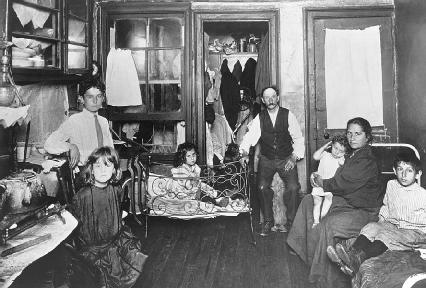
31.
The photo demonstrates one of the problems with
a)
overcrowding urban tenements.
b)
labor union activism in urban areas.
c)
the overproduction of consumer goods.
d)
the growth of political machines.
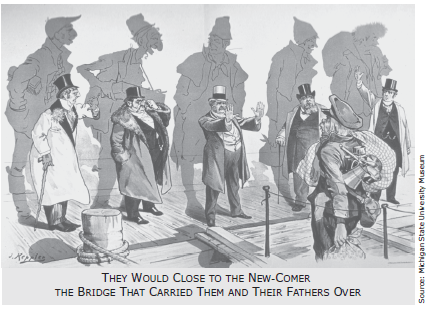
32.
Which group of people most likely inspired the creation of this 1893 cartoon?
a)
Union Leaders
b)
Philanthropists
c)
Nativists
d)
Political Bosses
33.
Which African American leader believed in full political, civil and social rights rather than to accept social segregation?
a)
Booker T. Washington
b)
J.P. Morgan
c)
W.E.B. DuBois
d)
Frederick Douglass
34.
What was the purpose of the Temperance Movement?
a)
Support immigrant rights
b)
Oppose the consumption of alcohol
c)
Gain women the right to vote
d)
Prevent unsafe working conditions
35.
Which of the following believed equality could be achieved through vocational education and accepted social segregation?
a)
W.E.B. DuBois
b)
Frederick Douglass
c)
Booker T. Washington
d)
Ida B. Wells-Barnett
36.

From this image, who is in control of the US lawmakers.

a)

Large monopolies

b)

small private business

c)

political machines

d)

labor unions

37.

What does this image say about the control of Stand Oil?

a)

Standard Oil is a monster trying to control the entire USA

b)

Standard Oil is trying to save government from political bosses

c)

Standard Oil is trying to keep government on the right track to benefit laborers

d)

Stand Oil had control over many aspects of government