
 Worksheets
BES 4th Grade-Water Cycle & Weather
Total questions: 30
Worksheet time: 17mins
Name
Class
Date
1.

What part of the water cycle does this picture show?
a)
condensation
b)
precipitation
c)
evaporation
2.
Which of these is an example of precipitation?
a)
snow
b)
air
c)
clouds
d)
vapor
3.
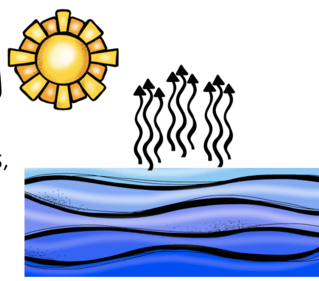
Evaporation happens when the sun ___________ water and turns it into vapor.
a)
cools
b)
heats up
c)
freezes
d)
lights up
4.

what does this tool measure?
a)
wind direction
b)
wind speed
c)
air temperature
d)
humidity
5.

What is the name of this tool?
a)
wind vane
b)
anemometer
c)
wind sock
6.
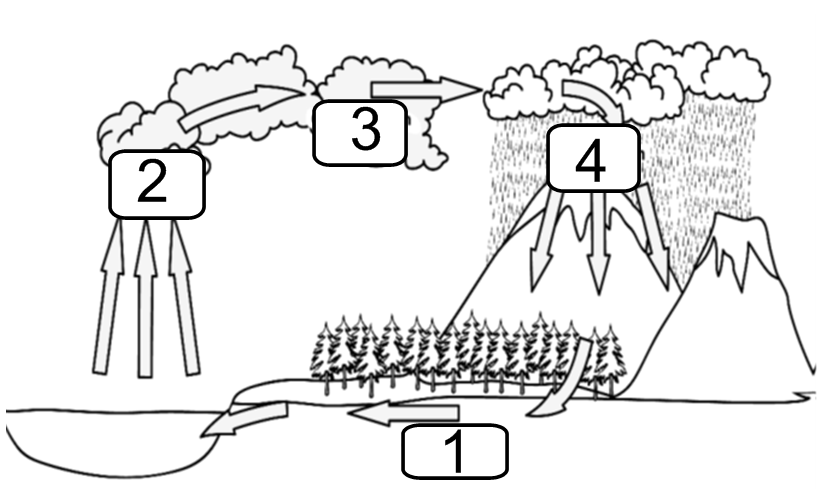
Which stage does the #2 show in the diagram?
a)
condensation
b)
evaporation
c)
precipitation
d)
run off
7.
Precipitation occurs because
a)
the droplets evaporate in the air
b)
the droplets are too light for the air to hold
c)
the droplets are too heavy for the air to hold
8.

This is the symbol for a...
a)
Cold Front
b)
Warm Front
c)
Stationary Front
d)
Occluded Front
9.

the amount of water vapor in the air
a)
warm front
b)
precipitation
c)
humidity
d)
air pressure
10.
Rain, sleet, hail, and freezing rain are all...
a)
precipitation
b)
condensation
c)
evaporation
d)
perspiration
11.
The conditions of the atmosphere at a certain time and place.
a)
weather
b)
climate
c)
precipitation
d)
atmosphere
12.

Number 4 in the diagram illustrates what part of the water cycle?
a)
Condensation
b)
Evaporation
c)
Runnoff
d)
Precipitation
13.

What type of cloud is pictured?
a)
Cirrus
b)
Stratus
c)
Cumulous
d)
Nimbus
14.
Which is NOT an example of precipitation?
a)
hail
b)
rain
c)
lightning
d)
snow
15.
What is the freezing point of water?
a)
0°F
b)
32°F
c)
50°F
d)
100°F
16.
What MOST LIKELY happens in the water cycle after water condenses?
a)
Water evaporates.
b)
Water flows in rivers.
c)
Water flows in the air.
d)
Water falls back to Earth.
17.
If it is raining and the temperature drops to 26°F, what will likely happen?
a)
The sun will come out.
b)
It will get warmer.
c)
It will rain harder.
d)
The rain will change to snow or ice.
18.
What could happen to the water cycle if we had no sun?
a)
The water cycle would be reversed.
b)
There would be no water cycle.
c)
There would be more rain.
d)
The water would evaporate more quickly.
19.

name this front
a)
warm front
b)
cold front
c)
stationary front
d)
occluded front
20.

name this front
a)
warm front
b)
cold front
c)
stationary front
d)
occluded front
21.
What are the three stages of the water cycle?
a)
evaporation, condensation, precipitation
b)
rain, condensation, precipitation
c)
steam, rain, snow
d)
evaporation, collection, precipitation
22.

What does the lamp represent in this water cycle set up?
a)
The Sun
b)
Precipitation
c)
Condensation
d)
Accumulation
23.

What does this tool measure?
a)
wind direction
b)
wind seed
c)
zoo this way
d)
ocean current
24.
A person who studies weather and weather patterns is a(n)
a)
Botanist
b)
Astronomer
c)
Geologist
d)
Meteorologist
25.
Rain, snow, sleet, and hail are all forms of _____.
a)
precipitation
b)
condensation
c)
evaporation
d)
climate
26.

This weather instrument is a...
a)
anemometer
b)
barometer
c)
wind vane
d)
thermometer
27.

This weather instrument is a...
a)
thermometer
b)
wind vane
c)
anemometer
d)
rain gauge
28.

This weather instrument is a...
a)
thermometer
b)
anemometer
c)
rain gauge
d)
barometer
29.
Temperature is measured in...
a)
degrees
b)
inches
c)
centimeters
d)
feet
30.
Where is most water found on Earth?
a)
glaciers
b)
lakes
c)
rivers
d)
oceans
100 %

