
 Worksheets
Ions, Formulas, Balancing Equations-Ms. Holt
Total questions: 102
Worksheet time: 2hrs 56mins
Name
Class
Date
1.

Who is your favorite rapper to ever get his start in Ms. Holt's Class?
a)
Conner Berry
b)
Hayden Catlett
c)
Morgan Tait
d)
Papa Twig
2.
The chemical formula for an ionic compound of aluminum and chlorine is
a)
AlCl.
b)
ClAl.
c)
AlCl3.
d)
Al3Cl.
3.
The correct formula for magnesium oxide is
a)
Mg2O
b)
MgO
c)
MgO2
d)
Mg2O3
4.
Na + and S -2
a)
Na2S
b)
NaS2
c)
Na2S2
d)
NaS
5.
Al+3, S-2
a)
AlS3
b)
Al2S3
c)
S3Al2
6.
Al +3 and P -3
a)
Al3P3
b)
AlP
c)
P3Al3
d)
Pal
7.
How do the following two elements bond together?
Pb4+ O2-
Pb4+ O2-
a)
PbO
b)
Pb4O2
c)
PbO2
d)
Pb2O4
8.
Chemical formula of Hydroxide ion?
a)
O2-
b)
H+
c)
OH-
d)
OH2-
9.
Chemical formula of Nitrate ion?
a)
NO2
b)
NO3-
c)
NO32-
d)
NO2-
10.
Chemical formula of Carbonate ion?
a)
CO2
b)
CO22-
c)
CO3-
d)
CO32-
11.
Chemical formula of Sulfate ion?
a)
S2-
b)
SO2
c)
SO32-
d)
SO42-
12.
Chemical formula of Silver ion?
a)
Ag+
b)
Ag2+
c)
Au+
d)
Au2+
13.
Chemical formula of Ammonium ion?
a)
NH3
b)
NH4+
c)
NH42+
d)
NH32+
14.
The first step in naming an ionic compound is always...
a)
Naming the anion (negative ion)
b)
Changing the ending to -ide
c)
Naming the cation (positive ion)
d)
Writing the cation charge
15.
Ba +2 and N -3
a)
Ba2N3
b)
Ba3N2
c)
BaN
d)
BaN3
16.
Zn +2 and F -
a)
ZnF2
b)
Zn2F
c)
F2Zn
d)
Fan2
17.
Pb +2 and S -2
a)
Pb2S2
b)
S2Pb2
c)
PbS
d)
Sub
18.
K + and I -
a)
KI
b)
IK
c)
K1I-1
d)
IK
19.

Is this equation balanced?
a)
yes
b)
no
c)
Not enough information
20.

Is this equation balanced?
a)
yes
b)
no
c)
Not enough information
21.
Is the equation balanced?: 2H2O + O2 --> 4MgO + 3Fe
a)
Yes
b)
No
22.
Balance this equation
_Al +_HCl --> _H2 +_AlCl3
_Al +_HCl --> _H2 +_AlCl3
a)
2, 6, 3, 2
b)
it is already balanced
c)
4, 12, 3, 4
d)
2, 1, 4, 5
23.
Balance this equation-
__P4 + __O2 --> __P2O3
__P4 + __O2 --> __P2O3
a)
it is already balanced
b)
2, 1, 3
c)
1, 2, 3
d)
1, 3, 2
24.
Balance this equation.
_CH4 + _O2 --> _CO2 + _H2O
_CH4 + _O2 --> _CO2 + _H2O
a)
1,2,1,1
b)
2,1,2,1
c)
1,2,1,2
d)
0,2,0,2
25.
Balance this equation.
_CF4 + _Br2 -- _CBr4 + _F2
_CF4 + _Br2 -- _CBr4 + _F2
a)
2,1,2,1
b)
1,2,2,1
c)
1,2,1,2
d)
2,2,2,2
26.
Balance this equation
_N2 + _H2 --> _NH3
_N2 + _H2 --> _NH3
a)
1,2,3
b)
1,3,2
c)
1,1,2
d)
2,1,1
27.
Balance this equation.
_Mg + _Cl2 --> _MgCl2
_Mg + _Cl2 --> _MgCl2
a)
1, 2,1
b)
already balanced
c)
2,1,1
d)
1,1,2
28.
Balance this equation.
_Mg + _Cl2 --> _MgCl2
_Mg + _Cl2 --> _MgCl2
a)
1, 2,1
b)
already balanced
c)
2,1,1
d)
1,1,2
29.
Balance this equation-
_SeCl6+_O2>_SeO2+_Cl2
_SeCl6+_O2>_SeO2+_Cl2
a)
1,2,1,2
b)
1,1,1,3
c)
1,2,1,1
d)
2,1,1,1
30.
What does the Law of Conservation of Mass state?
a)
Matter cannot be gained or lost in a chemical reaction.
b)
Matter can only be lost in a chemical reaction.
c)
Matter can only be gained in a chemical reaction.
d)
Matter can be gained and lost in a chemical reaction.
31.
What is the little number after an element in a chemical equation called.
Example: H2
Example: H2
a)
Coefficient
b)
Subscript
c)
Atom
d)
Equation
32.
At the end of chemical reactions, what is the total mass of the reactants compared to the total mass of the products?
a)
the product is doubled
b)
the product is half the mass of the reactants
c)
the mass is the same
d)
the mass changes depending on the reaction
33.
What is a coefficient?
a)
The small number on the right of the chemical symbol.
b)
The large number to the left of a formula.
34.
When balancing equations a ____ can be placed to the left of a formula of a substance to make the equations balanced
a)
charge
b)
subscript
c)
random number
d)
coefficient
35.
Balance this equation:
FeS + 2HCl -->
FeCl2 + H2O
FeS + 2HCl -->
FeCl2 + H2O
a)
FeS2 + 2HCl --> FeCl2 + H2O
b)
It's already balanced
c)
FeS2 + 2HCl --> FeCl2 + H4O
d)
None of these
36.
How would this equation be classified?
O2 + 2H2 --> 2H2O
O2 + 2H2 --> 2H2O
a)
Synthesis
b)
Decomposition
c)
Combustion
d)
Single Displacement
37.
Which problem is balanced?
a)
PbO2 + 2H2
b)
SO2 + H20 --> H2SO4
c)
2Na + 2H2O --> 2NaOH + H2
38.
Is the equation balanced?: 2H2O + O2 --> 4MgO + 3Fe
a)
Yes
b)
No
39.
A molecule is________
a)
a glob of gelatinous goo
b)
smaller than an atom
c)
filled with raisons
d)
more than one atom bonded together
40.
What is the left part of a chemical equation called?
H2 + O → H2O
H2 + O → H2O
a)
Reactants
b)
Products
c)
Yields
d)
Chemical Equation
41.
What is the right part of a chemical equation called?
H2 + O → H2O
H2 + O → H2O
a)
Reactants
b)
Products
c)
Yields
d)
Chemical Equation
42.

What are the PRODUCTS of the chemical reaction pictured?
a)
CH4 and CO2
b)
CH4 and O2
c)
CO2 and H2O
d)
O2 and H2O
43.
CH4 + 2 O2 → CO2 + 2H2O
In this equation, CH4 is a
In this equation, CH4 is a
a)
product
b)
reactant
c)
displacement
44.
CaCO3 represents a chemical
a)
Symbol
b)
Formula
c)
Subscript
d)
Reaction
45.
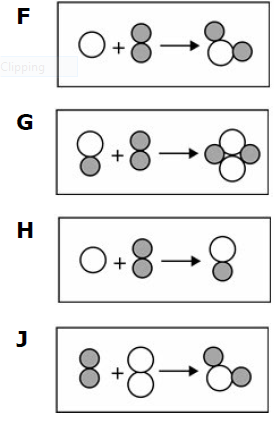
Which of the following models best demonstrates a balanced chemical equation?
a)
F
b)
G
c)
H
d)
J
46.

What is the mass of H2O in the reaction above?
a)
70.01
b)
24.11
c)
21.44
d)
48.22
47.
Si + S8 →Si2S4
a)
Synthesis (combination)
b)
Decomposition
c)
Single replacement
d)
Double replacement
48.
Ca + AlCl3→ CaCl2 + Al
a)
Synthesis (combination)
b)
Decomposition
c)
Single replacement
d)
Double replacement
49.
KOH + H3PO4 → K3PO4 + H2O
a)
Synthesis (combination)
b)
Decomposition
c)
Single replacement
d)
Double replacement
50.
Pb(NO3)2 →PbO + NO2 + O2
a)
Synthesis (combination)
b)
Decomposition
c)
Single replacement
d)
Combustion
51.
Mg + N2 →Mg3N2
a)
Synthesis (combination)
b)
Decomposition
c)
Single replacement
d)
Combustion
52.
NO2 →N2 + O2
a)
Synthesis (combination)
b)
Decomposition
c)
Single replacement
d)
Combustion
53.
AB + CD →AD + CB
a)
Double Replacement
b)
Single Replacement
c)
Synthesis
d)
Decomposition
54.
A + BC →B + AC
a)
Single Replacement
b)
Decomposition
c)
Double Replacement
d)
Synthesis
55.
AB →A + B
a)
Decomposition
b)
Single Replacement
c)
Double Replacement
d)
Synthesis
56.
Cu + 2Ag(NO3) → 2Ag + Cu(NO3)
a)
Synthesis Reaction
b)
Decomposition Reaction
c)
Single Displacement Reaction
d)
Double Displacement Reaction
57.
2NaCl →2Na +Cl2
a)
Synthesis Reaction
b)
Decomposition Reaction
c)
Single Displacement Reaction
d)
Double Displacement Reaction
58.
C + O2 → CO2
a)
Synthesis Reaction
b)
Decomposition Reaction
c)
Single Displacement Reaction
d)
Double Displacement Reaction
59.
Ca3(PO4)2 + 3 H2SO4 + 3 CaSO4 + 2 H3(PO4)
a)
Synthesis Reaction
b)
Decomposition Reaction
c)
Single Displacement Reaction
d)
Double Displacement Reaction
60.
During an endothermic reaction, what happens to energy in relation to the surroundings?
a)
released to
b)
absorbed from
c)
mixed with
61.
During an exothermic reaction, what happens to energy in relation to the surroundings?
a)
released to
b)
absorbed from
c)
mixed with
62.
Ions are:
a)
atoms with a positive or negative charge
b)
atoms with no charge
c)
atoms with ONLY a positive charge
d)
atoms with ONLY a negative charge
63.
Cations are
a)
positive
b)
negative
c)
neutral
d)
nonmetals
64.
If an atom gains an electron to become an ion, it is a(n)....
a)
cation
b)
anion
c)
noble gas
d)
metal
65.
What is the element/ion symbol for Iron(III)?
a)
Fe
b)
Fe3+
c)
Fe3-
d)
Fe(III)
66.
Name the ion... Cu2+
(Hint: This is a transition metal)
(Hint: This is a transition metal)
a)
Copper
b)
Copperide
c)
Copper(II)
d)
Copper(2)
67.
Which is false about the Cl ion?
a)
It is in Group 7A.
b)
It is a cation.
c)
It has -1 charge.
d)
It has more electrons than protons.
68.
Ammonium
a)
NH4+
b)
NO3-
c)
NO2-
d)
MnO4-
69.
Carbonate
a)
Cr2O4-2
b)
CH3COO-
c)
CO3-2
d)
CN-
70.
Chromate
a)
CH3COO-
b)
CrO4-2
c)
CO3-2
d)
Cr2O4-2
71.
Cyanide
a)
CrO4-2
b)
Cr2O4-2
c)
CO3-2
d)
CN-
72.
Nitrite
a)
NO2-
b)
NO3-
c)
MnO4-
d)
NH4+
73.
Permanganate
a)
NH4+
b)
NO2-
c)
NO3-
d)
MnO4-
74.
Sulfite
a)
S2O3-2
b)
O2-2
c)
SO4-2
d)
SO3-2
75.
CH3COO-
a)
Acetate
b)
Ammonium
c)
Hydroxide
d)
Cyanide
76.
NH4+
a)
Ammonium
b)
Nitrate
c)
Nitrite
d)
Cyanide
77.
CN-
a)
Dichromate
b)
Chromate
c)
Cyanide
d)
Hydroxide
78.
Cr2O7-2
a)
Chromate
b)
Dichromate
c)
Carbonate
d)
Cyanide
79.
What is the name of this polyatomic ion? MnO4-
a)
Carbonate
b)
Permanganate
c)
Phosphate
d)
Chromate
80.
How many elements are in C6H12O6?
a)
1
b)
2
c)
3
d)
4
81.
How many atoms of carbon (C) are in C6H12O6?
a)
3
b)
6
c)
12
d)
24
82.
Element or compound?
H2O
H2O
a)
element
b)
compound
83.
Element or compound?
O2
O2
a)
Element
b)
Compound
84.
Which is the correct formula for:
three hydrogen (H)
one sulfur (S)
four oxygen (O)
three hydrogen (H)
one sulfur (S)
four oxygen (O)
a)
H3SO4
b)
HSO4
c)
H4S3O
d)
H2O
85.
Which is the correct formula for:
one carbon (C)
two oxygen (O)
one carbon (C)
two oxygen (O)
a)
CO2
b)
CO
c)
C2O
d)
2CO
86.
Which of the following is NOT an element?
a)
H2O
b)
H2
c)
O2
d)
Au
87.
How many atoms are there TOTAL in:
H2SO4
H2SO4
a)
6
b)
5
c)
7
d)
3
88.

The blue numbers in the image below represent ________
a)
I don't know, and don't want to try
b)
coefficients
c)
subscripts
d)
none of the answers are correct
89.

The red numbers in the image below represent ________
a)
subscripts
b)
coefficients
c)
I don't know, and don't want to try
d)
None of the answers are correct
90.

Black = Carbon (C)
White = Hydrogen (H)
What would be the formula for ethane?
White = Hydrogen (H)
What would be the formula for ethane?
a)
CH4
b)
CH6
c)
C2H2
d)
C2H6
91.
How many atoms of aluminum are on each side of the following equation: 4Al + 3O2 --> 2Al2 O3
a)
2
b)
6
c)
1
d)
4
92.
How many Sodium (Na) are in 6NaCl?
a)
1
b)
12
c)
6
93.
How many O's are in Al₂(SO₄)₃
a)
4
b)
12
c)
7
d)
24
94.
How many Aluminum are in Al2O3?
a)
3
b)
2
c)
5
95.
Number of H in 3(NH₄)₂CrO₄
a)
4
b)
2
c)
8
d)
24
96.
A molecule that contains two or more elements is called --
a)
an atom
b)
a molecule
c)
a compound
d)
a mixture
97.
Which element is found in all of these compounds?
C3H6
H20
NaHCO3
CH3(OH)
C3H6
H20
NaHCO3
CH3(OH)
a)
Hydrogen
b)
Oxygen
c)
Sodium
d)
Carbon
98.
All of these are examples of a chemical compound except --
a)
H2
b)
MgO
c)
SiO2
d)
H2O
99.
In Cl2, the 2 is known as
a)
the subscript.
b)
the coefficient.
c)
the molecular mass.
d)
the number of protons.
100.
Chlorine, bromine, fluorine, and iodine are all
a)
nonmetals and good conductors.
b)
nonmetals and halogen gases.
c)
metals and bad conductors.
d)
metals and malleable.
101.
Diatomic molecules are __________ found in nature as their single element: I, O, N, H, Br, Cl, or H.
a)
often
b)
never
c)
sometimes
d)
always
102.

Who is our favorite chemistry Senior Basketball Player?
a)
Abby
b)
Not Olivia
c)
Not Cat
d)
Not Trinity
100 %

