wayground logo

Free Printable Worksheets

Font size

S
M
L
XL
Worksheets

Unit 1 Exam Review

Total questions: 100

Worksheet time: 2hrs 59mins

Name
Class
Date
1.

The penguins are black and white.

a)

Qualitative Observation

b)

Quantitative Observation

2.

The speed of the car is 55 mph.

a)

Qualitative Observation

b)

Quantitative Observation

3.

These kind of observations are made using instruments such as rulers, balances and thermometers.

a)

Qualitative

b)

Quantitative

4.
The leaf is 5mm wide.
a)
Qualitative
b)
Quantitative
5.
It tastes sweet.
a)
Qualitative
b)
Quantitative
6.
Research Question: Does the type of gasoline put in a car effect how fast the car can drive. What is the independent variable?
a)
Type of gasoline
b)
which car the gas is put into
c)
how fast the car can drive
d)
how much gas is put into the car
7.
When experimenting with the growth of a plant, a scientist uses three (of the same type of) plants, two different fertilizers, equal light, and equal water. What type of variable is the fertilizer?
a)
Dependent
b)
Independent
c)
Control
d)
Compound
8.
Ms. S set up an experiment to see how the mass of a ball affects the distance it rolls off a ramp. Identify the independent variable.
a)
Distance traveled by the ball
b)
Height of the ramp
c)
Mass of the ball
d)
Who set up the experiment (Ms. S, etc)
9.
a)
The dependent variable is total cost
b)
The dependent variable is weight
c)
The independent variable is total cost
d)
The independent variable is cost of a package
10.
On a graph, which axis shows the dependent variable?
a)
x-axis
b)
y-axis
c)
neither
d)
it changes
11.
On a graph, which axis shows the independent variable?
a)
x-axis
b)
y-axis
c)
neither
d)
it changes
12.
Research question: does the distance a person kicks a soccer ball effect how well they will do on their math test.  What is the dependent variable?
a)
How far they kick the soccer ball
b)
who the person is
c)
how well they do on the math test
d)
Type of soccer ball.
13.
When experimenting with the growth of a plant, a scientist uses three (of the same type of) plants, two different fertilizers, equal light, and equal water. What type of variable is the fertilizer?
a)
Dependent
b)
Independent
c)
Control
d)
Compound
14.
What would the INDEPENDENT variable be in an experiment testing which types of paper airplane goes furthest?
a)
the paper used
b)
the type of paper airplane
c)
the distance of each plane's flight
d)
how hard the plane is thrown
15.
Ms. S set up an experiment to see how the mass of a ball affects the distance it rolls off a ramp. What is the dependent variable?
a)
Distance traveled by the ball
b)
Height of the ramp
c)
Mass of the ball
d)
Where the experiment took place.
16.
Mr. S. sets up an experiment to see how the mass of a ball affects the distance it rolls off a ramp.  Identify the constant.
a)
distance traveled by the ball
b)
height of the ramp
c)
mass of the ball
d)
weight of the ball
17.
Mr. S. normally uses praise as a reward to train his dog.  He wants to know the best way to train his dog, so he sets up an experiment to find out if there is a better way to get his dog to respond to commands.  What is his control trial?
a)
type of reward
b)
trials done with new rewards
c)
trials done with praise 
d)
the leash that he uses
18.
Mr. S. uses a new spray cleaner to remove the green slime left by students on the tables.  Identify the control trial
a)
type of cleaner
b)
 test with a new cleaner
c)
test with the old cleaner
d)
the green slime
19.
A series of steps used by scientists to solve a problem or answer a question. 
a)
scientific method
b)
recipe
c)
data collection
d)
metric system
20.
The summary at the end of an experiment that explains the results. 
a)
conclusion
b)
procedures
c)
materials
d)
responding variable
21.
What is this?
a)
Measuring tube
b)
Test tube
c)
Graduated Cylinder
d)
Pipette
22.
Where do we read the level of liquid?
a)
The highest point the liquid touches
b)
The bottom of the meniscus
c)
Half way between, we make an educated guess and round it
d)
Somewhere about there
23.
What is the correct value?
a)
5 ml
b)
15 ml
c)
20 ml
d)
25 ml
24.
What is the mass on this triple beam?
a)
200g
b)
44g
c)
244g
d)
4g
25.
What is the volume of the liquid in this graduated cylinder?
a)
44 mL 
b)
30.6 mL 
c)
37 mL 
d)
36 mL
26.
What is the value on the balance?
a)
480.5 g
b)
840.05 g
c)
408 g
d)
800.5 g
27.
Measure to the nearest cm
a)
39.1 cm
b)
39.7 cm
c)
38.1 cm
d)
40.1 cm
28.
This step of the scientific method is an educated guess or a prediction. 
a)
Hypothesis
b)
Research
c)
Observation
d)
Conclusion
29.
Another word for prediction or educated guess is: ________________
a)
hypothesis
b)
conclusion
c)
experiment
d)
data
30.
How many sig. fig. are in the number below:
350.540
a)
4
b)
5
c)
6
d)
7
31.
How many sig. fig. are in the number below:
0.0005
a)
1
b)
2
c)
3
d)
4
32.
How many sig figs are there?
0.00400
a)
1
b)
3
c)
5
d)
6
33.
Which measurement contains 3 sig figs?
a)
200 mL
b)
20.0 mL
c)
0.02 mL
d)
0.020mL
34.
Round 1047.78 to three sig figs
a)
104
b)
105
c)
1050
d)
1050.00
35.
Round 720.36 to two sig figs
a)
72
b)
73
c)
720
d)
720.00
36.
Solve. Round using SigFig math rules.
12.5-mL + 20.05-mL + 2.69-mL
a)
35-mL
b)
35.2-mL
c)
35.24-mL
d)
35.240-mL
37.
Solve. Round using SigFig math rules.
98.7°C - 97.25°C 
a)
1°C
b)
1.4°C
c)
1.45°C
d)
1.450°C
38.
Find the sum 3.35 + 1.4 + 3.65
a)
8.9
b)
8.22
c)
8.43
d)
8.4
39.
Calculate 1.23 m x 0.89 m and give your answer with the appropriate number of significant figures.
a)
1.0 m2
b)
1.1 m2
c)
1.0947 m2
d)
1.09 m2
40.
Solve & Round to Correct Sig Figs.
4.5 x 2.34 = 
a)
11
b)
10.52
c)
10.5
d)
10
41.

What is the correct answer for this problem:

3.5 cm x 4.21cm =

a)

14.7 cm

b)

14.7 cm2

c)

15 cm

d)

15 cm2

42.
The following activity is allowed in the science laboratory
a)
Eating
b)
Drinking
c)
Chewing Gum
d)
None of these are allowed
43.
Long hair in the laboratory should always be
a)
Pulled back
b)
Always neatly groomed
c)
Cut short
d)
Held away from the table with one hand
44.
You have been injured during a lab (burned, cut, etc.). First you should
a)
Visit the school nurse
b)
Apply first aid yourself
c)
Go see a doctor after school
d)
Tell the teacher
45.
Approved eye protection devices (such as goggles) are worn in the laboratory
a)
To improve your vision
b)
To avoid eye strain
c)
Only if you don't wear corrective glasses
d)
Anytime chemicals, heat, or glassware are used
46.
If you do not understand a direction or part of a laboratory procedure, you should
a)
Skip it and go on to the next part
b)
Figure it out as you do the lab
c)
Ask the teacher before continuing
d)
Try several methods until something works
47.
If you break glass during an experiment, you should
a)
Have your lab partner clean it
b)
Clean it up yourself
c)
Leave it alone
d)
Tell the teacher
48.

Which of the following should you never do in the lab?

a)

Prank the teacher

b)

Horseplay

c)

Play practical jokes

d)

All of these

49.
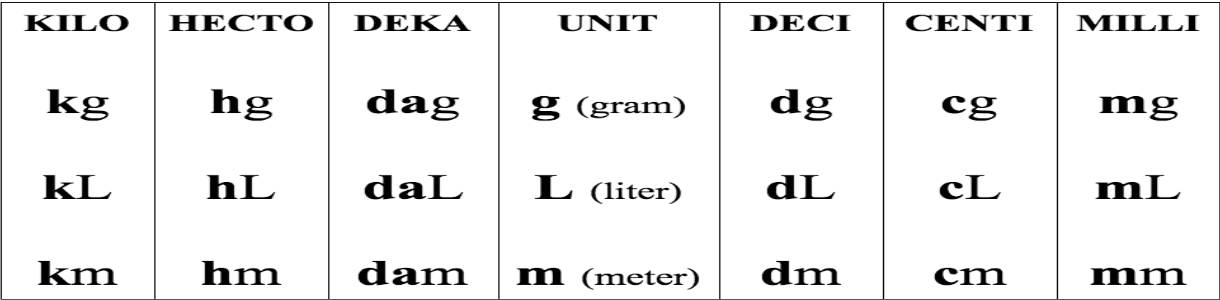
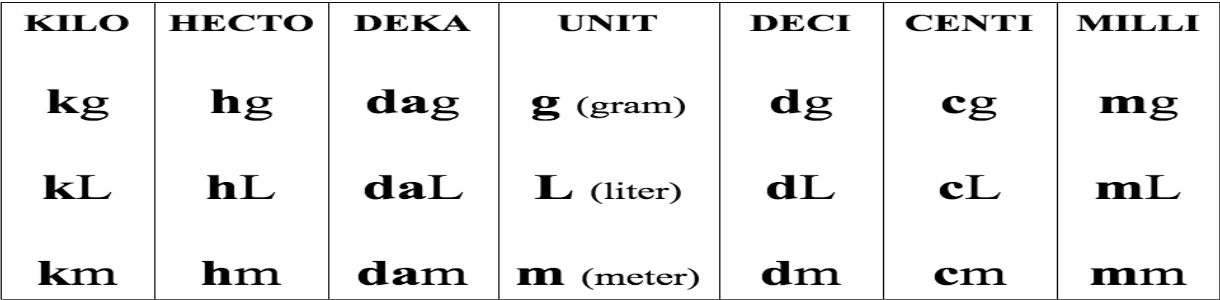
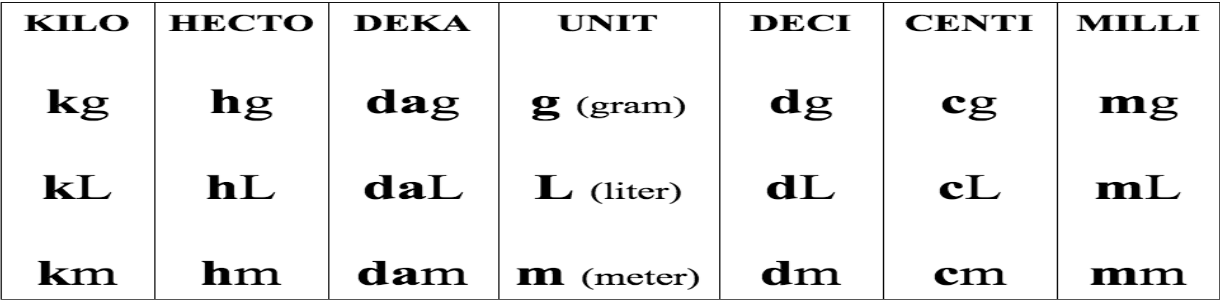
Convert 300 meters to centimeters:
a)
3000 cm
b)
0.3 cm
c)
30,000 cm
d)
3 cn
50.
Convert 8 kilometers to meters
a)
800 m
b)
80,000 m
c)
8,000 m
d)
.008 m
51.
Convert 5 cm to mm:
a)
5,000mm
b)
0.5 mm
c)
0.05 mm
d)
50 mm
52.

64,600,000 cm = ____ km

a)

646

b)

64.6

c)

6,460

d)

6.46

e)

64,600

53.

0.00817 km = ___ cm

a)

817

b)

81.7

c)

8.17

d)

0.817

e)

8,170

54.

0.0000000332 km = ___ mm

a)

0.0332

b)

0.332

c)

3.32

d)

0.00332

e)

0.000332

55.
What type of graph is this?
a)
Bar Graph
b)
Line Plot
c)
Pictograph
d)
Tally Chart
56.
How many students have blue for a favorite color?
a)
11
b)
12
c)
14
d)
17
57.
How many students take the bus to school?
a)
35
b)
20
c)
10
d)
15
58.
What is the formula for density?
a)
density = mass x volume
b)
density = mass / volume
c)
density = mass + volume
d)
density = mass - volume
59.
Frank has an eraser. It has a mass of 4g, and a volume of 2cm3. What is its density?
a)
8 g/cm3
b)
2 g/cm3
c)
1/2 g/cm3
d)
24 g/cm3
60.
Jack has a rock. The rock has a mass of 14g and a volume of 2cm3. What is the density of the rock?
a)
7 mL
b)
7 g/cm3
c)
28 g/cm3
d)
1/7 g/cm3
61.
What is the volume of Object X?
a)
10.0 cm3
b)
15.0 cm3
c)
20.0 cm3
d)
25.0 cm3
62.
Frank has a paper clip. It has a mass of 9g and a volume of 3cm3. What is its density?
a)
3 g/cm3
b)
1/3 g/cm3
c)
27 g/cm3
d)
39 g/cm3
63.
Why do some substances float on water?
a)
they are warmer than water
b)
they are cooler than water
c)
they are more dense than water
d)
they are less dense than water
64.
Which units of measurement are used for volume?
a)
grams
b)
centimeters
c)
grams/milliliter
d)
milliliter
65.
What units are used to measure Density?
a)
cm3/g
b)
g
c)
g/cm3
d)
cm3
66.
A crayon has a mass of 10g and volume of 5 mL. What is the density?
a)
30 g/mL
b)
15 g/mL
c)
1 g/mL
d)
2 g/mL
67.

What is the formula for Mass?

a)

Mass/Volume

b)

Density x Volume

c)

Mass/Density

68.

What is the formula for Volume?

a)

Mass/Volume

b)

Density x Volume

c)

Mass/Density

69.
It is a measure of how close measurements come to each other when they are made in the same way
a)
Accuracy
b)
Precision
c)
Error
d)
Extrapolation
70.

How close a measurement is to the accepted value is called..

a)

Accuracy

b)

Precision

c)

Significant

d)

Estimate

71.
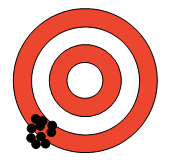
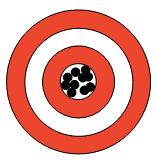
This bullseye demonstrates...
a)
High Accuracy & High Precision
b)
High Accuracy & Low Precision
c)
Low Accuracy & High Precision
d)
Low Accuracy & Low Precision
72.
?
a)
High Accuracy & High Precision
b)
High Accuracy & Low Precision
c)
Low Accuracy & High Precision
d)
Low Accuracy & Low Precision
73.
Which is NOT a step in the scientific method?
a)
Make observation
b)
Form a theory
c)
Collect data
d)
Form a hypothesis
74.
A testable explanation to a problem that has not yet been tested. 
a)
data
b)
theory
c)
hypothesis
d)
fact
75.
This variable in an experiment is the one being changed by the scientist. 
a)
dependent variable
b)
independent variable
c)
data
d)
control group
76.
Testing a hypothesis often involves a(n):
a)
answer
b)
experiment
c)
problem
d)
safety check
77.
The name of the information that you get from your experiment (you organize it into charts and graphs).
a)
observations
conclusion
b)
data
c)
variables
d)
hypothesis
78.
Dependent variable means
a)
the scientist controls what to test
b)
educated guess
c)
ask a question
d)
what is being measured
79.
If you increase the amount of spinach you eat, then you will increase the iron in your blood. 
What's the dependent variable?
a)
increase the amount of iron in your blood
b)
spinach you eat
80.
What is the first step in the scientific method?
a)
Ask a question
b)
Conclusion
c)
No Horse Play
d)
Observe
81.
If I ride my bike to school instead of walking, then I will get to school faster. What is the dependent variable?
a)
True
b)
How fast you get to school
c)
Riding a bike or walking
d)
False
82.
Will a construction paper air plane fly faster than an airplane made from notebook paper? Choose the best hypothesis.
a)
If I make a paper airplane from notebook paper, then it will fly faster than construction paper.
b)
Yes.
c)
No.
d)
I think the construction paper air plane will fly faster.
83.
If I study for my scientific method test, then I will have a better test score. What is the dependent variable?
a)
Scientific Method
b)
Studying
c)
Independent variable
d)
Test score
84.
If I read this question carefully, then I will answer it correctly. What is the independent variable?
a)
I hope so
b)
Yes
c)
Reading or not reading carefully
d)
Likelihood of a correct answer
85.
Convert from meters to cm:  9 meters
a)
900 cm
b)
90 cm
c)
0.9 cm
d)
0.09 cm
86.
Convert 300 cm to m:
a)
3 m
b)
30 m
c)
0.3 m
d)
0.03 m
87.
7,000 g = ____ kg
a)
70
b)
700
c)
7
d)
0.07
88.
The base unit to measure mass is called...
a)
liters
b)
meters
c)
grams
89.

What is the volume of the fish?

a)

3

b)

4

c)

5

d)

6

90.
What tool is used to measure the volume of a liquid?
a)
thermometer
b)
hand lens
c)
graduated cylinder
d)
ruler
91.
What tool is used to measure the mass of an object?
a)
meter stick
b)
graduated cylinder
c)
spring scale
d)
balance
92.
Calculate 923 g ÷ 20312 cm3 and give your answer with the appropriate number of significant figures.
a)
0.04 g/cm3
b)
0.045 g/cm3
c)
0.0454 g/cm3
d)
4 x 10⁻² g/cm3
93.
How many Significant Figures in the number below?
4,560
a)
5
b)
4
c)
6
d)
3
94.

What is the correct answer according to sig fig rules:

.005612 x .40145 =

a)

.0022

b)

.00225

c)

.002252

d)

.002253

95.

What is the correct answer for this problem:

3.5 cm x 4.21cm =

a)

14.7 cm

b)

14.7 cm2

c)

15 cm

d)

15 cm2

96.

Complete the following calculations. Round off your answers as needed.

245.01 km x 2.1 km

a)

5.14521 x 10²

b)

510

c)

514

d)

514.521

97.

33 g - 2.1 g = ?

a)

31.9 g

b)

31 g

c)

30.9 g

d)

30 g

98.
86.04 + 4.04
a)
9.044
b)
9044
c)
90.08
d)
90.44
99.

1.0 kg - 0.001 kg = ?

a)

0.999 kg

b)

0.99 kg

c)

0.9 kg

d)

1.0 kg

100.

55.04 - 24.7

a)

30.4

b)

30.3

c)

30.30

d)

30.340