
 Worksheets
🤗HW12: 9.21
Total questions: 100
Worksheet time: 1hrs 2mins


Mass Number + Atomic Number= Neutrons
Mass Number x Atomic Number = Neutrons
Mass Number - Atomic Number = Neutrons
Mass Number + Number of Protons = Neutron

Match the following.
Subatomic particle with +1 Charge.
Proton
Subatomic particle with -1 Charge.
Electron
Subatomic particle with 0 Charge.
Neutron
Center Region of Atom, Positively Charged.
Nucleus
Outer Region of Atom, Negatively Charged.
Electron Cloud
Match the following.
Center Region of Atom, Positively Charged.
Nucleus
Outer Region of Atom, Negatively Charged.
Electron Cloud
The Number of Protons.
Atomic Number
The amount of Nucleons.
Mass Number
Occurs with different amounts of Neutrons.
Isotope
Match the following.
Class of Element, Shiny, Ductile, Malleable, and Great Electrical Conductor.
Metal
Class of Element, Dull, Brittle and Poor Electrical Conductor.
Non-Metal
Class of Element, Properties in Between M+ and NM-, Semi-Conductors.
Metalloid
Small number in chemical formula, indicates the number of atoms present for the element it follows.
Subscript
Large number in FRONT of chemical formula, used as a multiplier for the ENTIRE compound.
Coefficient

Identify each element as Metal (M+), Non-Metal (NM-) or Metalloid (ML).
B
ML
Ca
M+
He
NM-
Identify each element as Metal (M+), Non-Metal (NM-) or Metalloid (ML).
Si
ML
H
NM-
K
M+
Identify each element as Metal (M+), Non-Metal (NM-) or Metalloid (ML).
O
NM-
Al
M+
Po
ML
Match each Element with its correct atomic number.
Ne
10
Na
11
N
7
Ti
22
F
9
Match each Element with its correct atomic number.
Rh
45
Xe
54
Mg
12
He
2
Kr
36

Determine the number of neutrons for this element. Use the mass number (round to the nearest whole number), minus the atomic number.
17
18
35.453
35

Determine the number of neutrons for this element. Use the mass number (round to the nearest whole number), minus the atomic number.
1
0
1.0079
2

Determine the number of neutrons for this element. Use the mass number (round to the nearest whole number), minus the atomic number.
136
87
223
223.020

Determine the number of neutrons for this element. Use the mass number (round to the nearest whole number), minus the atomic number.
48
16
32
32.066
Determine the number of electrons for these neutral elements.

6

54

22

8

7


What is the difference between Neon-20 and Neon-22?
They have different numbers of electrons.
They have different numbers of neutrons.
They have different numbers of protons.
No difference.


H2SO4


Match each of these Transformations of State with its correct State Change.
G → S
Deposition
S → G
Sublimation
G → L
Condensation
L → G
Vaporization
S → L
Melting

Select the State Changes that are Exothermic.
L → G
G → L
S → G
L → S
G → S

Which of these State Changes are "cousins"? Which have the same State Transformations.
Deposition
Sublimation
Condensation
Boiling
Evaporation
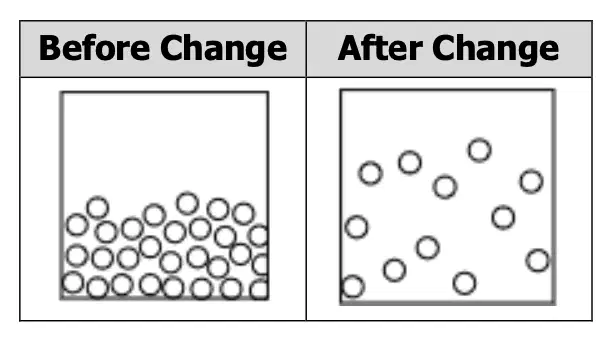
The models imaged show how the spacing between particles changes due to an increase in temperature.
Which statement describes what else occurs to the particles due to the increase in temperature?
The average kinetic energy among the particles increases, and the intermolecular forces become weaker.
The average kinetic energy among the particles decreases, and the intermolecular forces become weaker.
The average kinetic energy among the particles increases, and the intermolecular forces become stronger.
The average kinetic energy among the particles decreases, and the intermolecular forces become stronger.

Match each of these definitions with its term.
Forces of attraction.
Intermolecular Forces
State of Matter, STRONGEST Forces of Attraction.
Solid
State of Matter, WEAKEST Forces of Attraction.
Gas
Pure Substance, 1 Kind of Atom.
Element
Pure Substance, 2 or More Different Atoms.
Compound
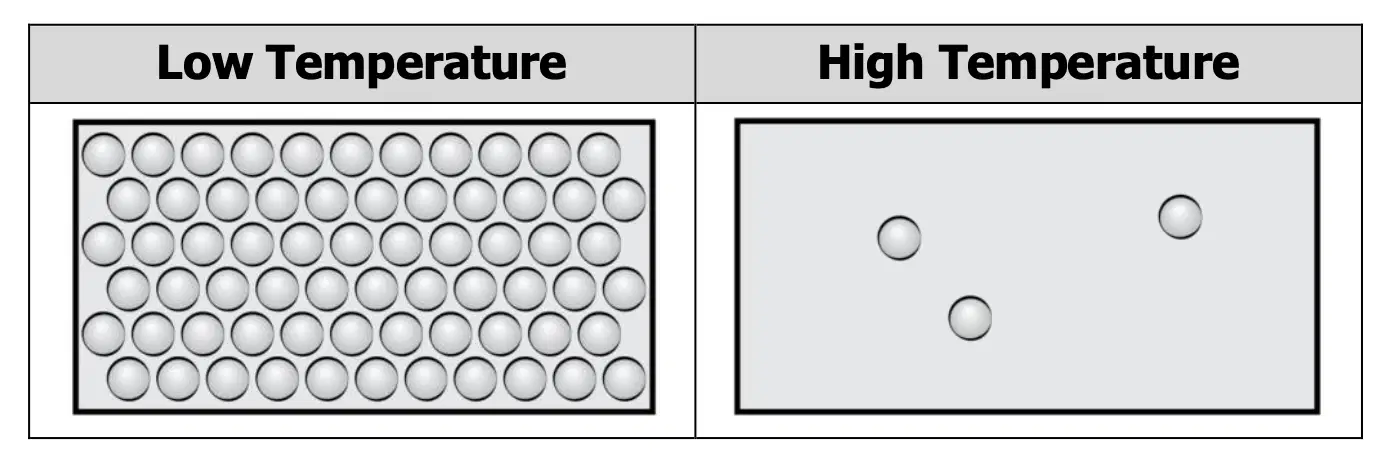
The diagram shows spacing of molecules in a substance at different temperatures.
How does the substance change phase when its temperature changes?
Solid to Gas
Gas to Solid
Liquid to Gas
Solid to Liquid
The diagram shows spacing of molecules in a substance at different temperatures.
Select the correct Descriptors of this occurence.
Physical Change
Chemical Change
Endothermic
Exothermic
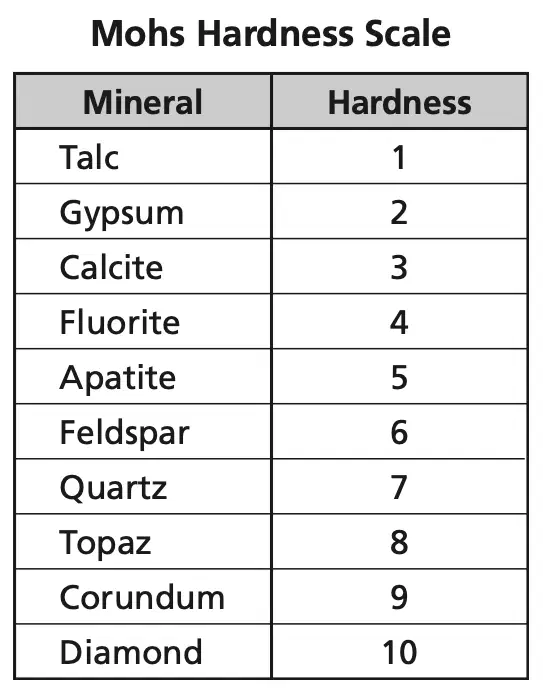
Mohs Hardness Scale is illustrated. Minerals with a GREATER Hardness may scratch minerals with a smaller hardness.
Which mineral will scratch calcite and be scratched by feldspar?
Gypsum
Fluorite
Diamond
Quartz
Mohs Hardness Scale is illustrated. Minerals with a GREATER Hardness may scratch minerals with a smaller hardness.
Which minerals could be scratched by Apatite?
Gypsum
Corundum
Diamond
Calcite
Talc
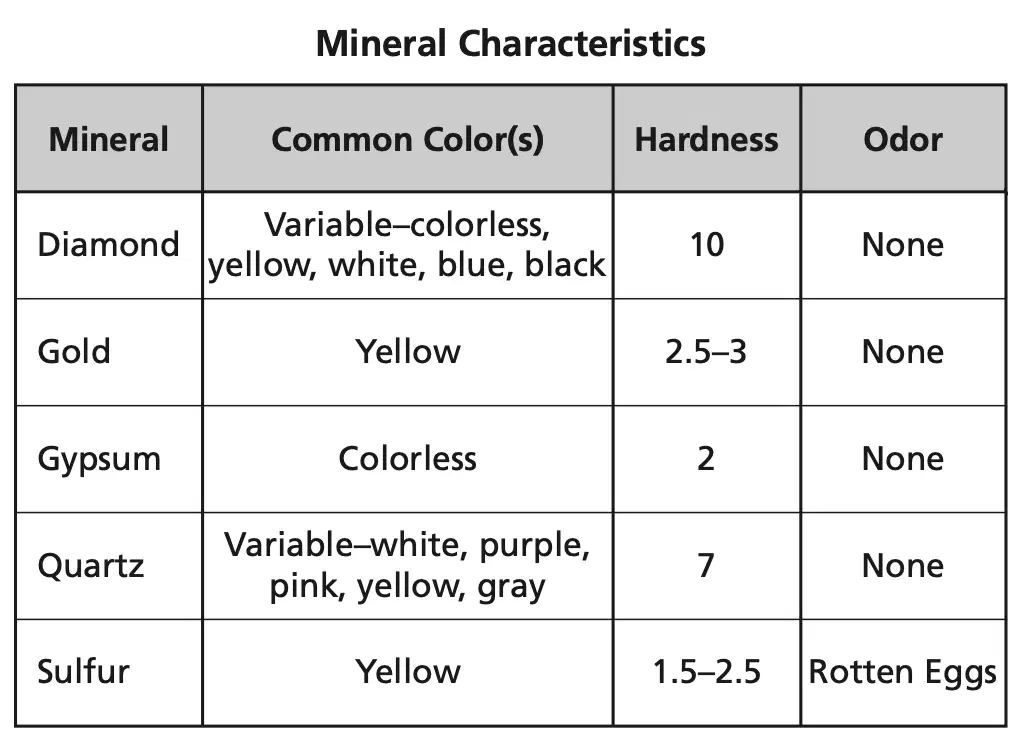
Some students on a field trip found an unknown yellow mineral. The mineral had a distinct odor and was scratched by Quartz. The students compared the mineral to the table.
Compared to the characteristics from the table, which mineral did the students find?
Diamond
Gold
Sulfur
Gypsum
Which of the minerals on the table could be classified as yellow in color and has no odor?
Diamond
Gold
Sulfur
Gypsum
Quartz

A student is trying to prove that air has mass and is made of atoms. Which experiment should the student perform?
Use a thermometer to take the classroom's temp. for a week.
Take the mass of a soccer ball before and after it has been inflated.
Go outside and record the speed of wind.
Attempt to capture air into a large plastic bag.

Which example BEST describes a chemical change?
An ice cube melting into water.
Dry wood burning and producing ash.
A pencil broken into halves.
Steam produced by boiling water.
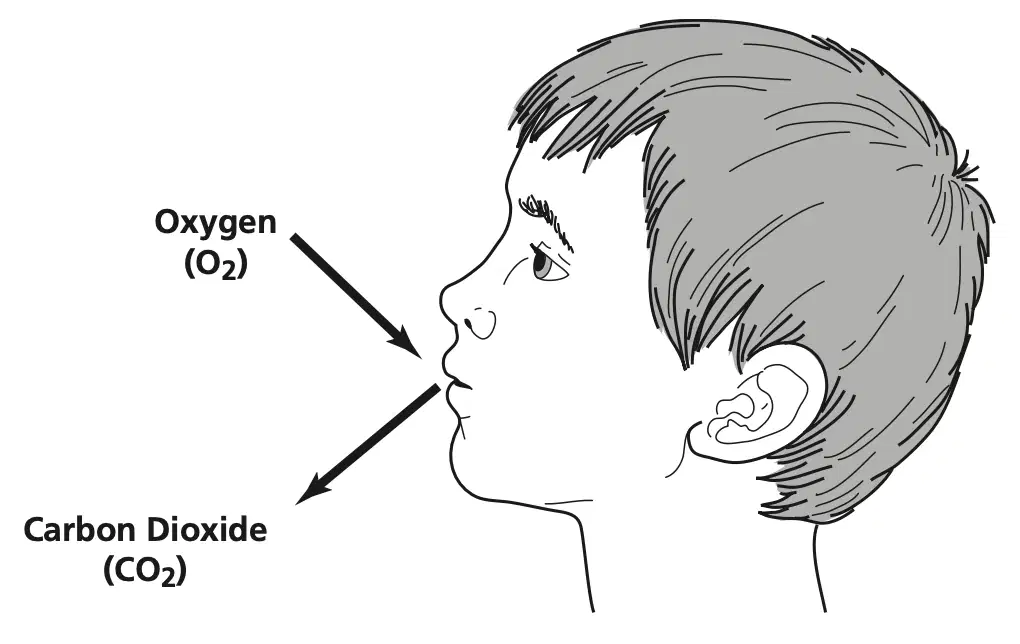
The picture shows gases being inhaled and exhaled.
Which BEST identifies the substances in this picture?
O2 is an element and CO2 is a compound.
O2 is a compound and CO2 is an element.
Both O2 and CO2 are elements.
Both O2 and CO2 are compounds.

Using tongs, a teacher puts a magnesium strip into a Bunsen burner flame so that the magnesium burns. Which response BEST identifies and describes the change that occurs during this demonstration?
A chemical change happens because energy is being released.
A chemical change happens because the size of the magnesium strip changed.
A physical change happens because gas is being released.
A physical change happens because the state of matter of magnesium changed.
Which procedure will result in the formation of a new compound?
Combining powder with water to make tea.
Combining lettuce with dressing to make a salad.
Combining vinegar with baking soda to make bubbles.
Combining one colored liquid with another to make a new color.

Mercury is the only liquid at 25°C. Which of these BEST describes how mercury particles are different from the particles of most metals (most are solids) at 25°C?
Mercury particles are farther apart and move more slowly.
Mercury particles are farther apart and move more quickly.
Mercury particles are closer together and move more slowly.
Mercury particles are closely together and move more quickly.

Students made a volcano by putting some baking soda in the bottom of a plastic bottle. They added red food coloring to some vinegar and poured he red vinegar into the plastic bottle to produce foam. Which result would MOST likely indicate a chemical change happen?
The vinegar turned red.
The foam made a sound.
The bottle became wet.
The foam formed in the bottle.

The particles in a substance are moving at a very high rate of speed and colliding with each other. Which of these BEST illustrates this type of particle motion?
Crushing an ice cube
Boiling water
Tearing a sheet of paper
Filling a glass with chocolate milk

A substance is characterized by the following. Its particles are held by STRONG forces. Its particles are DENSELY (tight) packed together. Its particles VIBRATE constantly but can't move from one place to another.
A solid
A liquid
A gas
An element
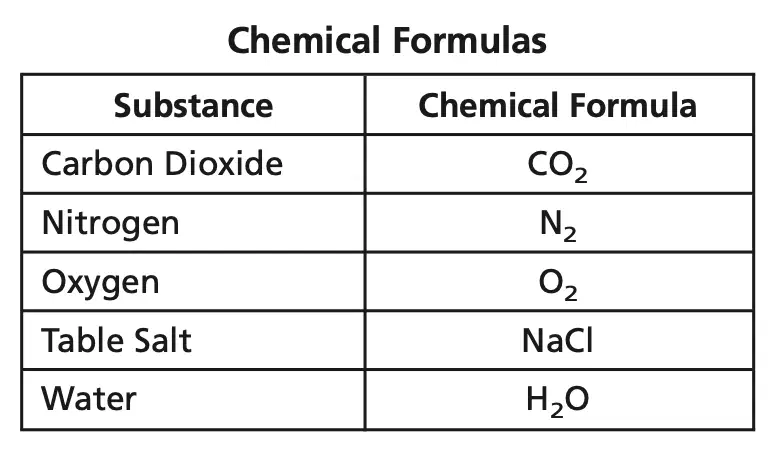
The table below shows the chemical formula of several substances.
Which substances in the table are elements?
Carbon Dioxide and Nitrogen
Nitrogen and Oxygen
Oxygen and Table Salt
Table Salt and Water
The table below shows the chemical formula of several substances.
Which substances in the table are compounds?
Carbon Dioxide and Nitrogen
Nitrogen and Oxygen
Oxygen and Table Salt
Table Salt and Water

Which of these illustrates elements? (a)

What is an element?
are pure substances that cannot be changed into simpler substances
A part or aspect of something abstract
A substance made of two or more different substances
arranges the elements in order of atomic number

Match each of these definitions with its term.
Pure substance made of one type of atom.
element
Two or more different elements chemically combined.
compound
Two or more different substances physically combined.
mixture
Exactly Measurable.
definite
Another term for homogeneous mixture.
solution

During a phase change, the temperature _____.

Which two phases changes absorb energy (heat enters)?
(a)
Freezing, Melting
Condensation, Evaporation
Freezing, Condensation

Which two phases changes take away energy (heat exits)?
(a)
Freezing, Melting
Condensation, Evaporation
Melting, Evaporation

Match each term with its definition.
Solid
Definite Shape and Definite Volume
Liquid
Indefinite Shape and Definite Volume
Gas
Indefinite Shape and Indefinite Volume
Matter
Anything with Mass and Volume
Mass
Amount of Atoms

The slower particles of a substance moves, _____ (Select all that apply).
the colder the particles are.
the warmer the particles are.
the more energy it has.
the less energy it has.
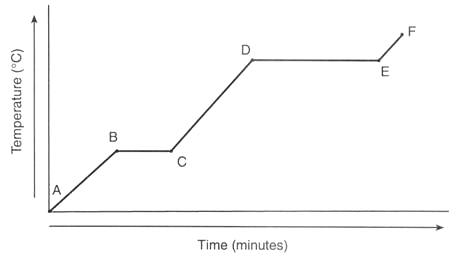
What state/phase is the object likely from points A to B?
Solid
Liquid
Gas

What phase of matter exists in part E of the graph?
Gas
Liquid
Solid
What phase change occurs when you start at D and end at E?
Freezing
Melting
Condensing
Evaporation
During a phase change, the temperature _____.
Labeling the Heating Curve.
Indicate the parts of this Heating Curve.
Place your Label on each numbered part.
L -> G (Boiling)
Solid
Liquid
Gas
S -> L (Melting)

Identifying the States of Matter.
Accurately select characteristics of each State of Matter.
Defintion: Definite, Definite
Definition: Indefinite, Definite
Definition: Indefinite, Indefinite
Particles: Packed Close
Movement: Vibrates
Intermolecular Force: Strongest

Temperature: Coolest
Particles: Loosely Touching
Movement: Slide Past One Another
Intermolecular Forces: Medium

Particles: Farthest apart
Movement: Zippy Bumper Cars
Intermolecular Forces: Weakest

Temperature: Warm
Temperature: Hottest
Labeling the State Change Triangle.
Indicate the parts of this State Change Triangle.
Place your Label on each numbered part.
Freezing
Sublimation
Deposition
Boiling/Evaporation
Condensation
Melting

What is the Law of Conservation of Mass?
It states that no matter can be created or destroyed.
It states that no energy can be created or destroyed.
It states that matter can be created or destroyed.
It states that no sound can be created or destroyed.
Match each term with its definition.
Solid
Definite Shape and Definite Volume
Liquid
Indefinite Shape and Definite Volume
Gas
Indefinite Shape and Indefinite Volume
Matter
Anything with Mass and Volume
Mass
Amount of Atoms

What happens to the movement of the particles in a substance when the thermal energy is decreased (Select all that apply)?
Speed Up
Slow Down
They Spread Out.
They Get Closer Together.

What happens to the movement of the particles in a substance when the thermal energy is increased (Select all that apply)?
Speed Up
Slow Down
They Spread Out.
They Get Closer Together.


Match each image with its meaning.

Solid Particles

Liquid Particles

Gas Particles

Graduated Cylinder

Triple Beam Balance

Where on the graph are phase changes taking place?
1
2
3
4
5
Labeling the Triple-Point Diagram.
Indicate the parts of this Phase Diagram.
Place your Label on each lettered part.
Solid
Liquid
Triple-Point
Gas

Understanding the Atom's Structure.
Accurately identify the property of each subatomic particle.
Negatively charged subatomic.
e-
Located in the Electron Cloud.
Smallest of the three subatomics.
Positively charged subatomic.
p+
Located in the Nucleus with n0.
Unique to each element.
Neutrally charged subatomic.
n0
Located in the Nucleus with p+.
Does not affect the charge of the Nucleus.

Blue subatomic particle

Green subatomic particle

Red subatomic particle


What letter on the diagram represents the substance only in the gas phase?
A
B
C
D
What letter on the diagram represents a substance only in the solid phase?
A
B
C
D

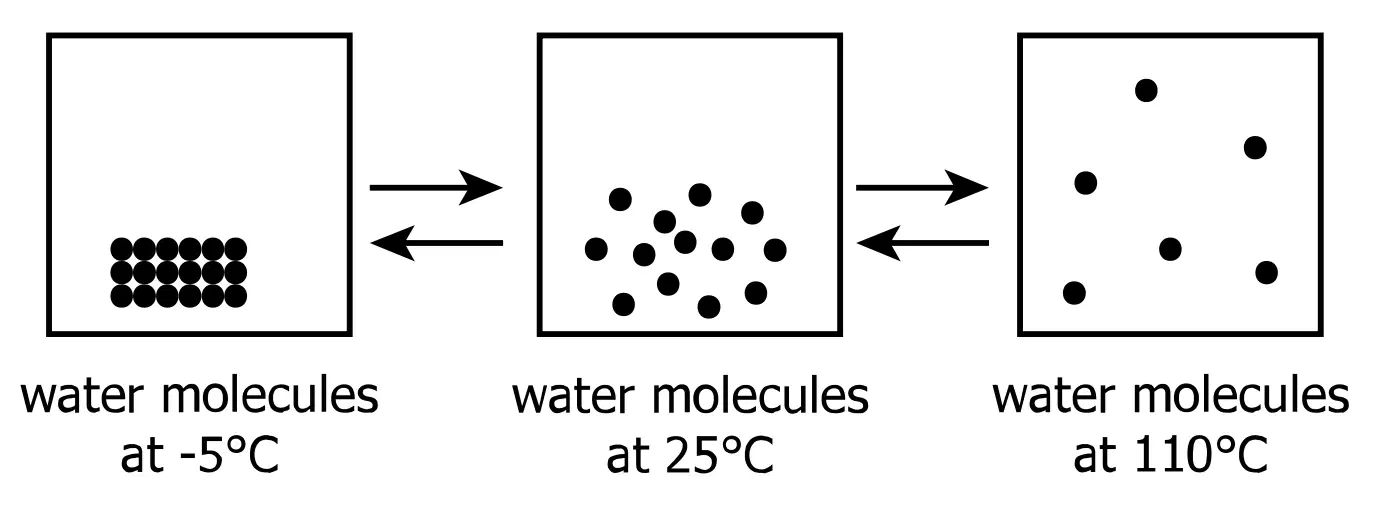
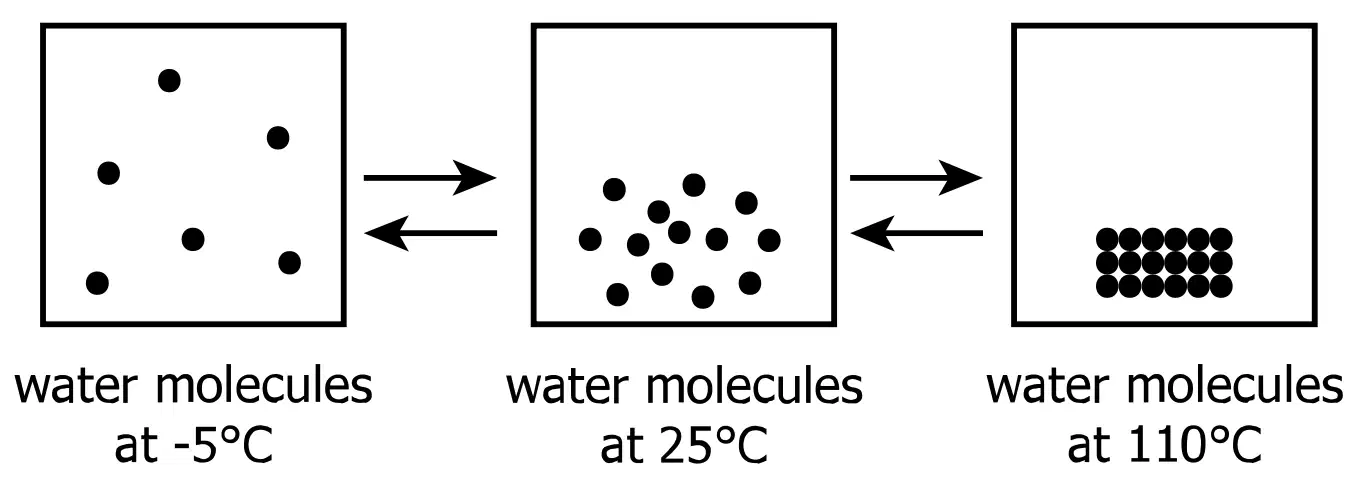
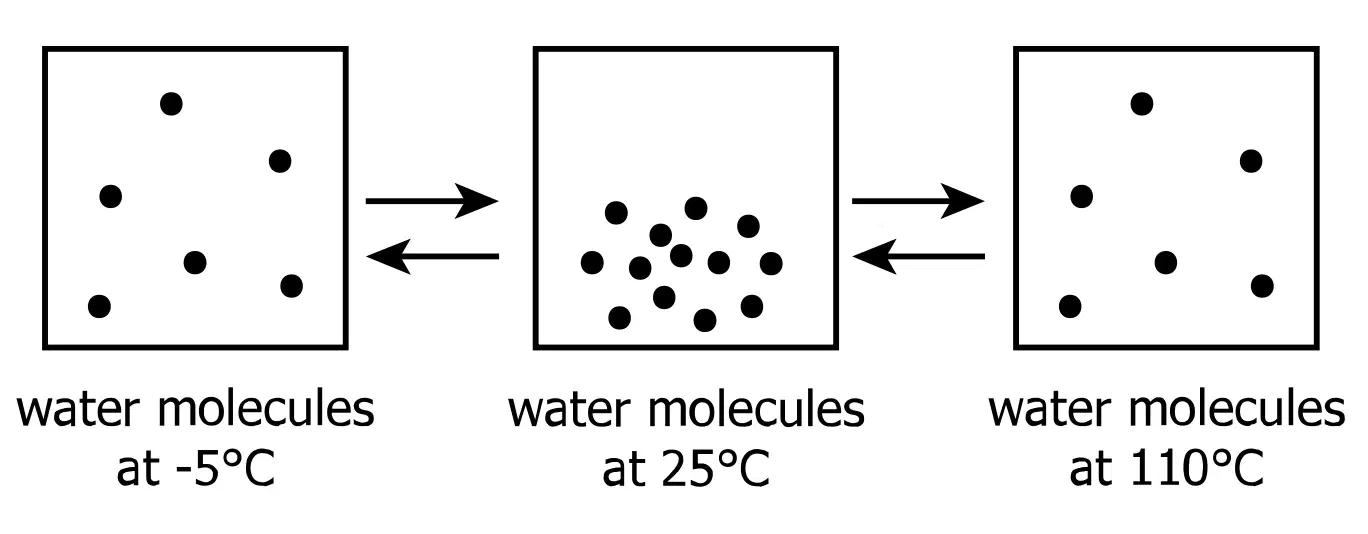
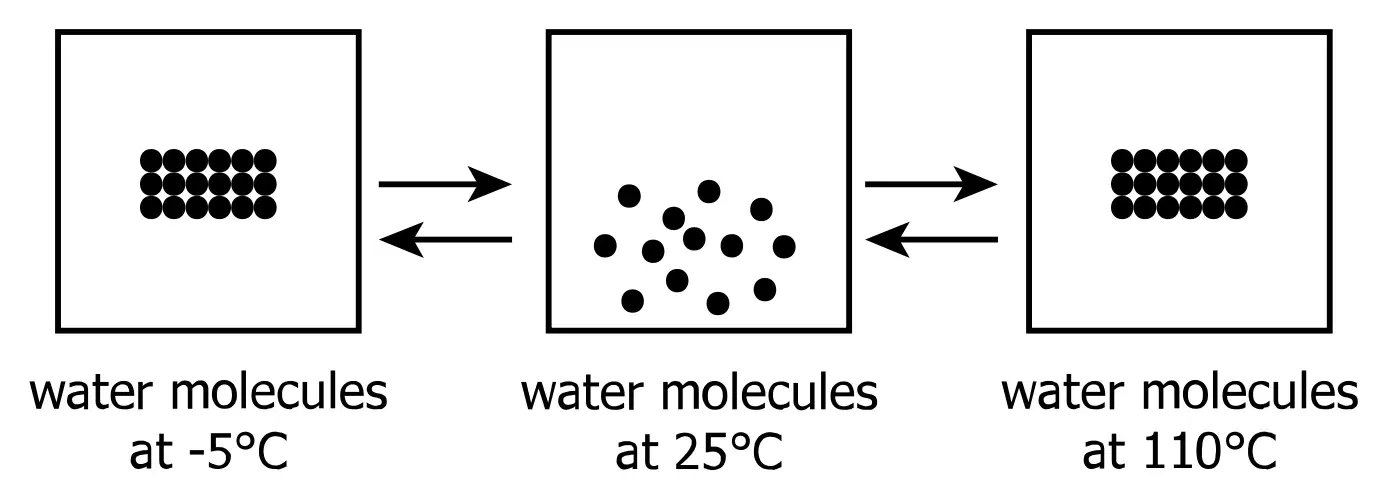
Ice changes to water at 0°C, and water changes to water vapor at 100°C. The diagram shows an incomplete model representing water molecules at different temperatures.
Which arrangement will create a CORRECT model?

Coins are used to model particles as pressure changes. Which model CORRECTLY shows how gas particles respond to a change in pressure?
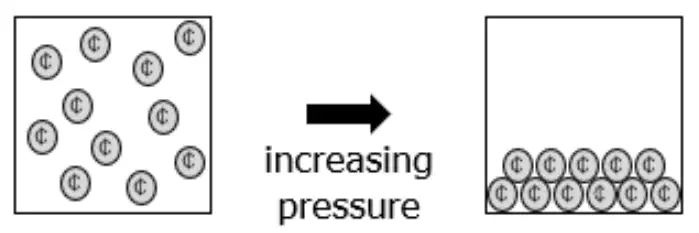
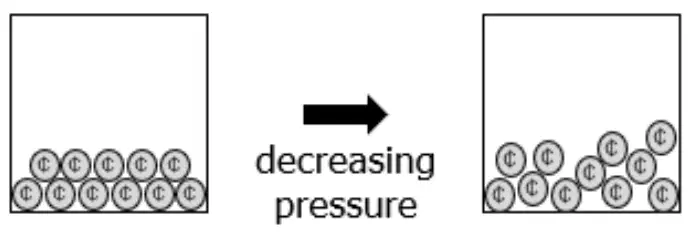
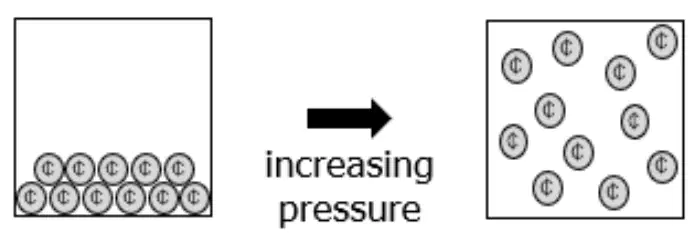
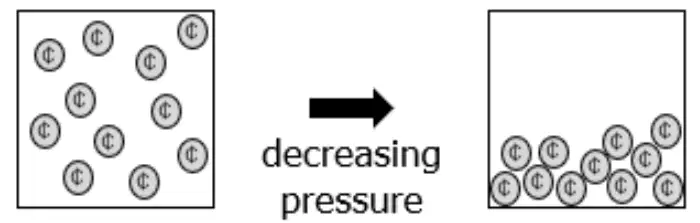

The gases released from Experiment 1 and Experiment 2 are identified.
Which table CORRECTLY classifies the two gases?


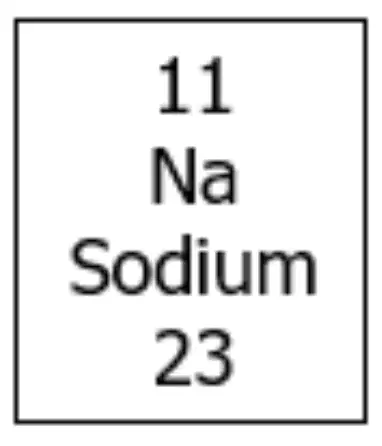
A student records information about an atom of sodium.
Which statement CORRECTLY describes the element of sodium?
The atom has a mass number of 11.
The atom has an atomic number of 23.
The atom has 23 neutrons.
The atom has 11 protons.
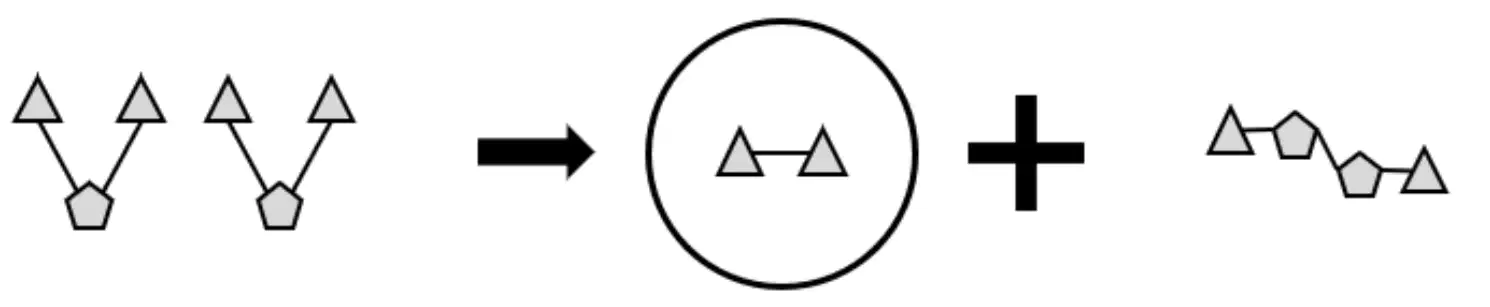
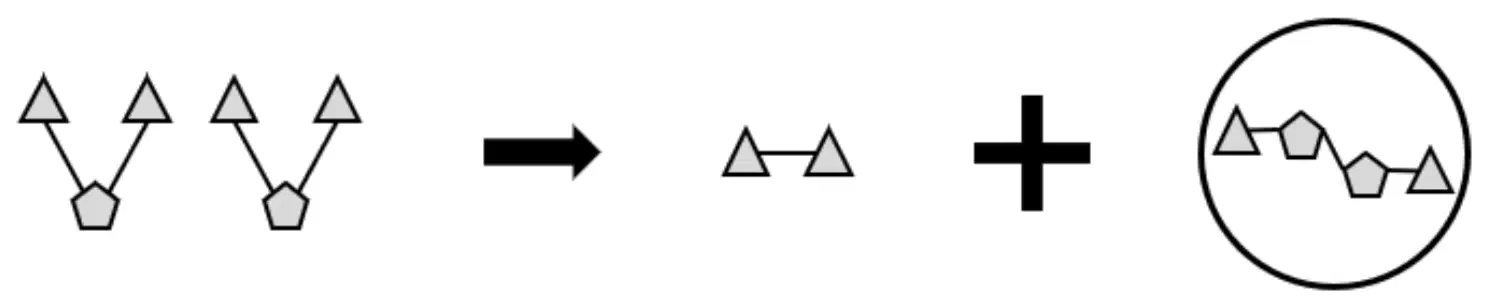
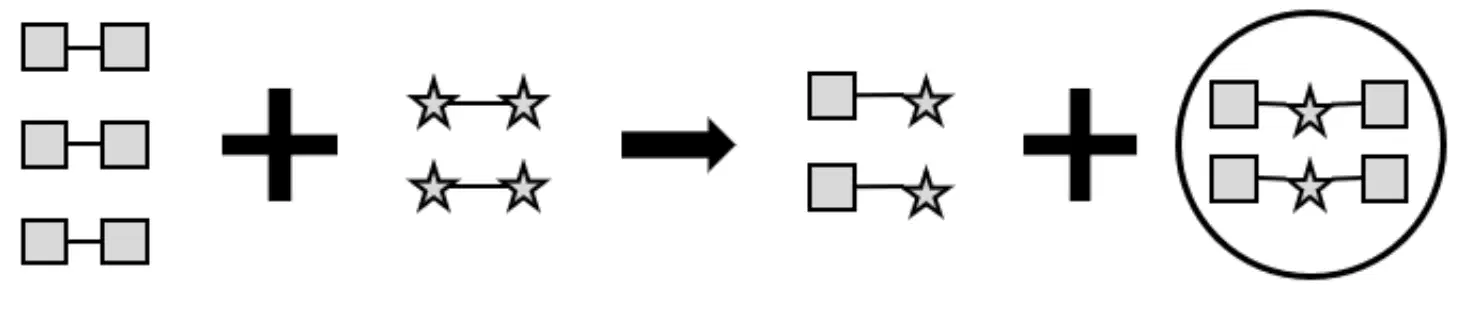
Four students model chemical reactions and highlight one product with an unshaded circle. Which student's model identifies a diatomic molecule?

Labeling the Metalloids.
Place a dot on each of these 4 Metalloids.
Astatine
Polonium
Boron
Arsenic
Labeling the Metalloids.
Place a dot on each of these 4 Metalloids (start with the higher atomic numbers, so you'll be able to see all 4).
Silicon
Antimony
Tellurium
Germanium
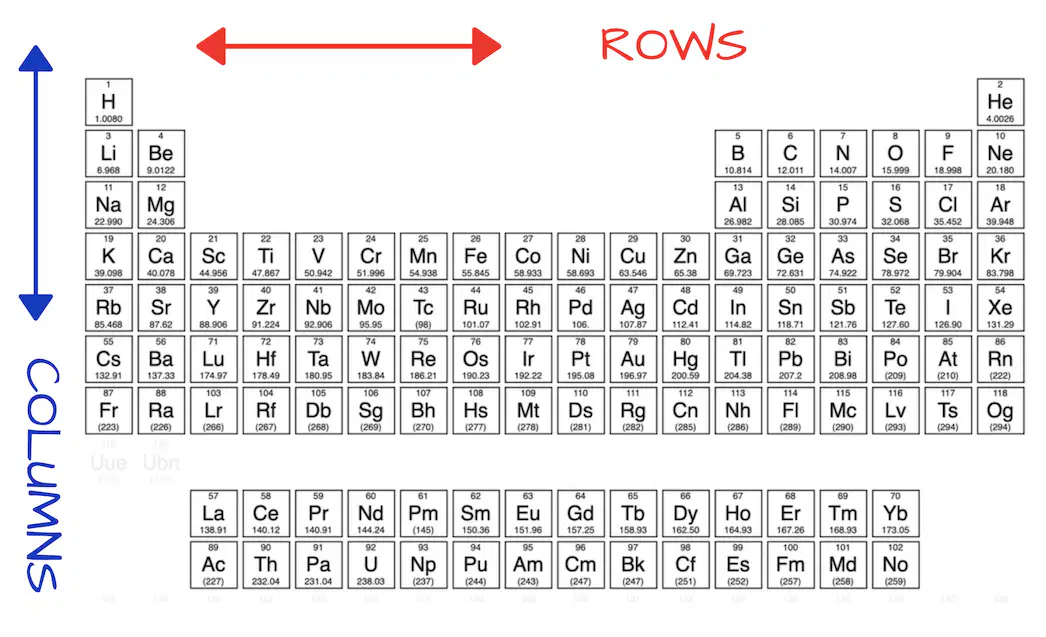
Identification of Element Class.
Which of these elements is classified as a non-metal?
He
F
Zn
Ca
Og
Identification of Element Class.
Which of these elements is classified as a metal?
K
F
Zn
Ca
Og
Identification of Element Class.
Which of these elements is classified as a metalloid?
Si
Al
Po
Ge
As
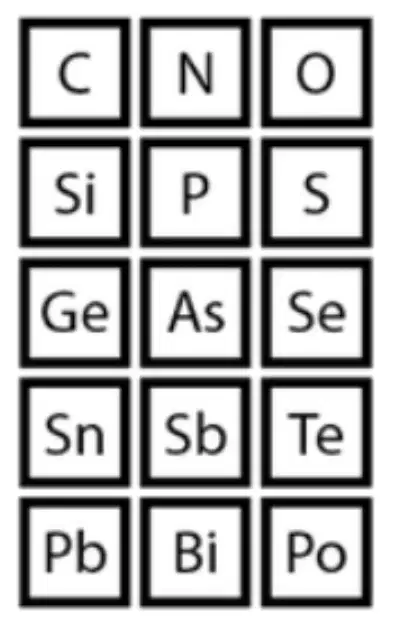
This image shows three columns on the periodic table. based on their placement on the periodic table, which set of 3 elements have the most similar physical and chemical properties?
P - As - Sb
Si - As - Te
C - Bi - Te
Sn - As - S
Ge - As - Se
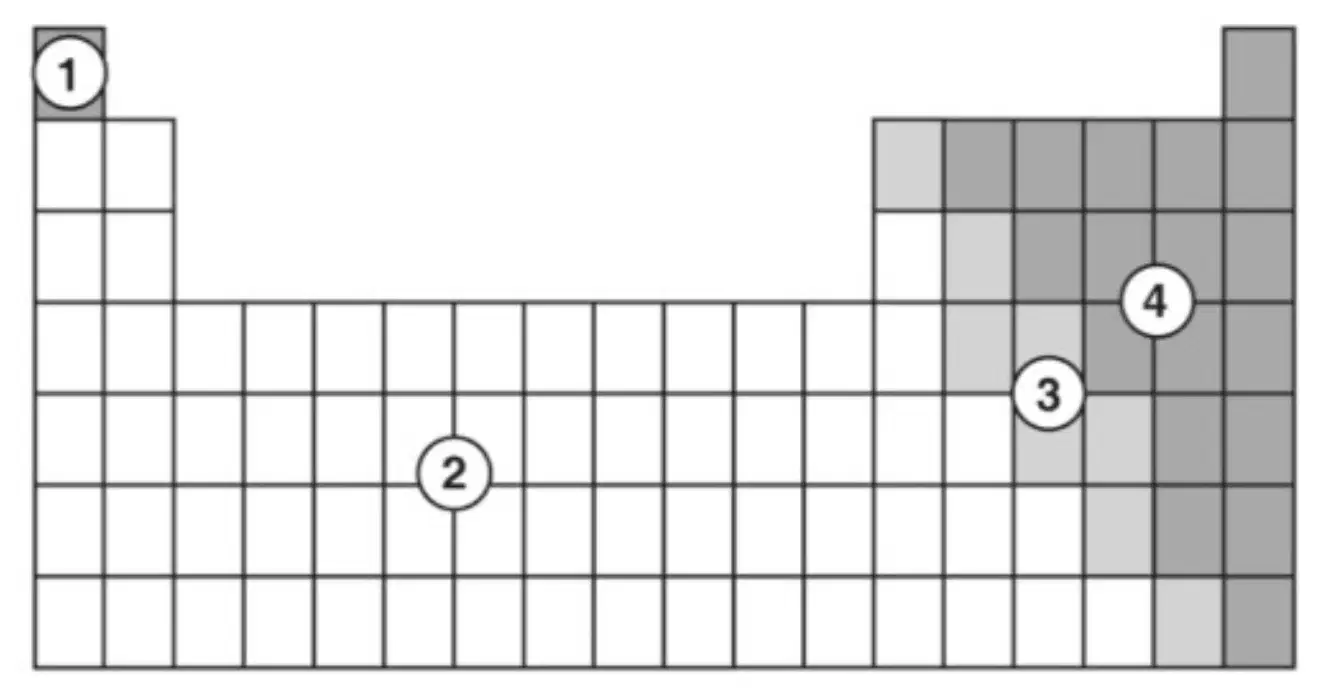
Review this partial periodic table. You are making observations of an unknown metal. In which section of the periodic table should the unknown metal be located?
Section 1
Section 2
Section 3
Section 4

Match each of these terms with its definition.
Anything that has mass and volume.
Matter
Description of matter that indicates its ability to participate in a chemical reaction.
Chemical Property
Action of matter that results in the creation of a new substance.
Chemical Change
Description of matter useful to indicate its size, shape, color, state of matter, etc.
Physical Property
Action of matter that may be reversible and could result in an alteration of its appearance, not its identity.
Physical Change
Match the following.
Subatomic particle with +1 Charge.
Proton
Subatomic particle with -1 Charge.
Electron
Subatomic particle with 0 Charge.
Neutron
Center Region of Atom, Positively Charged.
Nucleus
Outer Region of Atom, Negatively Charged.
Electron Cloud

Match each term with its definition.
Big number in front of a formula; multiplies all the atoms present.
Coefficient
Small, lowered number written behind its element, indicates the number of atoms present.
Subscript
Symbols and subscripts written together to express the kinds and numbers of each element present.
Chemical Formula
Formulas that are wrote in a chemical sentence to show activity.
Chemical Equation
In a chemical equation, when the kinds and numbers of the elements present on the reactant and products sides are the SAME.
Balanced Equation

a
b
c
d

a
b
c
d
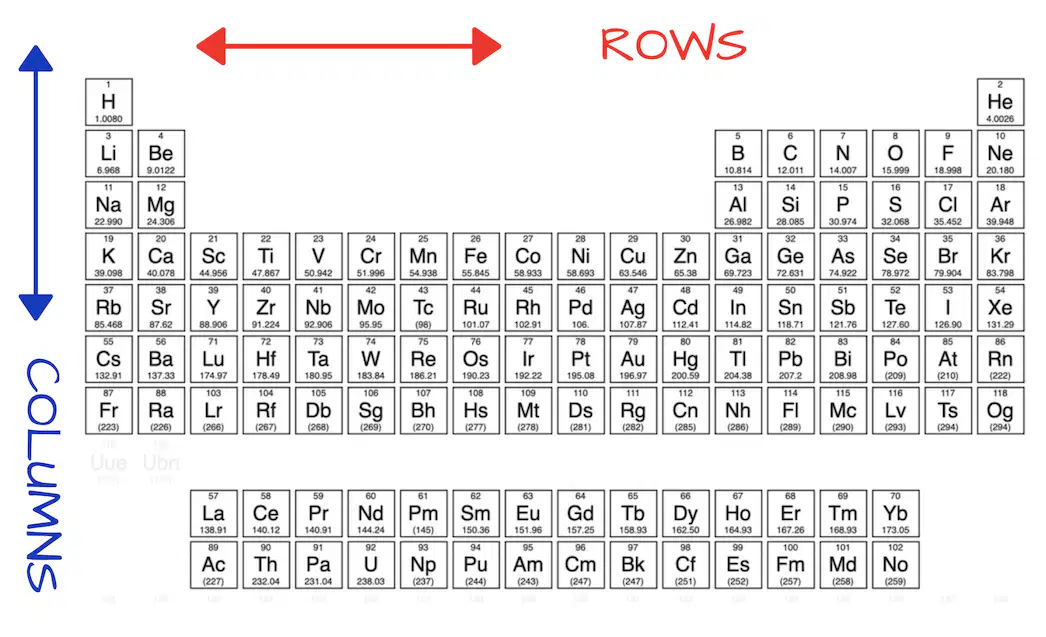
Identifying Properties of the Element Classes.
Correctly identify each of the characteristics of each element class.
Ductile
Malleable
Shiny
Great Electrical Conductors
M+
Includes Transitions
Includes Lanthanide and Actinide Series
Properties of Metals and non-Metals
ML
Semi-Conductors
8 Elements
B, Si, Ge, As, Sb, Te, Po, At
Staircase that separates the Periodic Table into 2-Halves
Most populated Class
Mostly on the LEFT of the PT
Brittle
Dull
Poor Electrical Conductors
NM-
Includes Noble Gases
Identification of Element Class.
Which of these elements is classified as a metalloid?
Si
Al
Po
Ge
As
Match the following.
Subatomic particle with +1 Charge.
Proton
Subatomic particle with -1 Charge.
Electron
Subatomic particle with 0 Charge.
Neutron
Center Region of Atom, Positively Charged.
Nucleus
Outer Region of Atom, Negatively Charged.
Electron Cloud

Which of the following described the properties of particles in gas? (Select all that apply).
very far apart
move randomly at high speed in all direction
Vibrate about fixed position
high kinetic energy
Closely packed in disorderly,random manner

This image shows three different phases of water. In which state are the molecules moving the fastest?
A
B
C
A and C

Gas particles in a container would most likely
spread far apart, filling the container completely.
lock in place, keeping a shape unlike the container.
remain close together, resting at the bottom of the container.
None of these.

Which of these is a physical property (Select all that apply)?
state of matter (is it solid, liquid, or gas)
size
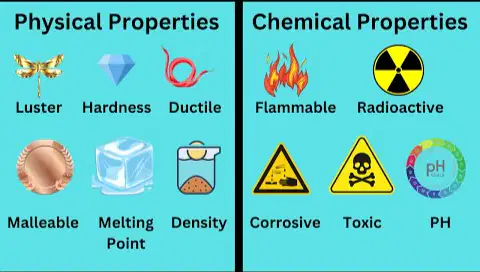
Which of these is a chemical property (Select all that apply)?
may react with oxygen

Brad is comparing a ceramic cup to the hot water inside the ceramic cup and the water vapor above the cup. What can she say about the motion of the particles in all of the substances?
They do not move.
They are all always moving.
They all move past each other slowly.
They all move very fast in all directions.
Brad is comparing a ceramic cup to the hot water inside the ceramic cup and the water vapor above the cup. What can she say about the motion of the particles in all of the substances?
They do not move.
They are all always moving.
They all move past each other slowly.
They all move very fast in all directions.

Which of these is a chemical change (Select all that apply)?
odor change
fizzing and popping
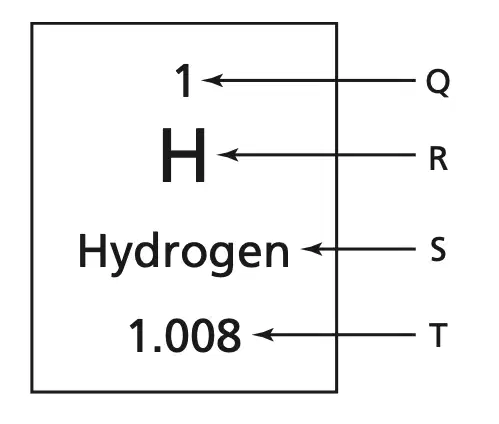
Match each of these Element Square Characteristics with its correct Label.
Atomic Number (p+)
Q
Element Symbol
R
Element Name
S
Atomic Mass (ROUNDED to determine MASS NUMBER)
T
Which of these Characteristics of the Element Square is used to determine the number of NEUTRONS (Select all that apply)?
Atomic Number (p+)
Element Symbol
Element Name
Atomic Mass (ROUNDED to determine MASS NUMBER)

