
 Worksheets
Unit One Review for Core
Total questions: 33
Worksheet time: 30mins
Name
Class
Date
1.

Where do we read the level of liquid?
a)
The highest point the liquid touches
b)
The bottom of the meniscus
c)
Half way between, we make an educated guess and round it
d)
Somewhere about there
2.

What is the correct value?
a)
5 ml
b)
15 ml
c)
20 ml
d)
25 ml
3.
all matter is made of what
a)
energy
b)
atoms
c)
electrons
d)
compounds
4.
The positive particles of an atom are
a)
electrons
b)
positrons
c)
neutrons
d)
protons
5.
the central region of an atom where its neutrons and protons are is its
a)
nucleus
b)
electron cloud
c)
core
d)
center
6.
an atom with atomic number 6 would have how many protons
a)
6
b)
12
c)
3
d)
cannot be determined
7.
Particles in an atom that are neutral and have no charge are
a)
negatrons
b)
electrons
c)
neutrons
d)
protons
8.
True or False? Neutrons have a negative charge
a)
True
b)
False
9.
What is the atomic number for an element with three protons?
a)
2
b)
1
c)
3
d)
6
10.
A particle that moves around the nucleus is a(n)...
a)
Proton
b)
Neutron
c)
Electron
d)
Quark
11.

What does the 1.00794 stand for?
a)
Hydrogen
b)
atomic number
c)
atomic mass
d)
atomic explosion
12.
The first energy level can hold up to how many electrons?
a)
8
b)
4
c)
2
d)
5
13.
An atoms overall charge is
a)
positive
b)
depends on its mood
c)
neutral
d)
negative
14.
Where are electrons of an atom found?
a)
Nucleus
b)
Electron Cloud
c)
Some are in the nucleus and some in the electron cloud.
d)
They are moving everywhere.
15.
What is the atomic symbol for sodium?
a)
Na
b)
So
c)
NaCl
d)
S
16.
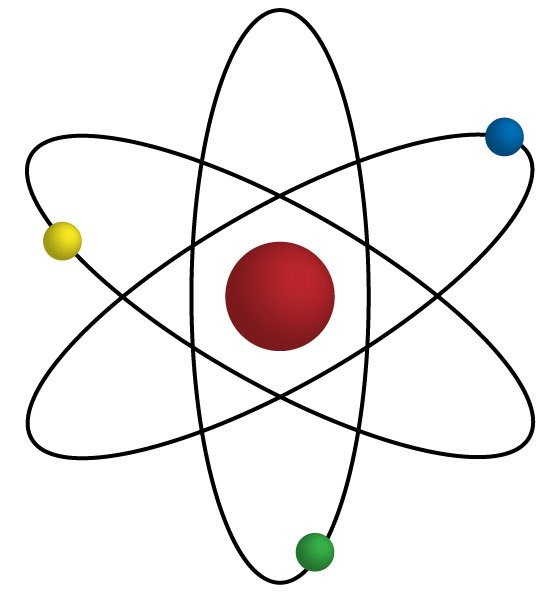
What are the 3 particles that make-up the atom?
a)
protons, neutrons, and isotopes
b)
neutrons, isotopes, and electrons
c)
positives, negatives, and electrons
d)
protons, neutrons, and electrons
17.
How many elements are in C6H12O6?
a)
1
b)
2
c)
3
d)
4
18.
How many atoms of carbon (C) are in C6H12O6?
a)
3
b)
6
c)
12
d)
24
19.
Element or compound?
H2O
H2O
a)
element
b)
compound
20.
Element or compound?
O2
O2
a)
Element
b)
Compound
21.
Which of the following is a compound?
a)
Co
b)
O2
c)
C
d)
CO2
22.
Which is the correct formula for:
three hydrogen (H)
one sulfur (S)
four oxygen (O)
three hydrogen (H)
one sulfur (S)
four oxygen (O)
a)
H3SO4
b)
HSO4
c)
H4S3O
d)
H2O
23.
Which of the following is NOT an element?
a)
H2O
b)
H2
c)
O2
d)
Au
24.
How many atoms are there TOTAL in:
H2SO4
H2SO4
a)
6
b)
5
c)
7
d)
3
25.
What element is found in all four areas of the earth that we studied?
a)
Sodium (Na)
b)
Oxygen (O)
c)
Carbon (C)
d)
Nitrogen (N)
26.
The two most common elements found in the oceans are. Remember oceans are made up of water.
a)
Sodium and Nitrogen
b)
Oxygen and Aluminum
c)
Iron and Carbon
d)
Oxygen and Hydrogen
27.
What is the most abundant element found in the earth's atmosphere?
a)
Oxygen
b)
Sulfur
c)
Nitrogen
d)
Argon
28.
This element occurs in large amount in the atmosphere and small amount in living things.
a)
Nitrogen
b)
Oxygen
c)
Argon
d)
Carbon
29.
Elements are represented by chemical symbol. Symbols are written with
a)
all lower case letters
b)
all capital letters
c)
always only one letter
d)
At least and ONLY one capital letter
30.
The element that occurs in highest percentage in the crust is
a)
Calcium
b)
Oxygen
c)
Iron
d)
Potassium
31.
Ramone wants to know: does the distance a person kicks a soccer ball effect how well they will do on their math test. What is the dependent variable?
a)
How far they kick the soccer ball
b)
who the person is
c)
how well they do on the math test
d)
Type of soccer ball.
32.
Marcos wants to know: Does the type of gasoline put in a car effect how fast the car can drive? What is the independent variable?
a)
Type of gasoline
b)
which car the gas is put into
c)
how fast the car can drive
d)
how much gas is put into the car
33.
Angelina set up an experiment to see how the mass of a ball affects the distance it rolls off a ramp. Identify the independent variable.
a)
Distance traveled by the ball
b)
Height of the ramp
c)
Mass of the ball
d)
Who set up the experiment (Ms. S, etc)
100 %

