
Font size
S
M
L
XL
 Worksheets
Chemistry Review *
Total questions: 100
Worksheet time: 1hrs 8mins
Name
Class
Date
1.

In this image, what are the information in red is called the_______.
a)
Product
b)
Reactant
c)
Chemical Subscript
2.

In this image, what are the information to the right of the arrow (in black) is called the_______.
a)
Product
b)
Reactant
c)
Chemical Subscript
3.
Read the following chemical formula: C6H12O6. How many hydrogen atoms are in the formula?
a)
12
b)
6
c)
4
4.
Is this balanced?...
Al + O2 --> 2Al2O3
Al + O2 --> 2Al2O3
a)
Yes!
b)
NO!
5.
In the equation, 2Mg + O2 ---> 2MgO, which are the reactants?
a)
Mg and O
b)
MgO
c)
Mg and MgO
d)
O and MgO
6.
What is the little number after an element in a chemical equation called.
Example: H2
Example: H2
a)
Coefficient
b)
Subscript
c)
Atom
d)
Equation
7.

What is the volume of Object X?
a)
10.0 cm3
b)
15.0 cm3
c)
20.0 cm3
d)
25.0 cm3
8.

Calculate the density of the cube.
a)
2 g/cm3
b)
4 g/cm3
c)
6 g/cm3
d)
8 g/cm3
9.
Elements which are shiny, conduct electricity and heat are called
a)
metal
b)
nonmetal
c)
metalloid
d)
nonexistent
10.
Elements which are considered semiconductors are
a)
metal
b)
nonmetal
c)
metalloid
d)
nonexistent
11.
The atomic number tells you what?
a)
number of electrons
b)
number of protons
c)
number of neutrons
d)
both electrons and protons in an atom.
12.
How many electrons can the second electron shell hold?
a)
2
b)
8
c)
16
d)
18
13.

How many valence electrons does this atom have?
a)
2
b)
4
c)
6
d)
8
14.
Which subatomic particles are found in nucleus?
a)
Proton and electron
b)
Proton and neutron
c)
neutron and electron
d)
neutron, electron and proton
15.
Each row in the periodic table is called a
a)
group
b)
period
c)
cluster
d)
unit
16.
Each column in the periodic table is called a
a)
period
b)
group
c)
cluster
d)
unit
17.
Two elements chemically bonded form
a)
element
b)
compound
c)
mixture
d)
solutions
18.

The yellow atoms are called
a)
metals
b)
nonmetals
c)
metalloids
d)
noble gases
19.
The Law of Conservation of Mass states
a)
that matter exists in all states and reacts the same
b)
that matter can only be changed into new substances by introducing a catalyst
c)
that matter exists in the same state throughout any chemical change
d)
that matter cannot be created or destroyed and that the mass of the products must equal the mass of the reactants
20.
How many F atoms are in this compound?
6MgF2
6MgF2
a)
2
b)
6
c)
8
d)
12
21.

a copper penny turning greenish after a few years.
a)
Chemical Change
b)
Physical Change
22.
Particles in an atom that are neutral and have no charge are
a)
negatrons
b)
electrons
c)
neutrons
d)
protons
23.
If an atom has 3 electrons, how many protons does it have?
a)
1
b)
2
c)
4
d)
3
24.
The subatomic particle with a negative charge is the
a)
electron
b)
proton
c)
neutron
d)
nucleus
25.
Left of zigzag line
a)
metals
b)
nonmetals
c)
metalloid
26.
On Periodic Table, how are elements ordered?
a)
color
b)
shape
c)
atomic number
d)
alphabetically
27.
which of the following is an example of a physical change?
a)
a car rusting
b)
cutting a piece of wood
c)
acid rain corroding a barn door
d)
water seperating into hydrogen and oxygen atoms.
28.
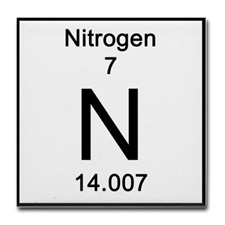
What is the number of protons that the element in this image contain?
a)
14
b)
7
c)
15
d)
18
29.
The positive particles of an atom are
a)
electrons
b)
positrons
c)
neutrons
d)
protons
30.
the central region of an atom where its neutrons and protons are is its
a)
nucleus
b)
electron cloud
c)
core
d)
center
31.

In which region would the nonmentals be found?
a)
1
b)
4
c)
3
d)
5
32.
Something that is made up of only one kind of atom is known as _________________.
a)
a molecule
b)
a compound
c)
an element
d)
a proton
33.
How many elements are represented in the compound?
Na2CO3
Na2CO3
a)
1
b)
2
c)
3
d)
4
34.
Is salt (NaCI) a compound or a element
a)
Compound
b)
element
35.
Which of the following is a sign that a chemical reaction has occurred?
a)
change in shape
b)
melting
c)
formation of a gas
d)
dissolving
36.
Is melting butter for popcorn a chemical or physical change?
a)
chemical
b)
physical
37.

Is burning wood a chemical or physical change?
a)
chemical
b)
physical
38.
When you break a cracker into pieces it is a
a)
Chemical change
b)
Physical change
c)
Chemical Weathering
d)
Physical Weathering
39.
Which is a chemical change?
a)
freezing fruit juice
b)
slicing a potato
c)
boiling water
d)
copper metal turning green
40.
If there is no subscript, there is ______ atom(s) of that element.
a)
0
b)
2
c)
only 1
d)
1 million
41.

How many atoms of Hydrogen are in this compound
a)
1
b)
2
c)
3
d)
4
42.
How many elements are in the this compound?
H2CO4N5
H2CO4N5
a)
11
b)
4
c)
12
d)
5
43.
How many TOTAL atoms are in this compound?
H2C3O4N5
H2C3O4N5
a)
5
b)
14
c)
15
d)
19
44.
5H2O
How many atoms of Hydrogen?
How many atoms of Hydrogen?
a)
2
b)
7
c)
10
d)
5
45.
Luster is a physical property of...
a)
Metals
b)
Non-Metals
46.

What kind of mixture does the picture show?
a)
Heterogeneous Mixture
b)
Homogeneous Mixture
47.
Identify this chemical formula
C6H12O6
C6H12O6
a)
Salt
b)
Simple Sugar - Glucose
c)
Carbon Dixoxide
d)
Oxygen Gas
48.
What is the subscript in the compound H2O?
a)
H
b)
2
c)
O
49.
Carbon is a/an...
a)
element
b)
compound
c)
diatomic molecule
d)
mixture
50.
What is the formula for Density?
a)
volume/mass
b)
mass/volume
51.
Chocolate Chip Cookie Dough is what kind of mixture?
a)
heterogeneous mixture
b)
homogeneous mixture
52.
If an object's mass is 56g and it's volume is 8mL, what is the object's density?
a)
7 g/cm3
b)
48 g/mL
c)
7g/mL
d)
6 g/mL
53.
The smallest particle of matter is a/an...
a)
element
b)
atom
c)
compound
d)
diatomic molecule
54.

What physical property of metals is the picture showing?
a)
luster
b)
malleability
c)
ductility
d)
conductor
55.

What physical property of metals is the picture showing?
a)
luster
b)
malleability
c)
ductility
d)
brittle
56.
All mixtures are put together....
a)
chemically
b)
physically
57.

Which liquid layer has the HIGHEST density in the picture?
a)
red
b)
yellow
c)
green
d)
blue
58.

Which liquid layer has the LOWEST density in the picture?
a)
red
b)
yellow
c)
green
d)
blue
59.
Which chemical property describes the ability oxygen to react with metals?
a)
ability to burn
b)
ability to rust
60.
A Non-metal bonded to another non-metal makes which kind of bond?
a)
ionic
b)
covalent
61.
Substance can't be broken down any further.
a)
element
b)
compound
c)
mixture
62.
Example of mixture.
a)
nitrogen
b)
water
c)
salad dressing
63.
Example of compound.
a)
Oxygen
b)
Gold
c)
Table Salt
64.
Metal bonded to nonmetal
a)
Covalent Bond
b)
Ionic Bond
65.
Left of zigzag line
a)
metals
b)
nonmetals
c)
metalloid
66.
O
a)
Optional
b)
Oxygen
67.
Nitrogen
a)
N
b)
Ni
c)
Na
68.
Iron
a)
Fe
b)
I
c)
In
69.
Carbon
a)
CD
b)
CO2
c)
C
70.

What is the number 22?
a)
Atomic Number
b)
Atomic Mass
c)
Element Name
d)
Chemical Symbol
71.
Signs that a chemical change has occurred include
a)
a change in color
b)
the release of bubbles
c)
the production of an odor
d)
all of the above
72.

Where on the periodic table are the metalloids found?
a)
Right Side
b)
Along the Zig Zag Line
c)
Right Side
73.

Nonmetals are located in what section of this periodic table?
a)
Blue
b)
Yellow
c)
Pink
74.
CO2
a)
Element
b)
Compound
75.
Burning a piece of paper
a)
Chemical Change
b)
Physical Change
76.
Melting Ice
a)
Chemical Change
b)
Physical Change
77.
What is the symbol for chlorine?
a)
C
b)
Ch
c)
Ce
d)
Cl
78.
A mixture can be separated by ________ means.
a)
physical
b)
chemical
79.
What is the formula for density?
a)
density = mass x volume
b)
density = mass / volume
c)
density = mass + volume
d)
density = mass - volume
80.
Jack has a rock. The rock has a mass of 14g and a volume of 2cm3. What is the density of the rock?
a)
7 mL
b)
7 g/cm3
c)
28 g/cm3
d)
1/7 g/cm3
81.

What is the volume of Object X?
a)
10.0 cm3
b)
15.0 cm3
c)
20.0 cm3
d)
25.0 cm3
82.
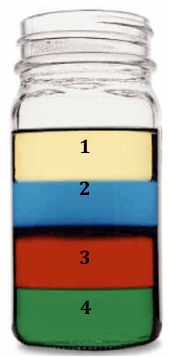
Put the liquids in order from most dense to least dense?
a)
4, 3, 2, 1
b)
1, 2, 3, 4
c)
3, 4, 2, 1,
d)
4, 3, 1, 2
83.
What is the number of protons that the element in this image contain?
a)
14
b)
7
c)
15
d)
18
84.
Which of the following is a subatomic particle with no charge that is found in the nucleus of an atom?
a)
Electron
b)
Proton
c)
Neutron
d)
Quark
85.

What is the number of protons that the element in this image contain?
a)
14
b)
7
c)
15
d)
18
86.
The three main regions on the periodic table are ____________.
a)
solid, liquid, gas
b)
metals, nonmetals, meatlloids
c)
radioactive, man-made, poisonous
87.
Atoms can be seen with the naked eye.
a)
True
b)
False
88.
Elements on the periodic table that are often gases at room temperature, are poor conductors of electricity, and are good insulators are called _____________.
a)
metals
b)
nonmetals
c)
metalloids
d)
transition elements
89.
Elements on the periodic table that have physical and chemical properties of both metals and nonmetals are called _____________.
a)
metals
b)
nonmetals
c)
metalloids
d)
transition elements
90.
In the equation below, what are the reactants
2 H2 + O2 → H2O
2 H2 + O2 → H2O
a)
H2O
b)
2 H2 + O2
91.
Ammonia has a pH of 12. Ammonia is __________.
a)
an acid
b)
a base
c)
an element
d)
a metal
92.
Soap is a weak base. What is true about the taste of bases?
a)
they taste sour
b)
they taste sweet
c)
they taste bitter
d)
they taste salty
93.
Which of these solutions is an acid?
a)
Dish Soap: pH of 12
b)
Tomato Soup: pH of 4
c)
Baking Soda: pH of 9
d)
Drain Cleaner: pH of 14
94.
What does the pH scale measure?
a)
the concentration of acids and bases
b)
the malleability of a metal
c)
the temperature of the water in a swimming pool
d)
the amount of phosphorus in a compound
95.
Ranging from 0 to 14, a pH value indicates how acidic or basic a solution is. Which of these pH values would be a strong acid?
a)
2
b)
6
c)
9
d)
13
96.
What is the pH of water?
a)
0
b)
4
c)
7
d)
14
97.
Litmus paper can tell you if a solution is acidic, neutral or basic by changing color when placed in a solution. If you test a base with litmus paper, it will turn ____________.
a)
purple
b)
red
c)
blue
d)
pink
98.

is this object acidic or base
a)
Acidic
b)
Base
c)
neither
d)
neutral
99.
Carrie's teacher hands out test tubes filled with different chemicals and tells the students to identify their liquid as an acid, base, or neutral chemical. Carrie's test tube contains a clear chemical. She adds phenolpthalein to her test tube and gently moves the tube from side to side. A few moments later, the chemical in the test tube turns bright pink.
What type of chemical does Carrie have?
What type of chemical does Carrie have?
a)
Carrie has a neutral chemical.
b)
Carrie has an acidic chemical.
c)
Carrie has a basic chemical.
d)
The type of chemical Carrie has cannot be determined.
100.
Holly has an unknown substance in a beaker. She wants to determine the relative pH of the unknown substance. She places a piece of blue litmus paper into the substance, and the litmus paper stays blue.
The substance in the beaker
The substance in the beaker
a)
is a base.
b)
has a neutral pH.
c)
is an acid.
d)
does not have a pH.
Reset

