wayground logo

Free Printable Worksheets

NEW

Font size

S
M
L
XL
Worksheets

Pearson ch 2 - competitive markets

Total questions: 30

Worksheet time: 22mins

Name
Class
Date
1.

according to Friedman - a market does care about your - straight out of the text - reading is important you have to engage with what you read - good to check exercises to confirm your understanding

a)

religion

b)

money

c)

colour

d)

hates or likes

2.

What refers to the entire activity of buying and selling that takes place out in the real world?

a)

consumption

b)

market

c)

innovation and salespersonship

d)

scarcity

3.

What type of market does this image represent?

a)

Perfect Competition

b)

Monopolistic Competition

c)

Oligopoly

d)

Monopoly

4.
What type of market is this image represent
a)
Monopoly
b)
Oligopoly
c)
Perfect Competition
d)
Monopolistic Competition
5.
What type of market does the image represent?
a)
Perfect Competition
b)
Monopolistic Competition
c)
Oilgopoly
d)
Monopoly
6.
What type of market does the image represent?
a)
Perfect Competition
b)
Monopolistic Competition
c)
Oligopoly
d)
Monopoly
7.
What type of monopoly does this image represent?
a)
Natural
b)
Technological
c)
Geographical
d)
Government
8.
Which of the following best describes the Law of Demand?
a)
As price goes down, demand goes down. (and vice versa).
b)
As price goes down, demand goes up (and vice versa).
c)
As demand goes down, supply goes up.
d)
As demand goes up, price becomes elastic.
9.
A change in demand is shown
a)
along the demand curve
b)
with a new demand curve above or below the original demand curve
c)
without a demand graph
d)
with a totally vertical line
10.

A change in quantity demanded is shown- the words you use are really important

a)

movement up or down along the demand curve

b)

with a new demand curve drawn above or below the original demand curve

c)

with a vertical line

11.
Which of the following would NOT cause a demand curve to shift?
a)
a change in a consumer's income level
b)
a change in population
c)
a change in a consumer's expectations
d)
a change in the price of a product.
12.
The Hong Kong government reduced income tax by 10%. The demand for shoes will 
a)
increase
b)
decrease
13.
A new study has shown that avocados are extremely healthy. The demand for avocados has increased due to a change in
a)
market size
b)
price of a substitute good
c)
price of a complementary good
d)
tastes and preferences 
14.
What happens when supply decreases (and demand doesn't change)?
a)
Price increases
b)
Price decreases
c)
Price stays the same
d)
Impossible to know
15.

Which of the following is the best example of the law of supply?

a)

a milling company builds a new factory to process flour for export

b)

a catering company buys a new dishwasher to make their work easier

c)

a food producer increases the number of acres of wheat he grows to supply a milling company

d)

a sandwich shop increases the number of sandwiches they supply every day when the demand for sandwiches increases

16.
When the selling price of a good goes up, what is the relationship to the quantity supplied? 
a)
the cost of production goes up
b)
the profit made on each item goes up
c)
it becomes practical to produce more goods
d)
there is no relationship between the two
17.
How does an increase in price affect a producer? 
a)
The producer becomes more willing but less able to supply goods.
b)
The producer becomes  less willing but more able to supply goods.
c)
The producer becomes  more willing and more able to supply goods.
d)
The producer becomes  less willing and less able to supply goods.
18.

What happens when demand increases - remember words have very specific meaning clue (shift =FOTP)

a)

Quantity demanded increases

b)

Quantity demanded decreases

c)

Quantity stays the same

d)

quantity supplied increase

19.
Which of the following could cause the price for automobiles to decrease?
a)
The local factory gives a big raise to its employees.
b)
None of the choices
c)
A brand new automobile dealership opens in town.
d)
The price of gasoline falls.
20.
The diagram represents a(n)
a)
increase in supply
b)
decrease in supply
c)
change in quantity supplied
d)
none of the above
21.
What causes movement along the supply curve?
a)
Taxes, Subsidies, Regulations, cost of inputs
b)
ONLY a change in price
22.

According to the image, what happens to the price and quantity of a good when the demand for the product decreases?

a)

Price increases; Quantity demanded increases.

b)

Price increases; Quantity demanded decreases.

c)

Price decreases; Quantity supplied increases.

d)

Price decreases; Quantity demanded decreases.

23.
How would an increase in wages paid to workers impact the supply curve of a product?
a)
no shift
b)
shift down
c)
shift right
d)
shift left
24.

What factor could have caused the demand to decrease and the curve to shift left ?

a)

incomes increased

b)

expectation that prices will increase

c)

a decrease in the price of a substitute

d)

increase in market size

25.
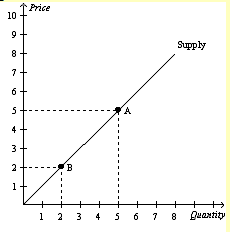
The movement from Point A to Point B represents a(n)
a)
increase in the price.
b)
decrease in the quantity supplied.
c)
shift in the supply curve.
d)
decrease in quantity demanded.
26.
What are inferior goods?
a)
Goods that are not well produced
b)
Goods no one has demand for
c)
Goods for which demand rises when income falls
d)
Goods for which the demand falls when income rises
27.

Which would most likely increase the quantity of gasoline/petrol sold in a competitive market?

a)

an increase in the price of crude oil

b)

a decrease in the price of automobiles/cars

c)

a decrease in the income of consumers

d)

an increase in taxes on gasoline/petrol products
28.
What is created when prices are too low?
a)
surplus
b)
shortage
c)
equilibrium price
d)
subsidy
29.
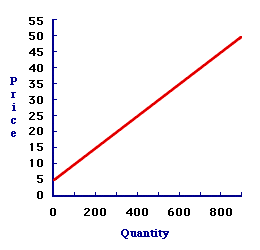
What does this curve represent?
a)
demand
b)
supply
c)
equilibrium
d)
shortage
30.

An increase in the price of aspirin is likely to be paired with a(n) ___________________ in the demand for panadol because the two goods are __________________. (think about connections )

a)

increase; complements

b)

increase; substitutes

c)

decrease; complements

d)

decrease; substitutes