
 Worksheets
Pearson Ch 5 Government intervention
Total questions: 25
Worksheet time: 20mins
Name
Class
Date
1.
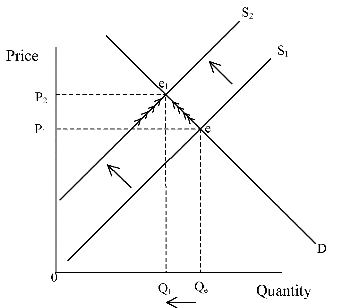
Assume the image is showing the market for apples. Which of the headlines could indicate the pictured shift is occurring in the market?
a)
Pesticides on apples linked to mouth cancer.
b)
Storms destroy apple orchards.
c)
An apple a day really does keep the doctor away.
d)
New genetic strain leads to apple trees that produce twice as many apples.
2.
The minimum wage is an example of a
a)
price floor
b)
price ceiling
c)
shortage
d)
surplus
3.
A government payment made to a business is a
a)
tax
b)
regulation
c)
subsidy
d)
resource
4.
Rent control is an example of a
a)
price ceiling
b)
price floor
c)
surplus
d)
shortage
5.
The maximum amount that sellers may charge for a good or service is called a
a)
maximum wage.
b)
minimum wage.
c)
price ceiling.
d)
price floor.
6.
If the government set a limit on the cost of baseball bats, this action would be called
a)
setting an equilibrium price.
b)
setting a minimum price.
c)
setting a price ceiling.
d)
setting a price floor.
7.
A shortage of a good is often a signal for a producer to
a)
lower production of that good.
b)
lower the prices of that good.
c)
raise the prices of that good.
d)
shift production to another good.
8.
Which of the following does NOT explain why market-clearing prices are important in a free enterprise economy?
a)
They help to ration available goods and services.
b)
Equilibrium prices provide incentives for people to produce goods and services.
c)
They provide information about producer costs and consumer wants.
d)
They help to create competition to drive prices upwards in order to create necessary surpluses.
9.
a sugar tax doesn't work
a)
because sugar is sweet
b)
because its addictive and people will pay the extra
c)
the tax will cause inflation
d)
the tax is likely to be too effective and efficient
10.
Why do the government set tax for petrol
a)
Because the supply of petrol is inelastic
b)
To increase total revenue for firms
c)
To increase positive externalities
d)
to pay for negative externalities
11.
If a tax is placed on a relatively inelastic good as shown on the graph above where supply shifts from s to s1, who pays the tax?
a)
Mostly the consumer and partly the producer
b)
Mostly the producer and partly the consumer
c)
All paid by the consumer
d)
All paid by the producer
12.
If the government is in need of more revenue and wants to tax a product. This strategy will work best if demand for the good is
a)
unit elasticity
b)
perfectly elastic
c)
relatively elastic
d)
relatively inelastic
13.
the tax on cigarettes will not solve the problem because
a)
it increases cigarette producers profits
b)
it will encourage vaping
c)
it is a major source of government revenue
d)
all of the above
14.
A price floor is
a)
the minimum price that government may charge
b)
what leads to utility
c)
the maximum price that a producer may charge by law
d)
the minimum price that a producer may charge by law
15.
Does a price floor create a producer surplus or consumer surplus?
a)
consumer surplus (benefit to producers)
b)
producer surplus (benefit to consumers)
c)
consumer surplus (benefit to consumers)
d)
producer surplus (benefit to producers)
16.
Why does the government allow monopolies to form through a patent?
a)
they do not want competition
b)
no one makes the product better
c)
company pays for the patent
d)
company put in the time/ research so they should get rewarded
17.
What kind of market structure is efficient with one business supplying?
a)
natural monopoly
b)
oligopoly
c)
imperfect competition
d)
perfect competition
18.
Why does the government place price ceilings on some "essential" goods?
a)
to prevent inflation during to reduce supply for these goods
b)
to keep business people from making large profits
c)
to keep the goods from becoming too expensive
d)
to reduce demand for these goods
19.

If the Price is $2, there will be...
a)
A surplus of 45
b)
A shortage of 85
c)
A shortage of 45
d)
A surplus of 85
20.

What does this graph show?
a)
Shortage
b)
Surplus
c)
Supply Table
d)
Equilibrium
21.

If a Price Ceiling was placed at 320, where would price end up?
a)
280
b)
300
c)
320
d)
340
22.
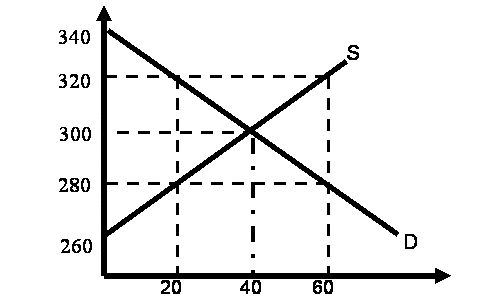
If a price floor was set at 320, what quantity would be purchased?
a)
20
b)
40
c)
60
d)
80
23.
Which of the following would cause a change in supply?
a)
A change in market price
b)
A change in technology available
c)
A change in the number of sellers
d)
All of the above
24.
What may be true of price floors in the long run?
a)
Consumer surplus increases
b)
Producer surplus increases
c)
Both producers and consumers would benefit.
d)
Price control would hurt everyone.
25.
Which of the following describes when the government sets a price floor?
a)
The price cannot go any higher
b)
The price cannot go any lower
c)
The price will remain the same
100 %

