
 Worksheets
Founding Documents
Total questions: 144
Worksheet time: 2hrs 41mins
Name
Class
Date
1.
What is the name of the first written plan of government in America?
a)
Constitution
b)
Treaty of Paris
c)
Declaration of Independence
d)
Articles of Confederation
2.
Americans were afraid that a __?__ would lead to tyranny, or oppressive rule.
a)
strong state government
b)
weak government
c)
strong central government
d)
legslature
3.

Under the Articles of Confederation, most of the power was where?
a)
Legislative branch
b)
the president
c)
the states
d)
national government
4.

Under the Articles of Confederation, how many votes did each state get when voting on a new law?
a)
Zero
b)
One
c)
Two
d)
Three
5.

How many branches of government were there under the Articles of Confederation?
a)
One
b)
Zero
c)
Two
d)
Three
6.

Which of the following was NOT a power of Congress under the Articles of Confederation?
a)
Create a plan for the Northwest Territory
b)
Negotiate treaties
c)
Levy taxes
d)
Declare war and peace
7.
Anti-Federalists preferred a strong ____________ government.
a)
National
b)
State
c)
Central
d)
Republican
8.
What was the position of the group known as the Federalists?
a)
they supported a new Constitution
b)
they questioned the justice of slavery
c)
the feared the power of the national government
d)
the believed that states should have equal representation
9.

Which is a weakness of the Articles of Confederation?
a)
Congress couldn't collect taxes
b)
Weak central government
c)
Provided for no common currency
d)
All of the these
10.
Under the Articles of Confederation Congress could only pass a law if ____________ out 13 states agreed.
a)
13
b)
8
c)
9
d)
10
11.
In order to change (amend) the Articles of Confederation, __________ out of 13 states had to agree.
a)
9
b)
10
c)
13
d)
15
12.
Under the Articles of Confederation, Congress could regulate trade between the states.
a)
true
b)
false
13.
Membership into Congress was based upon a state's population.
a)
true
b)
false
14.
The Articles of Confederation created a _________________ type of government.
a)
strong
b)
average
c)
weak
d)
federal
15.

This picture shows which weakness of the Articles?
a)
no common currency
b)
no executive branch
c)
no power to tax
d)
one vote for each state
16.
The weaknesses of the Articles of the Confederation led to an effort to create a new _____________.
a)
Proclamation of 1763
b)
Constitution
c)
Declaration of Independence
d)
Treaty of Paris 1783
17.
This was America's 1st constitution, which proved to weak to protect the American people.
a)
Articles of Confederation
b)
U.S. Constitution
c)
Bill of Rights
d)
Declaration of Human Rights
18.
The Articles of Confederation was created during what war?
a)
Operation Iraqi Freedom
b)
World War 2
c)
Civil War
d)
American Revolution
19.
One weakness of the Articles of Confederation is that it DID NOT create which 2 branches?
a)
executive and judicial
b)
legislative and executive
c)
judicial and legislative
d)
bicameral and legislative
20.
Which of the following was a weakness of the Articles?
a)
No legislative branch
b)
No common currency
c)
Strong National Government
d)
7 votes for each state
21.
Congress never had any money because under the Articles they did NOT have the power to ____.
a)
print money
b)
sell items to other countries
c)
tax
d)
spend money
22.
Because of the Articles the government could NOT regulate ______ among the states.
a)
food quality
b)
laws
c)
travel
d)
commerce (trade)
23.
The Articles created a _____ national government.
a)
strong
b)
weak
c)
nope
d)
nope
24.
Which of the following was a weakness of the Articles?
a)
national government taxed the states a lot
b)
created a very strong president
c)
all states used the same money
d)
could not regulate commerce (trade) among the states
25.
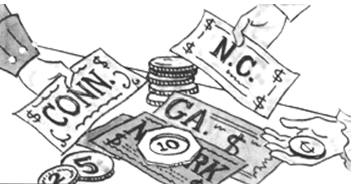
This picture shows which weakness of the Articles?
a)
no common currency
b)
no executive branch
c)
no power to tax
d)
one vote for each state
26.
-Idea that absolute power rests with the people (people rule)
a)
Limited Government
b)
Popular Sovereignty
c)
Federalism
d)
Republicanism
27.
- Idea that government power is divided/shared between the national and state levels.
a)
Repubicanism
b)
Popular Sovereignty
c)
Limited Government
d)
Federalism
28.

The Bill of Rights protects our personal freedoms from government interference
a)
republicanism
b)
federalism
c)
individual rights
d)
separation of powers
29.

The three branches of government have different jobs and responsibilities
a)
limited government
b)
separation of powers
c)
republicanism
d)
popular sovereignty
30.

Government officials must obey the law
a)
checks and balances
b)
federalism
c)
popular sovereignty
d)
limited government
31.

The people elect government officials to represent them
a)
separation of powers
b)
individual rights
c)
limited government
d)
republicanism
32.

The three branches of government control each other to maintain equal power
a)
checks and balances
b)
limited government
c)
federalism
d)
individual rights
33.

Power is shared and divided between the states and the national government
a)
federalism
b)
individual rights
c)
checks and balances
d)
republicanism
34.

"No person shall be elected to the office of the President more than twice ..."
a)
federalism
b)
limited government
c)
popular sovereignty
d)
republicanism
35.

"The right of the people to be secure in their persons, houses, papers, and effects, against unreasonable searches and seizures, shall not be violated"
a)
popular sovereignty
b)
checks and balances
c)
republicanism
d)
individual rights
36.
The Purpose of Checks and Balances is to prevent
a)
Any branch from becoming too powerful
b)
People from losing their rights.
c)
States from losing more power
d)
The government from changing the Constitution
37.
A state having the power to run their own school system is an example of
a)
Checks and Balances
b)
Federalism
c)
Rule of Law
d)
Separation of Powers
38.

The people have the power to rule
a)
federalism
b)
individual rights
c)
popular sovereignty
d)
separation of powers
39.
Which statement in the Preamble reflects the principle of the Bill of Rights?
a)
"to form a more perfect union"
b)
"to establish justice"
c)
"to insure domestic tranquility"
d)
"to secure the blessings of liberty"
40.
Which of the following ideas define a republic?
a)
People elect representatives to make laws.
b)
People have certain rights guaranteed to them.
c)
People are free to carry on their lives as they choose to.
d)
People can rebel against their government and overthrow it.
41.
How does someone become a member of the Supreme Court?
a)
by popular election and Senate approval
b)
by judicial appointment and presidential approval
c)
by presidential appointment and Senate approval
d)
by senatorial appointment and judicial approval
42.
How do states determine their number of electors in the electoral college?
a)
by the total population in the state
b)
by its number of Senators and Representatives
c)
by a lottery decided by Congress
d)
by the total number of eleigible voters in a state
43.
What is the path a bill must take to become a law?
a)
The House introduces a bill, and if the Senate approves it, the bill becomes law.
b)
The President proposes a bill, and if the House approves and signs it, the bill becomes law.
c)
The House introduces a bill, and if the Senate approves it, the bill becomes a law.
d)
The House or Senate introduces a bill, and if both houses approve it and the President signs it, the bill becomes a law.
44.
When a President is impeached, he is
a)
removed from office by the Senate.
b)
voted out of office by popular vote.
c)
charged by the House of wrongdoing.
d)
found innocent by the Senate of wrongdoing.
45.
Under the federal system, the states delegated certain powers to the federal government, but kept, or _______, other powers for themselves.
a)
reserved
b)
chartered
c)
shared
d)
regulated
46.
The three branches of government as described in Articles I-III of the Constitution illustrates the principle of
a)
individual rights.
b)
republicanism
c)
popular sovereignty
d)
separation of powers.
47.
How does the Constitution reflect the principle of federalism?
a)
by establishing a strong executive branch
b)
by implementing a system of checks and balances
c)
by dividing power between federal and state government
d)
by establishing a strong legislative branch
48.
The term "judicial review" means that the Supreme Court has the ability to determine if
a)
a law passed by Congress is unconstitutional.
b)
a lower court's decision is correct.
c)
the executive branch is enforcing laws properly.
d)
one of the the justices should be removed from office.
49.
Upon what basis does the Supreme Court have the power to declare a law unconstitutional?
a)
by majority vote in Congress
b)
under Article III of the Constitution
c)
by the decision in Marbury v. Madison
d)
with permission of the executive branch
50.
Which branch of government is responsible for interpreting laws?
a)
Executive
b)
Judicial
c)
Legislative
51.
Which branch of government is responsible for creating laws?
a)
Executive
b)
Judicial
c)
Legislative
52.
Which branch of government is responsible for enforcing laws?
a)
Executive
b)
Judicial
c)
Legislative
53.
What are the first three words of the Constitution?
a)
In order to
b)
We the people
c)
Once upon a
d)
The United States
54.
_____ of the members of the Congress must agree to change the Constitution.
a)
1/2
b)
2/3
c)
3/4
d)
All
55.
The Constitution made federal laws _______________ to state laws.
a)
Interior
b)
Inferior
c)
Supplementary
d)
Superior
56.
How many houses make up the legislative branch under the Constitution?
a)
1
b)
2
c)
3
d)
4
57.
In which house of Congress does each state get 2 votes?
a)
House of Representatives
b)
Senate
58.
What term refers to the idea that the national government shares power with state governments?
a)
Articles of Confederation
b)
Ratification
c)
Federalism
d)
Checks and Balances
59.
What term refers to the process of approving the Constitution?
a)
Articles of Confederation
b)
Ratification
c)
Federalism
d)
Checks and Balances
60.
What term refers to the system that gives each government branch some power over the others?
a)
Articles of Confederation
b)
Ratification
c)
Federalism
d)
Checks and Balances
61.
What is the name for a change or addition to the Constitution?
a)
Federalism
b)
Amendment
c)
Ratification
d)
Veto
62.
What are the first 10 amendments to the Constitution called?
a)
The Bill of Rights
b)
The Preambles
c)
The Vetos
d)
The Federalisms
63.
What amendment protects freedom of speech?
a)
1st
b)
2nd
c)
3rd
d)
4th
64.
What amendment protects people from unreasonable searches without a warrant?
a)
1st
b)
2nd
c)
3rd
d)
4th
65.
What amendment protects people's right to own guns?
a)
1st
b)
2nd
c)
3rd
d)
4th
66.
What amendment prohibits the government from being allowed to make people house soldiers during times of peace?
a)
1st
b)
2nd
c)
3rd
d)
4th
67.
What amendment protects people from having to testify against themselves in court?
a)
5th
b)
6th
c)
8th
d)
9th
68.
What amendment protects people from being put on trial for the same crime twice?
a)
5th
b)
6th
c)
8th
d)
9th
69.
What amendment guarentees people's right to a fair trial and representation by a lawyer?
a)
5th
b)
6th
c)
8th
d)
9th
70.
Which principle of government is illustrated by this statement?
"Congress passes a law. The Supreme Court declares this law unconstitutional."
"Congress passes a law. The Supreme Court declares this law unconstitutional."
a)
checks and balances
b)
individual rights
c)
limited government
71.
What is the set of rules and principles that organizes our government?
a)
Bill of Rights
b)
Mayflower Compact
c)
The Constituion
d)
Declaration of Independence
72.
Under a constitutional government, where does power come from?
a)
The President
b)
The Courts
c)
The Military
d)
The People
73.
What branch of government is the President a member of?
a)
Executive
b)
Legislative
c)
Judicial
d)
Adminstrative
74.
What is a change to the Constitution called?
a)
Bill
b)
Law
c)
Amendment
d)
Warrant
75.
Which is an example of checks and balances?
a)
The Supreme Court tries a criminal
b)
The president vetoes a law
c)
Congress passes a new tax bill
d)
The people elect representatives
76.
Which is an example of separation of powers?
a)
Each state gets two votes in the Senate
b)
Representatives are elected by citizens
c)
Congress makes laws and the president enforces them
d)
The government cannot make a law to restrict freedom of speech
77.
Which branch of government makes laws?
a)
Legislative
b)
Executive
c)
Judicial
78.
Which branch of government enforces the law?
a)
Legislative
b)
Executive
c)
Judicial
79.
Which branch of government applies / interprets laws?
a)
Legislative
b)
Executive
c)
Judicial
80.

Which idea matches the picture?
a)
popular sovereignty
b)
limited government
c)
separation of powers
d)
checks and balances
81.
Anti-federalists wanted a Bill of Rights added to the constitution to help protect...
a)
Individual Rights
b)
State Rights
c)
Slavery
d)
The Articles of Confederation
82.
Which of the following is NOT a branch of the government?
a)
Legislative
b)
Judicial
c)
Executive
d)
Constitutional
83.
The Federalists papers were written to persuade people to support the new constitution.
a)
True
b)
False
84.
Which one of the following is not a guaranteed freedom found in the First Amendment?
a)
Right to own a gun
b)
Right to freedom of Speech
c)
Right to petition the government
d)
Right to assemble peacefully
85.
______ is the belief that the government gets its power from the people.
a)
Rule of Law
b)
Popular Sovereignity
c)
Checks and balances
d)
Federalism
86.
What article of the Constitution created the Executive Branch of government?
a)
ArcticleI
b)
Article II
c)
Article III
d)
Article IV
87.
The Constitution replaced the ______ as the governing document of the country.
a)
Declaration of Independence
b)
Bill of Rights
c)
Emancipation Proclamation
d)
Articles of Confederation
88.
The _______ is the opening paragraph of the Constitution.
a)
Article 1
b)
Preamble
c)
Bill of Rights
d)
Prelude
89.
Patrick Henry opposed the Constitution because...?
a)
The states would give too much power to the Federal government
b)
The Federal government would give too much power to the states
c)
He was the main author of the Articles of Confederation
d)
He wanted the U.S. to be part of England again
90.
George Mason refused to sign the Constitution because...?
a)
He felt that it did not do a good enough job protecting individual rights
b)
He felt that the executive branch did not have enough power over the military
c)
The legislative branch was weaker then the executive branch
d)
He wanted to be President
91.
The Great Compromise solved the problem of both big and small states wanting representation.
a)
True
b)
False
92.
The Three-Fifths Compromise help settle the debate over whether to count slaves in the population or not.
a)
True
b)
False
93.
Federalist SUPPORT a strong, national government and creating a new constitution.
a)
True
b)
False
94.
Which compromise is made up of ideas from the Virginia Plan and the New Jersey plan?
a)
The Great Compromise
b)
The three-fifths compromise
c)
The constitutional compromise
d)
The big compromise
95.
Which group of people wanted the Constitution to include a Bill of Rights?
a)
Federalists
b)
Anti-federalists
c)
Democrats
d)
Northerners
96.
Shay's Rebellion helped prove what point?
a)
The federal government needed changing
b)
The states powers were too weak
c)
The Articles of Confederation were powerful
d)
George Washington was a great leader.
97.
Which term means 'introduce a new amendment'?
a)
propose
b)
republican
c)
federalism
d)
execute
98.
Which term means 'a representative form of government'?
a)
propose
b)
republican
c)
federalism
d)
execute
99.
Which term means 'approve or pass an amendment'?
a)
republican
b)
federalism
c)
execute
d)
ratify
100.
Which terms means 'carry out a law'?
a)
republican
b)
federalism
c)
execute
d)
ratify
101.
How many members are there in the U.S. Senate?
a)
50
b)
100
c)
435
102.
Congress is made up of which two parts?
a)
Cabinet and Senate
b)
Senate and the House of Representatives
c)
Supreme Court and House of Representatives
d)
Senate and Supreme Court
103.
How do federal judges gain that position
a)
They are appointed
b)
They are elected
104.
a written plan for how a country or organization is governed. It has a set of basic standards or rules to lead a particular group. It defines the principles of the organization, and sets up a process to establish laws.
a)
Tranquility
b)
Justice
c)
Welfare
d)
Constitution
105.
The state of being free within society from oppressive restrictions imposed on one's way of life, behavior, or political views.
a)
Liberty
b)
Tranquility
c)
Justice
d)
Welfare
106.
Free from commotion or stress; peaceful; quiet; calm
a)
Liberty
b)
Tranquility
c)
Ordain
d)
Justice
107.
Just or equal behavior or treatment; fairness
a)
Liberty
b)
Tranquility
c)
Justice
d)
Posterity
108.
To order or establish by law or decree
a)
Primary Source
b)
Posterity
c)
Justice
d)
Ordain
109.
Future generations of people; our descendants
a)
Preamble
b)
Tranquility
c)
Posterity
d)
Ordain
110.
Each side gives in a little
a)
revising
b)
compromise
c)
liberties
d)
adoption
111.
freedoms
a)
revising
b)
compromise
c)
liberties
d)
adoption
112.
Adding on or accepted
a)
revising
b)
compromise
c)
liberties
d)
adoption
113.
A law that does not follow the constitution is called?
a)
cabinet
b)
Federalism
c)
unconstitutional.
d)
Separation of powers
114.
How many articles are in the US Constitution?
a)
5
b)
6
c)
7
d)
9
115.
In which part of the US Constitution are the goals explained?
a)
Article I
b)
Preamble
c)
Article II
d)
Article III
116.
What does Article I (1) discuss in the Constitution?
a)
Legislative Branch
b)
Executive Branch
c)
Judicial Branch
d)
Amendments
117.
What does Article II (2) discuss in the Constitution?
a)
Legislative Branch
b)
Executive Branch
c)
Judicial Branch
d)
Amendments
118.
What does Article III (3) discuss in the Constitution?
a)
Legislative Branch
b)
Executive Branch
c)
Judicial Branch
d)
Amendments
119.
What does Article V (5) discuss in the Constitution?
a)
Legislative Branch
b)
Executive Branch
c)
Judicial Branch
d)
Amendments
120.
The Constitution was written in:
a)
1776
b)
1787
c)
2016
d)
1678
121.
Which is NOT a qualification for President?
a)
35 years old
b)
Resident of US for at least 14 years
c)
Natural born citizen of US
d)
Experienced member of government
122.
What type of government does a constitution create?
a)
Limited
b)
Unlimited
123.

Who is in charge of the Executive Branch?
a)
Senate
b)
Supreme Court and House of Rep.
c)
President
d)
Vice President
124.
Why did the states have a Constitutional Convention?
a)
in order to meet the other delegates
b)
to make new laws
c)
to appoint new officials to government offices
d)
to improve the Articles of Confederation
125.
What happens after a government official is impeached?
a)
the senate holds a trial
b)
he is kicked out of office
c)
he becomes president
d)
he has to learn new skills
126.
What are 3 examples of powers the president has?
a)
carry out the laws, interpret the laws, and make the laws
b)
change the constitution, impeach officials, and hold trials
c)
choose the mayors, make laws, and act as judge during trials
d)
grant pardons, commander of armed forces, and sign bills into laws
127.
Which word means "not criminal; involving disputes about money or property"?
a)
civil
b)
criminal
c)
procedure
d)
advisers
128.
Which word means "proper legal procedure, like a fair trial"?
a)
amendment
b)
due process
c)
constitution
d)
ratify
129.
What is a group of citizen called that are chosen to determine the outcome of a trial?
a)
judge
b)
cabinet
c)
jury
d)
students
130.
What is the name for the group of advisers who help the president make decisions?
a)
cabinet
b)
friends
c)
jury
d)
judges
131.
What is a negative opinion about someone?
a)
amend
b)
compromise
c)
bill
d)
prejudice
132.
Why is the Bill of Rights important?
a)
It lists the freedoms of American citizens.
b)
It makes sure people follow the laws.
c)
It makes sure everyone has a job.
d)
It says what power the government has.
133.
The eighth amendment gives us what rights?
a)
right to bear arms
b)
no cruel or unusual punishment
c)
right to a speedy trial
d)
freedom of religion
134.
What happens if a person is accused of a crime but can't afford a lawyer?
a)
The accused has no right to have a lawyer if they cannot afford it.
b)
They are automatically convicted of the crime.
c)
The government will provide a lawyer at no expense.
d)
They have to represent themselves.
135.
What rights does the sixth amendment give us?
a)
freedom of speech
b)
freedom of press
c)
freedom of religion
d)
a speedy trial and right to a lawyer
136.
What does double jeopardy mean?
a)
being put on trial or being punished twice for the same crime
b)
going to court two times
c)
following due process of the law
d)
the government will provide a lawyer at no cost
137.
The right to a fair trial is found in which Amendment?
a)
Fourth Amendment
b)
Fifth Amendment
c)
Sixth Amendment
d)
Seventh Amendment
138.
The idea that soldiers kick you out and live in your house is called:
a)
Militia
b)
Assembly
c)
Quartering
d)
Due Process
139.
An unofficial army is often referred to as a what?
a)
Jury
b)
Militia
c)
Attorney
d)
Corp
140.
The right to privacy is part of which Amendment?
a)
Amendment Three
b)
Amendment Four
c)
Amendment Five
d)
Amendment Seven
141.
Amendment Five says you need a warrant or probable cause to execute search and __________.
a)
Saviors
b)
Sharing
c)
Seizures
d)
Slavery
142.
The rights to ask the government to change a law is found in which amendment?
a)
First Amendment
b)
Third Amendment
c)
Five Amendment
d)
Seven
143.
Requires grand jury indictment for a serious crime, bans double jeopardy, no loss of life, liberty or property without due process of law.
a)
5th
b)
7th
c)
9th
d)
10th
144.
Guarantees the right to a speedy, impartial public trial in criminal cases with counsel and the right to cross examine.
a)
6th
b)
7th
c)
9th
d)
10th
100 %

